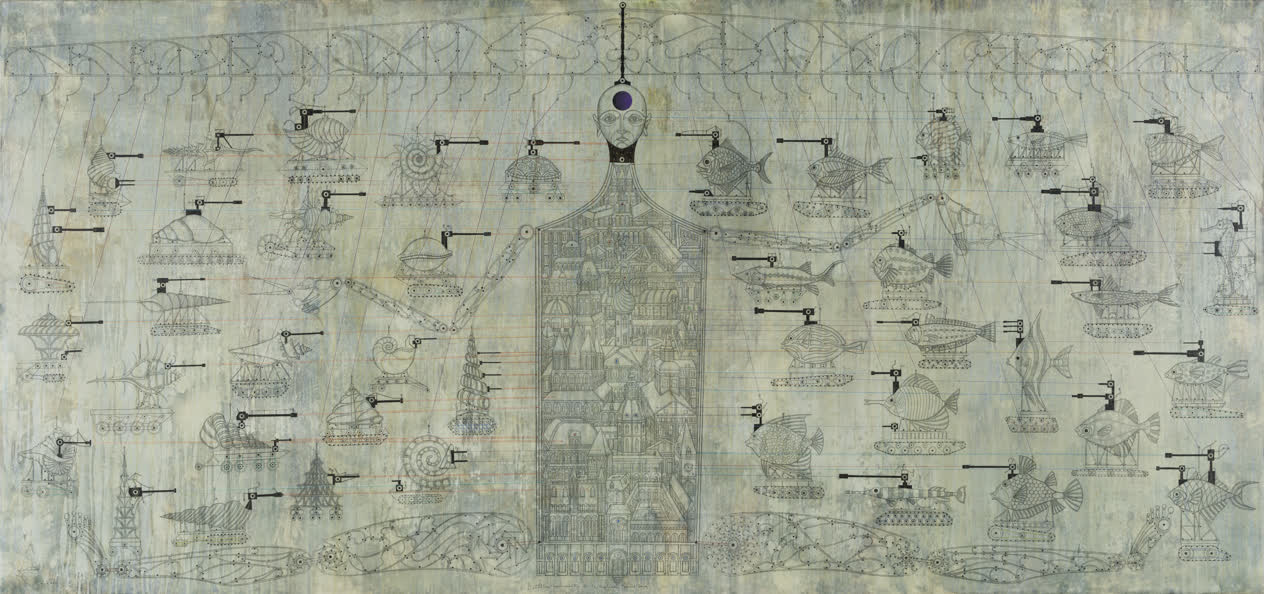
Carlos Estévez La batalla permanente de la vida transitoria (The Permanent Battle of the Transitory Life) 2010
© Carlos Estévez

Carlos Estévez is one of the most prominent and prolific Cuban-born artists residing in Miami. A typical work by Estévez recalls the moodiness and obscurity of Surrealism, yet is rendered in a precise style reminiscent of architectural designs or technical, scientific imagery, particularly pre-modern medical illustrations, astrological maps, and alchemical charts and diagrams. In La batalla permanente de la vida transitoria, we see a figure at the center of the painting whose body consists of a city. At the very bottom of the figure are the city’s gates. On the outside, there are dozens of figures looking toward the figure, aiming what appear to be weapons from either side. These mysterious figures are strung together by thin straight lines, reminiscent of cable cars. The central figure’s arms and legs are mechanical looking structures that stretch out toward both sides of the painting. From a distance, these darker “weapons” on each of the figures look like small cannons or pistols, taking aim at the figure in the center.
Identification
Title
La batalla permanente de la vida transitoria (The Permanent Battle of the Transitory Life)
Production Date
2010
Object Number
2019.003
Credit Line
Collection Pérez Art Museum Miami, gift of Chris and Suzanne Armstrong
Copyright
© Carlos Estévez
https://www.pamm.org/en/artwork/2019.003
Copy artwork link
Physical Qualities
Medium
Oil and watercolor pencil on canvas
Dimensions
68 x 144 x 1 1/2 inches
Visual Description
La batalla permanente de la vida transitoria (The Permanent Battle of the Transitory Life) by Carlos Estevez is an oil painting with watercolor pencil on canvas made in 2011. It measures roughly five and a half feet tall by twelve feet wide. It is hung in landscape orientation, meaning its longest side runs parallel to the ground.
The painting depicts a dystopian scene of fish, shells, and a mechanical figure caught in a battle. They are pitted against each other with a mechanical figure dominating the middle of the canvas.
Starting with the background, the entire canvas is painted in a cloudy mixture of greens, blues, yellows, and greys. This serves as the backdrop for the battle scene. On the left of the composition, there is an army of seashells. The shells have cannons attached to their tops and tank treads underneath them. They are all facing towards the right. Long thin streaks of horizontal parallel red colored pencil lines exit through their cannons toward the right side of the canvas, ending at the mechanical figure.
Across the top band of the entire painting, a large mechanical beam, resembling the wide wingspan of a crane takes up the entire width of the painting. Along the underside of the wing, are a series of several dozen hooks in a row. Each of the seashells is attached to this large gantry with a long, straight colored pencil line running from the top of its cannon up to one of the dangling hooks.
At the center we see a figure with mechanical arms and legs. Inside its torso is a dense cityscape, filled with onion domes and narrow steeples typically seen in Russia. In its hands, the figure is holding scissors appearing to threaten to cut the hooks which hold both the shells and fish. Its face shows no emotion and, on its forehead, is a large purple circle. Extending from its head is a black bar that is attached to the wing-like beam that takes up the upper tier of this painting.
To the right is an army of fish. Like the shells, the fish have cannons at their tops and tank treads beneath their forms. Like the shellfish, they are also connected to the hooks dangling from the beam above them. Blue streaks of colored pencil exit through their cannons towards the left of the canvas, pointed toward the central figure.