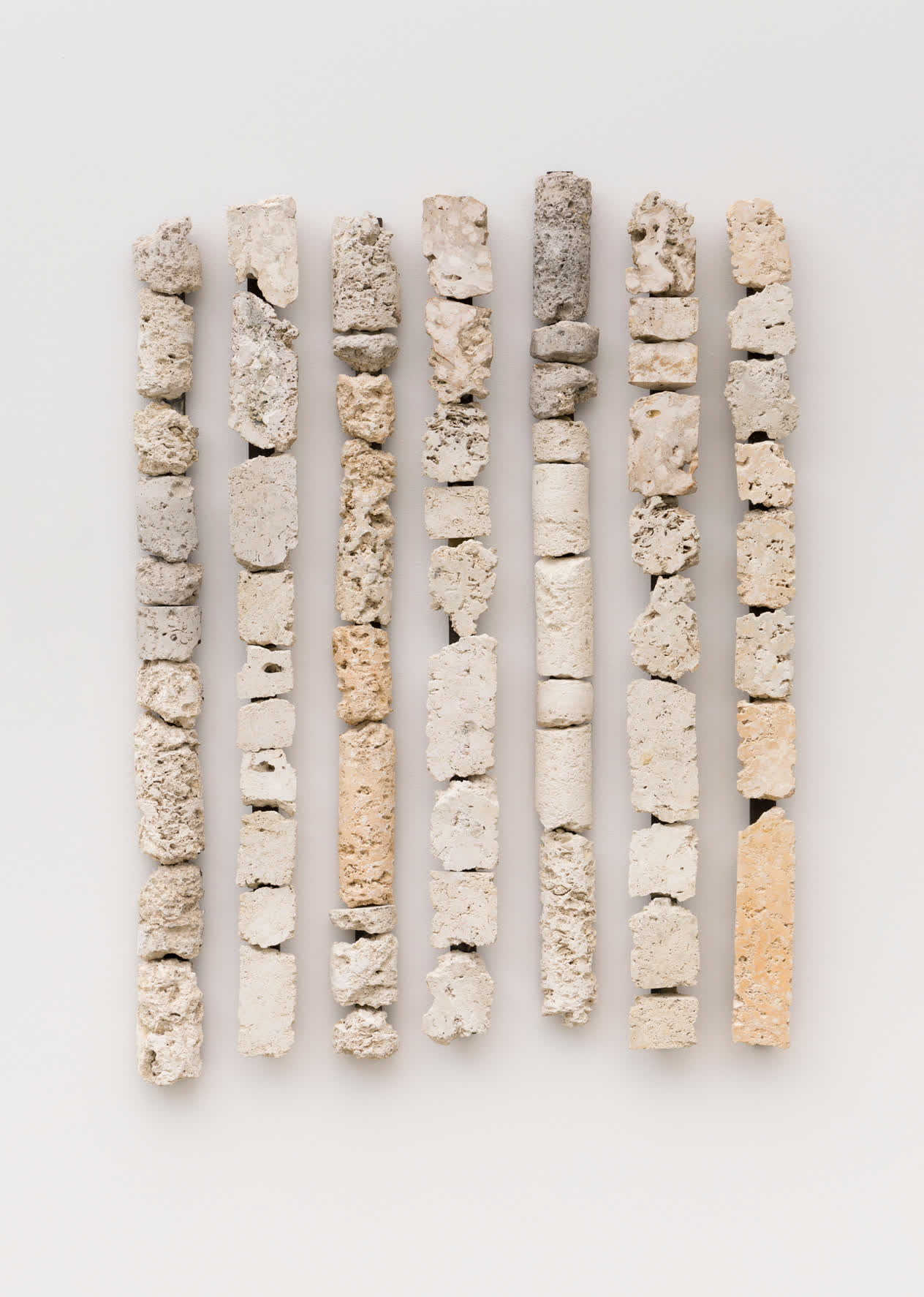
Alan Sonfist Rock Monument 1971
© Alan Sonfist

Alan Sonfist is one of the founding members of the Land art movement that originated in the 1960s and 1970s. Rock Monument consists of a series of core samples that Sonfist extracted from the earth while completing a public project in Key Biscayne. A core sample is a cylindrical section of earth obtained by drilling deep into the ground; the section reveals the geological changes that a given site has undergone over the course of millions of years of sedimentation. The work typifies Sonfist’s interest in the concept of “deep time”––the notion that nature exists on a time scale that far exceeds the scope of human existence, and is therefore ultimately indifferent to us.
Identification
Title
Rock Monument
Production Date
1971
Object Number
2020.130
Credit Line
Collection Pérez Art Museum Miami, gift of anonymous donor
Copyright
© Alan Sonfist
https://www.pamm.org/en/artwork/2020.130
Copy artwork link
Physical Qualities
Medium
Stone
Dimensions
53 1/2 x 38 x 3 inches, overall
Visual Description
Rock Monument by American artist Alan Sonfist, is an example of geological art. Made entirely of stone, the artwork measures a total of forty-eight inches tall and thirty-six inches wide. This equals to four feet by three feet, with the shorter side running parallel to the floor.
This artwork is made up of seven cylindrical columns of natural stone. Rock Monument is part of a larger series where the artist takes core samples beneath the soil substrate in different urban environments. The rock cores reveal the natural foundations of their urban locations, as well as a geological record of time beneath a city’s streets. The seven cores in PAMM’s Rock Monument are parallel and vertically arranged, pointing straight up and down. They measure about three and a half inches in diameter and have about two inches in clearance between them. The seven cores are roughly the same length, varying an inch or two in length from one another at their ends.
The seven column-like rock cores are made up of chunks of oolitic limestone, or oolite. This type of rock is formed from fossilized coral reefs and rests under the majority of the state of Florida. Oolite therefore serves as the geologic foundation of South Florida and Miami. The stone is mostly white with a slight beige tinge, and its texture is rough. If one could imagine running one’s hands up and down the columns, one’s fingers would catch in the cracks and voids in the porous, Swiss cheese-like stone. The chunks of stone are roughly cylindrical in shape, as they were cut as cores from their surrounding rock. They are mounted on a long straight strip of wood serving as a backing, like vertebrae on a spine. Some of the core chunks are longer, some are shorter, and no two are alike. Some of the cores have an orange tinge, others a gray, smokey color, revealing other minerals in their composition.