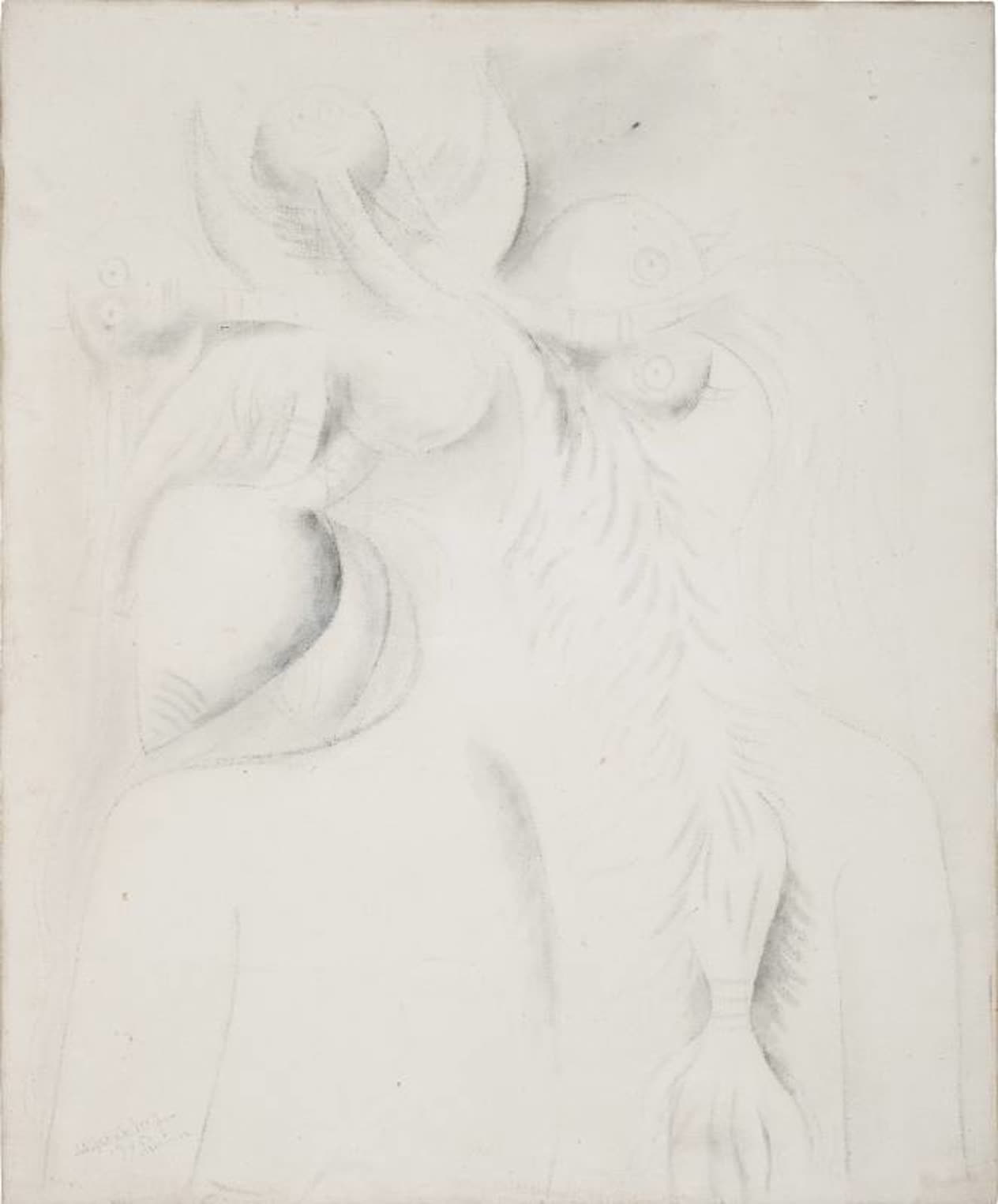
Wifredo Lam La Chevelure (The Mane) 1945
© 2022 Artists Rights Society (ARS), New York / ADAGP, Paris

Wifredo Lam’s unique practice was deeply influenced by his own diverse cultural identity, which included family members of Spanish, African, and Chinese descent. He spent two decades living in Europe, where he met Pablo Picasso, whose development of Cubism had a strong effect on his work. He also met André Breton, the leader of the Surrealist movement, who became a close friend.
In 1942, Lam fled Europe, and travelled with Breton to Martinique and the Dominican Republic, before returning to his native Cuba. There, he became strongly influenced by the mythology and forms of Afro-Cuban religions. This delicate painting, Le Chevelure, shows a horse-woman, a figure that appears in many of the artist’s works. She is portrayed with a long mane flowing down her back. Also present are plant and animal forms, as well as small round faces with bulging eyes that are attributed to the playful and cunning Afro-Cuban deity, Eleguá, known as “the trickster.”
Identification
Title
La Chevelure (The Mane)
Production Date
1945
Object Number
2007.43
Credit Line
Collection Pérez Art Museum Miami, gift of Jorge M. Pérez
Copyright
© 2022 Artists Rights Society (ARS), New York / ADAGP, Paris
https://www.pamm.org/en/artwork/2007.43
Copy artwork link
Physical Qualities
Medium
Oil and charcoal on canvas
Dimensions
28 3/4 x 23 5/8 inches
Visual Description
La Chevelure by Wilfredo Lam is a painting from 1945. It is made of oil paint and charcoal on canvas. It measures twenty-eight and three-quarters of an inch by twenty-three and five-eighths of an inch. It is hung in portrait orientation, meaning its shortest side runs parallel to the ground.
The painting depicts the back and shoulders of a figure and an abstracted mane.
The entirety of the canvas is painted in white oil paint. On top of this white paint the figure is drawn with charcoal. The application of the charcoal is light and appears as subtle pencil-like marks. The figure has their back turned toward us. Their left shoulder blade is visible while the one on the right is obscured by hair that is tied into a large braid that reaches the lower extreme of the canvas. The braids appear to fade into white and only subtle traces of it are visible as they reach toward where the figure’s head would be. Where the head would be there is instead an abstract collection of shapes that join together at the center. The shapes resemble spades, hearts, and circles, connected by cylindrical tubes. Several of these shapes have smaller shapes within them that resemble facial features like eyes, nostrils, and lips.
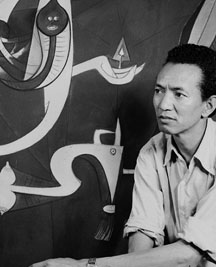 Wifredo Lam — b. 1902, Sagua la Grande, Cuba; d. 1982, Paris