


Introduction
We’re so happy you’re here! Welcome to the Pérez Art Museum Miami.
Let’s go on an ARTventure through our Overview galleries. These galleries hold artwork from PAMM’s permanent collection of Contemporary and Modern art. If you need help finding the galleries on our tour, be sure to ask a PAMM staff member for assistance. As you move through the galleries, please make sure to use your walking feet, and your soft voices, and to keep a safe distance from the artwork.
Don’t forget about your PAMM ARTventure activity booklet that goes along with this tour. When you hear this sound, that’s your time to look around. When you hear this sound, that’s your time to interact with your booklet. You can pause this tour at any time to create in your PAMM ARTventure book. Ready to begin, let’s dive into your imagination. To start, use your “Where to Look Card” to locate your first gallery.
Line and Shape
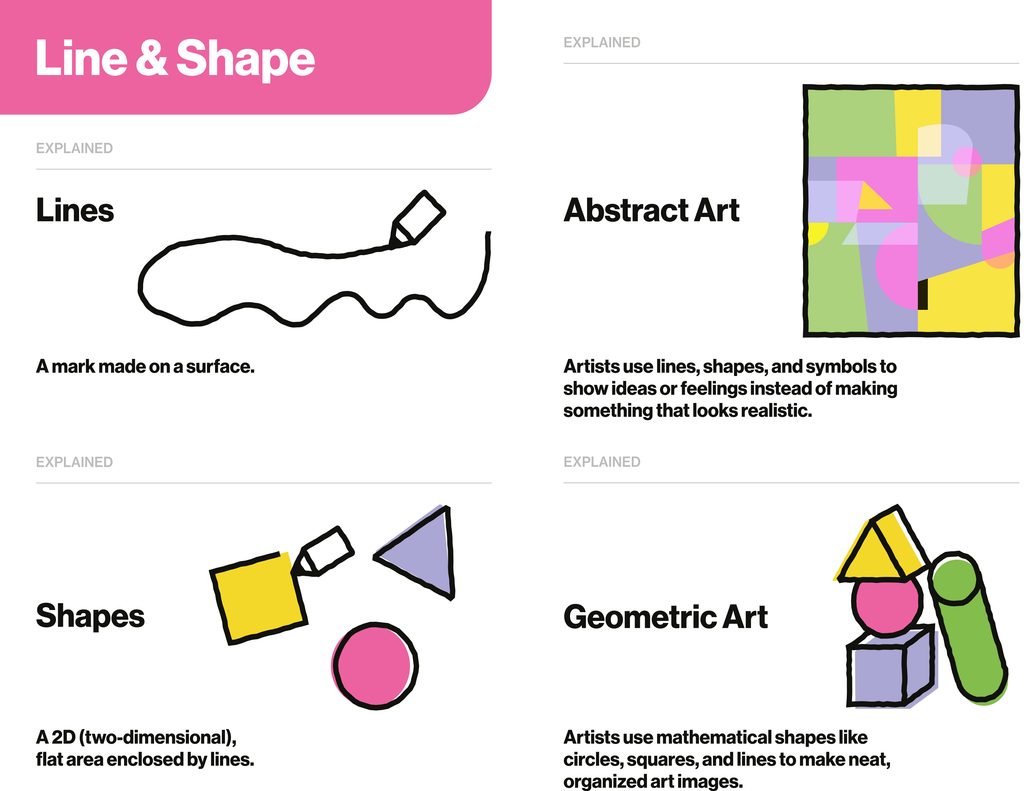
Let’s begin our ARTventure by exploring line and shape.
Lines are marks we make with our pen or pencil, and when we connect them together, sort of like connecting the dots, that is the way we make shapes and build pictures and symbols. Shapes are two-dimensional flat drawings on paper or canvas, connected or enclosed by a line. Circles, rectangles, squares, and triangles are some examples of shapes
The artwork in the museum shows different kinds of abstract art. This means how much an artwork looks like something in real life or not. Some art looks very real, like a picture of a person or a tree. Other art uses shapes, colors, and lines to make something from the artist’s ideas, feelings, or imagination instead of real life.
One type of abstract art is geometric art. In geometric art, artists use mathematical shapes like circles, squares, and lines to make neat, organized art images.
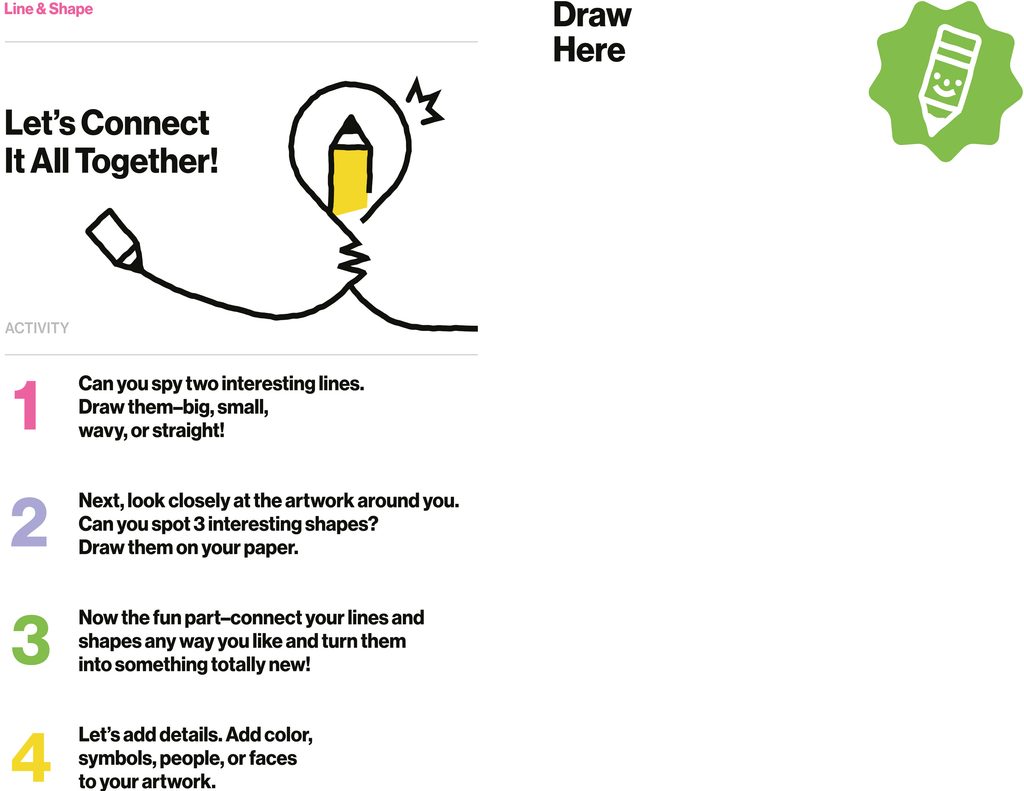
Let’s build an abstract, geometric artwork using lines and shapes…
Look around you at the artwork in this gallery.
Can you spy two interesting lines?
Take a moment to draw those lines on the first page of your PAMM ARTventure booklet.
Can you find three shapes you like?
Take a moment to draw those three shapes on the first page of your PAMM ARTventure booklet, with the lines you already drew.
In abstract geometric artworks, artists may put shapes and lines together to create images that look familiar to us, like pictures and symbols that tell a story. Take a moment to connect the shapes and lines you have in your PAMM ARTventure booklet to create a unique drawing.
Let’s explore your art.
Does your artwork have any images that look familiar to you like a person, face, or object?
Let’s add detail…
Draw darker lines or add extra color to the symbols, people or faces that stand out to you in your artwork.
We hope that you enjoyed exploring lines and shapes through abstract, geometric art. Which one of these artworks in this gallery is your favorite?
Once ready, let’s flip to the next page in your PAMM ARTventure booklet and head over to the next artwork.
Material and Form
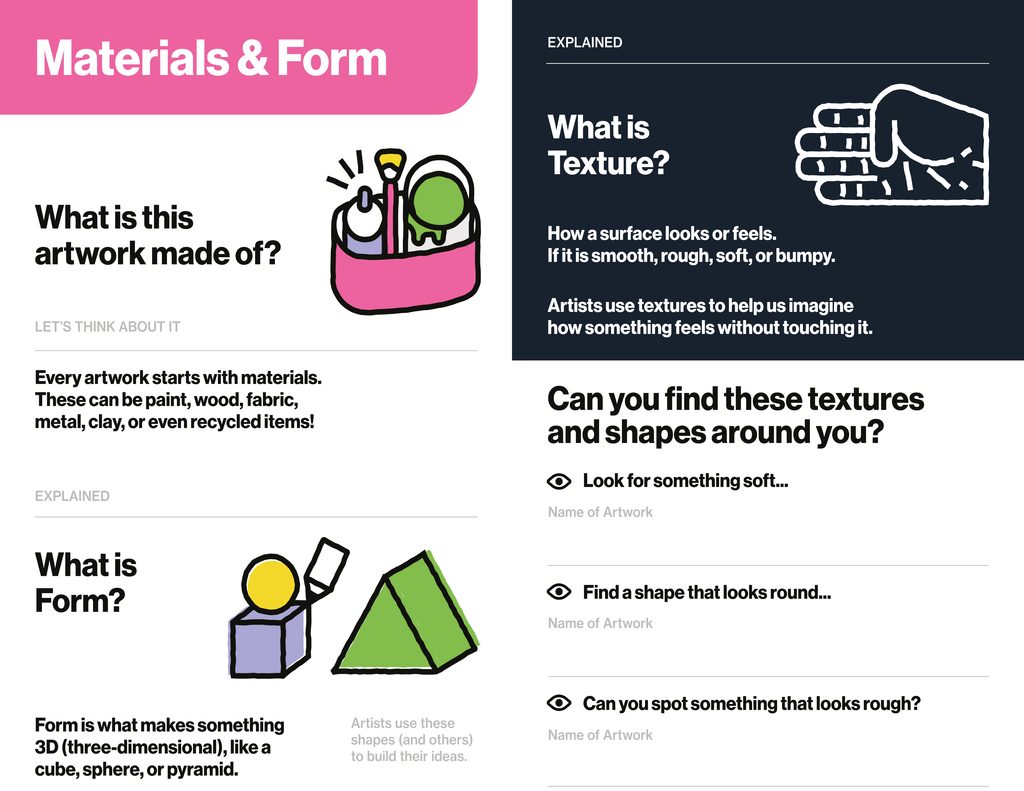
Look around you in the gallery and find an artwork to spend time with. Look closely…
Let’s think about it—What is an artwork made of?
Every artwork starts with materials. Materials can tell stories that make us feel a certain way too. Paint, fabric, metal, wood, or clay… these are all materials artists use to build or make something else.
Now let’s move onto form. When we think of form, we usually imagine something three-dimensional; it has height, width, and depth. Like a cube, a sphere, or a pyramid. 3D forms can be shapes that pop out at you, or objects you can hold in your hand like blocks.
Look around you, can you find a form in this artwork that looks round, square, or maybe pointy? Artists often use these forms in their work to build their ideas!
As you get closer, you may notice that the surface of the artwork has a texture! Texture means how something looks or feels, like soft fabric, rough wood, or shiny metal. Even though we can’t touch art, artists use texture to make us feel something with our eyes.
Without touching the artwork, imagine how the surface would feel.
Would it feel bumpy like dried clay, or soft like fabric?
A shiny surface might remind you of something new, while cracks or worn textures could make you think of something old or fragile.
Can you find these textures and shapes around you?
Look for something soft…
Find a shape that looks smooth and round…
Can you spot something that looks rough?
Activity
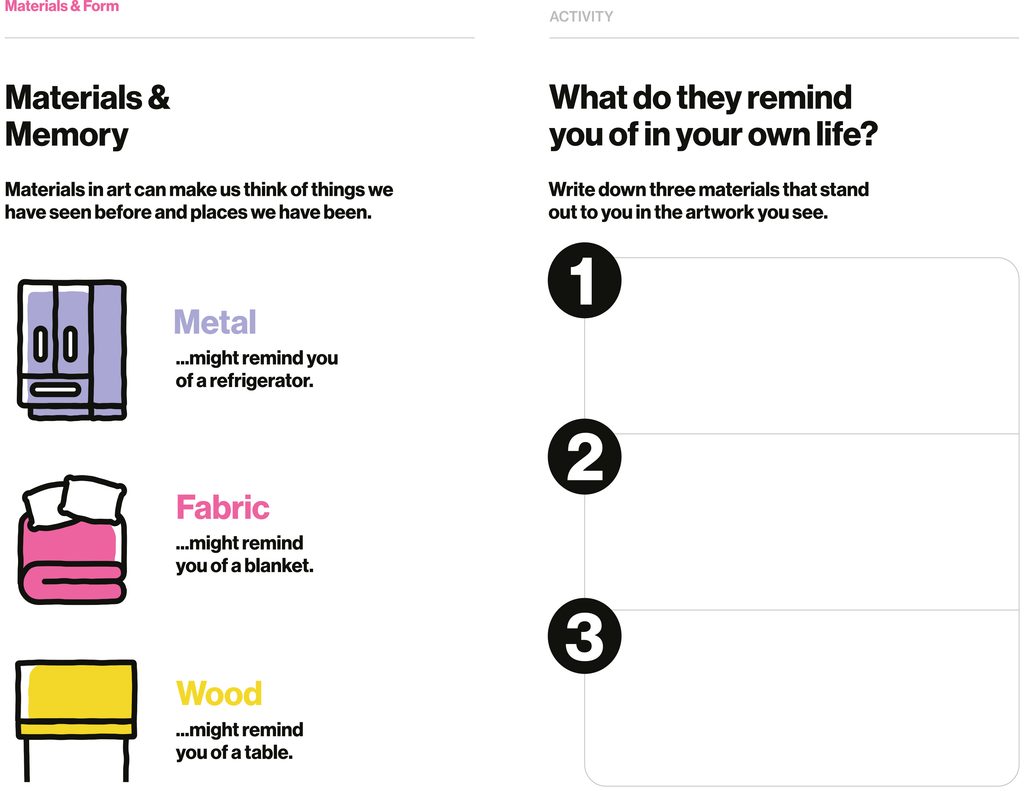
Materials & Memory
Materials in art can make us think of things we have seen before and places we have been.
- Metal might remind you of a refrigerator.
- Wood might remind you of a table.
- Fabric might remind you of a blanket.
What do these materials remind you of in your own life?
Look carefully at the artworks in this gallery. Pick three materials you notice. In your booklet, use your pencil to write or draw the three materials that stand out to you.
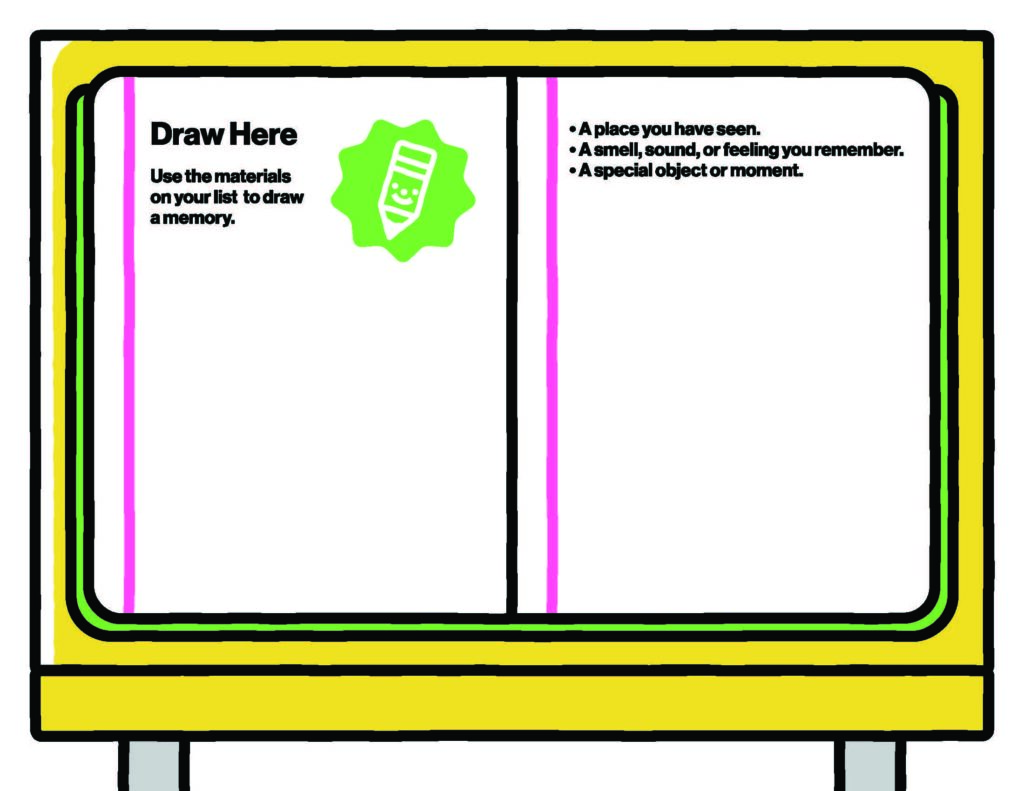
Now let’s create a bigger picture… In your PAMM Art Venture booklet, use the materials on your list to draw a memory.
- A place you have seen.
- A smell, sound, or feeling you remember.
- A special object or moment.
- A place you have seen.
- A smell, sound, or feeling you remember.
- A special object or moment.
When you’re done, think about how those materials make you feel…calm, happy, curious, or maybe full of ideas! Just like an artist, the materials you choose can tell a story and share your feelings!
Once ready, let’s flip to the next page in your PAMM ARTventure booklet and head over to the next artwork.
Color Exploration
Artists explore and play with lots of colors to investigate abstract ideas and emotions. Like scientists, artists experiment with different tools and mix colors in new and creative ways. Others used math to organize their colors in different shapes and patterns. Finally, some artists use ideas from music to inspire the colors they chose within their art. Let’s play some games that will allow us to explore these artworks of color through science, math, and music.
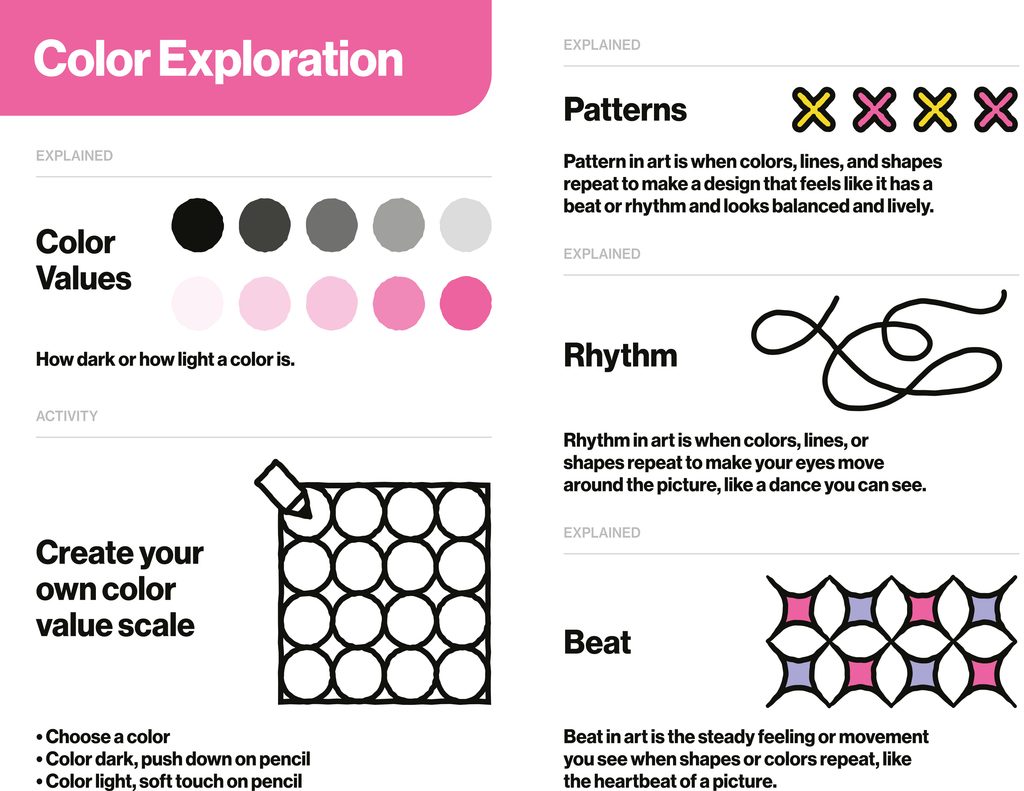
Let’s experiment with the values of color. Value is the lightness or darkness of a color. Value changes how intense or bright a color looks in an artwork. Choose one color pencil and explore the value of that color in the circles in your PAMM ARTventure booklet.
You will need to use your color pencil softly to make your color value light, and you will need to add more pressure to your color pencil when you want to make your color value dark.
Ideas used in math such as patterns are a great way for artists to organize the space, images, and color – within their compositions.
Pattern in art is when colors, lines, and shapes repeat to make a design that feels like it has a beat or rhythm and looks balanced and lively.
Like music there is rhythm in art where colors, lines, or shapes repeat to make your eyes move around the picture, like a dance you can see. Beat in art is the steady feeling or movement you see when shapes or colors repeat, like the heartbeat of a picture.
Let’s organize and play with colors. Use the pattern shapes in your PAMM ARTventure booklet and create colorful designs.
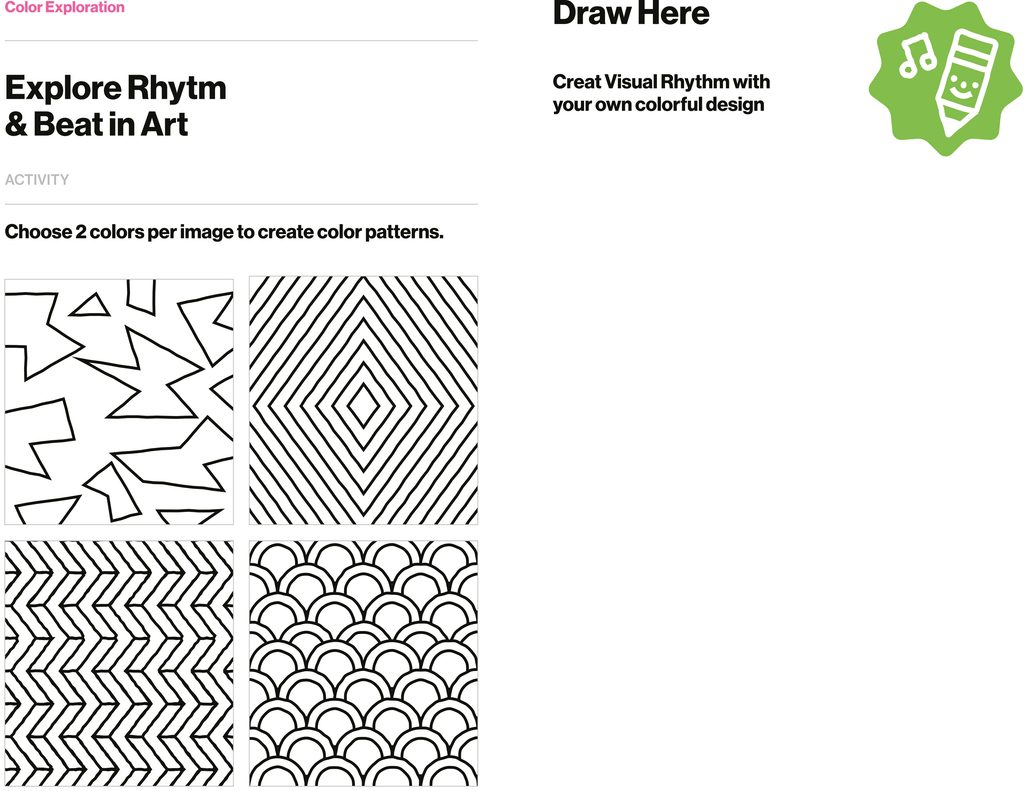
Choose two different colors for each square design. Think and organize your color choices by using the ideas of value, pattern, rhythm, and beat.
Now it’s time for your own design! Create visual rhythm by drawing colorful artwork that makes our eyes move and dance.
Once you’re done with your colorful musical drawing, flip to the next page in your book and meet us in the next gallery!
Faces and Stories
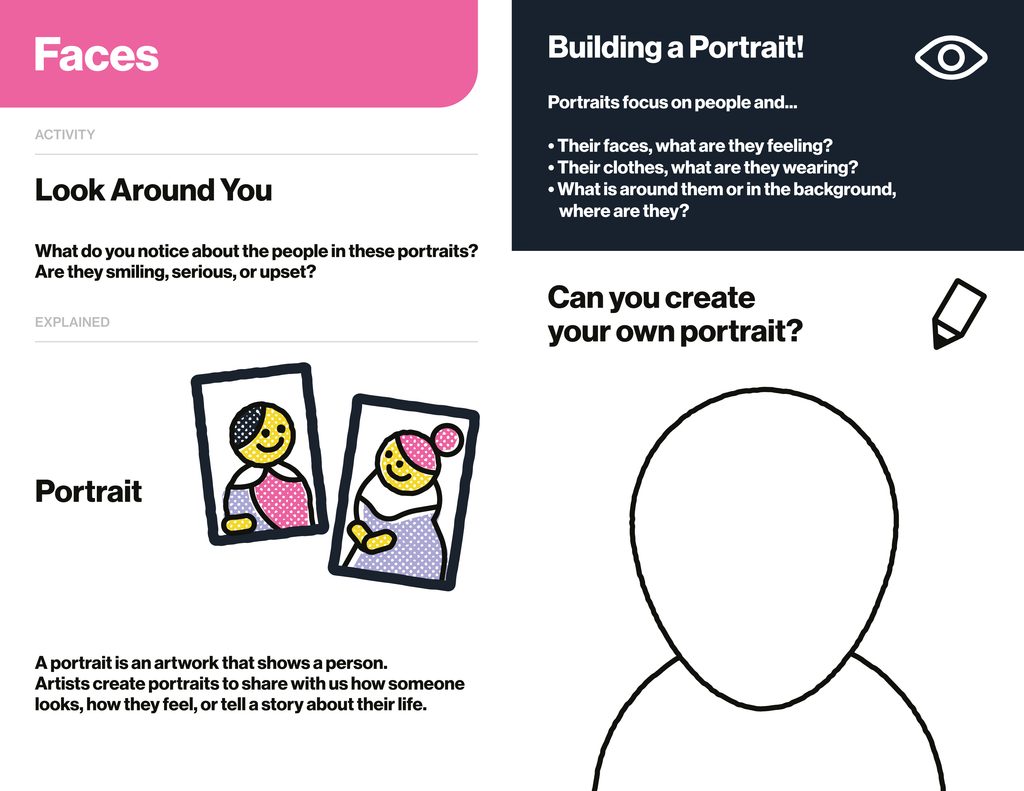
As we walk into this gallery, you’ll see lots of faces looking back at you. Some are smiling, some look serious, and some look upset. Look closely at each picture. What do their faces tell you?
First, a quick definition: a portrait is an artwork that shows a person. It can tell us about how someone looks, how they feel, or something about their life.
How does an artist build or create a Portrait?
When looking closer at a portrait of a person or people, pay attention to their faces, clothes, and what’s around them. What do you notice in the background? Do you see objects or symbols that might give clues about their life? Portraits can give us hints about who a person is and the world they live in.
Can you create your own portrait? Use the figure in your PAMM ArtVenture booklet to make a portrait of your own.
Let’s pretend we can step right into the artwork. What might you hear and smell? Notice how the artist uses color, light, and shadow to show us something about the person. Portraits can also tell us stories about culture and community.
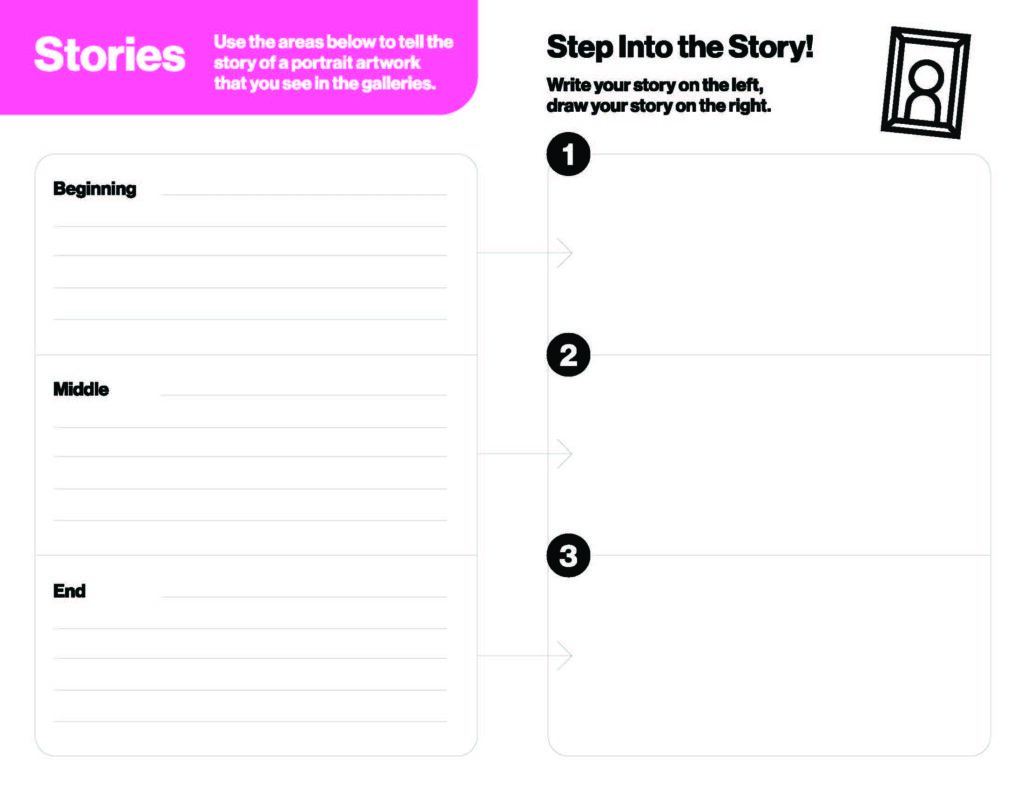
Step Into the Story!
Now we’re going to use the three boxes in your booklet to make a short story about the artwork.
Box 1: Beginning
Think about what happened the moment before the portrait was created.
Draw or write one thing that could have happened to the person minutes or hours earlier.
Box 2: Now or Middle
Think about what is happening right now in the portrait.
Draw or write one thing that shows what is happening in this moment.
Box 3: After or End
Think about what might happen next or what will be the end of the story in this portrait.
Draw or write one thing that could happen after this moment.
When you finish, look back at all three boxes. Tell another person about the story you made. Use the clues from the portrait, the face, clothes, and background, to explain why your story makes sense.
Thanks for being our travel buddy on this awesome ARTventure! We hope you had as much fun as we did. Please come back and visit us soon!

