Introduction
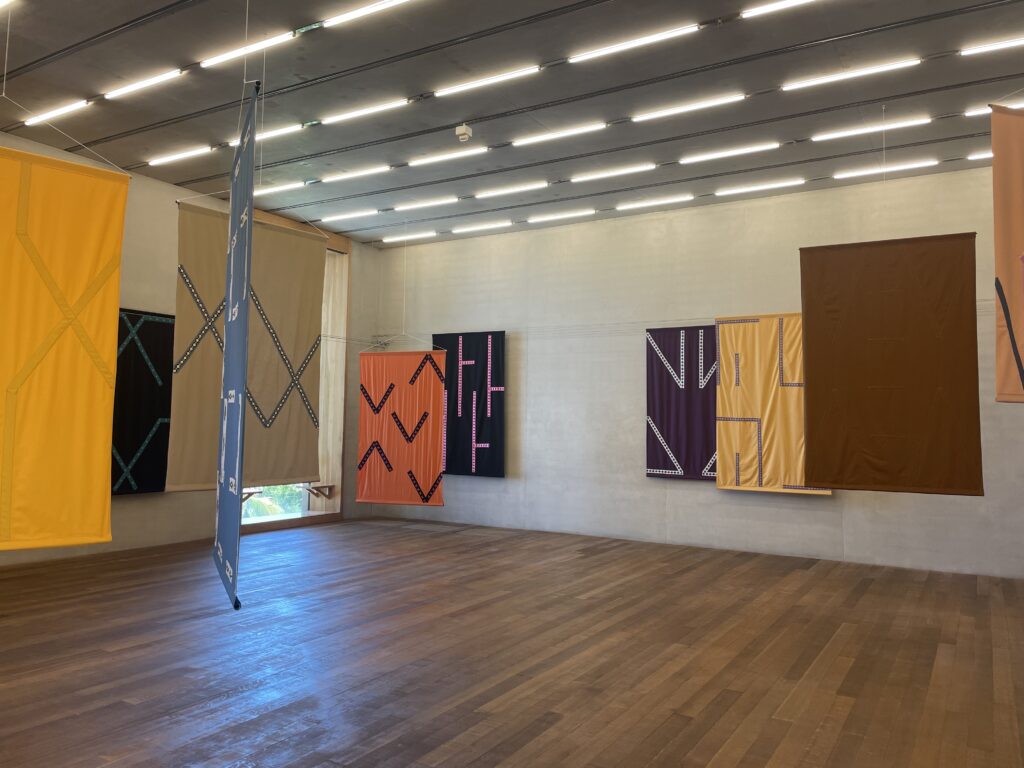
The Swaying Motion on the Bank of the River Falls, by Felipe Mujica in collaboration with Miccosukee artist Khadijah Cypress, is an installation of nineteen cotton fabric panels, or curtains, in the Rose Ellen Meyerhoff Greene and Gerald Greene Focus Gallery. There are also four larger panels hung outdoors on PAMM’s outward facing concrete walls and by the stairs that lead into the parking garage.
The curtains on view in the Greene gallery measure on average around seven to eight feet tall by about four to five feet wide, and are all visible in a portrait style orientation. The shorter side of each curtain is parallel to the ground, while the longer side is rises up toward the ceiling.
Ten of out of the nineteen curtains are arranged along the perimeter walls of the gallery. They are held in place with a system of metal wires anchored to PAMM’s concrete walls, each one displaying a single curtain along the length of the cable track. There are three panels directly on the wall to the left of the entryway. Four curtains are located opposite the entryway, and the three more are on the far wall to the right of the entry way. The nine remaining curtains hang from single wires anchored to the gallery ceiling, and they are spread out within the center of the gallery space.
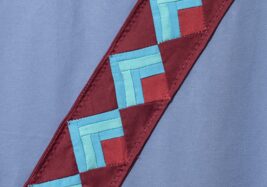
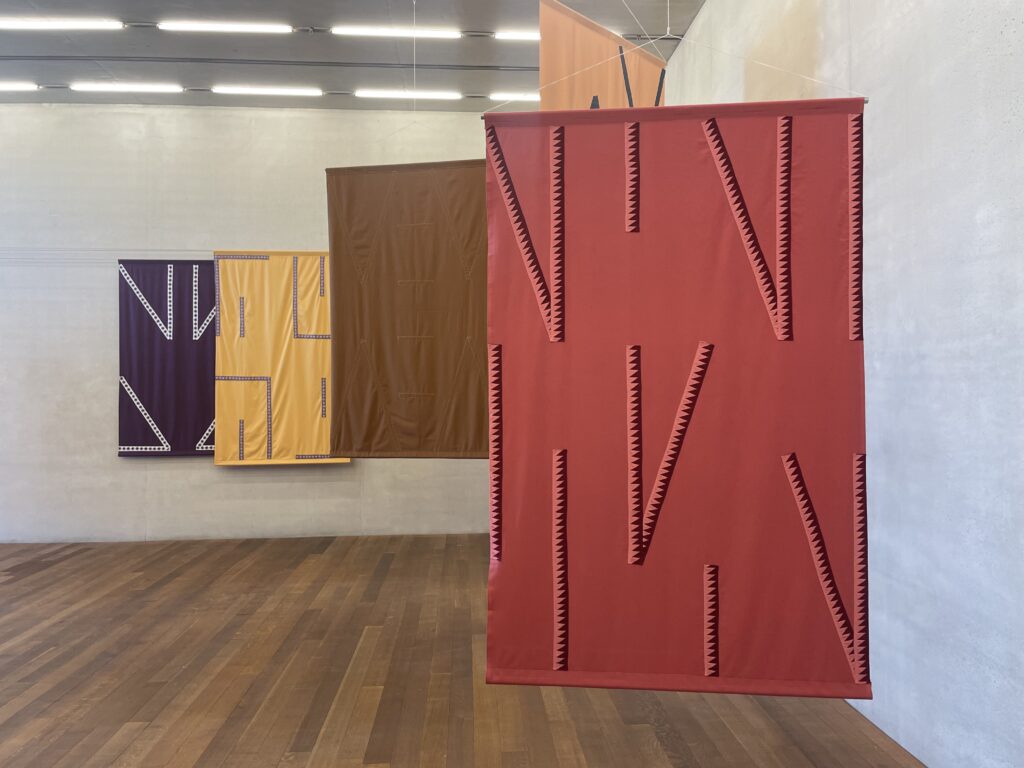
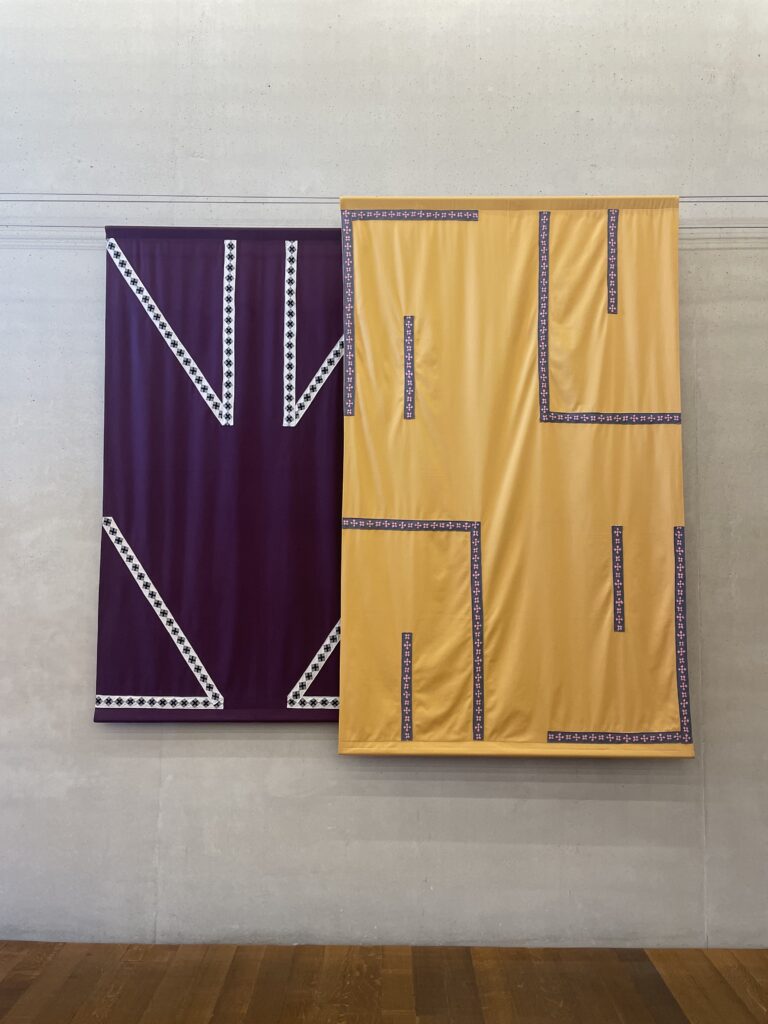
All nineteen curtains follow a similar pattern, where they are made up of one large cotton fabric panel that serves as a color background. Stitched on these panels are various geometric designs created by Miccosukee artist Khadijha Cypress. These designs are arranged along stirps approximately an inch and a half in width, and varying in length from several inches to several feet. The strips of geometric designs are stitched in a variety of different patterns on each of the panels, with no two being alike in color or composition. The geometric designs are all examples of a contemporary indigenous artist continuing in the tradition of Miccosukee patchwork.
Patrons are invited to gently tug on the curtains installed on tracks against the walls of the galleries, in order to rearrange and personalize the composition of the curtains. Please be mindful of the free-hanging curtains, and watch your step as you explore the gallery.
The Tequesta
PAMM, Downtown Miami, and many coastal communities in South Florida are built on land formerly lived on by Native Americans.
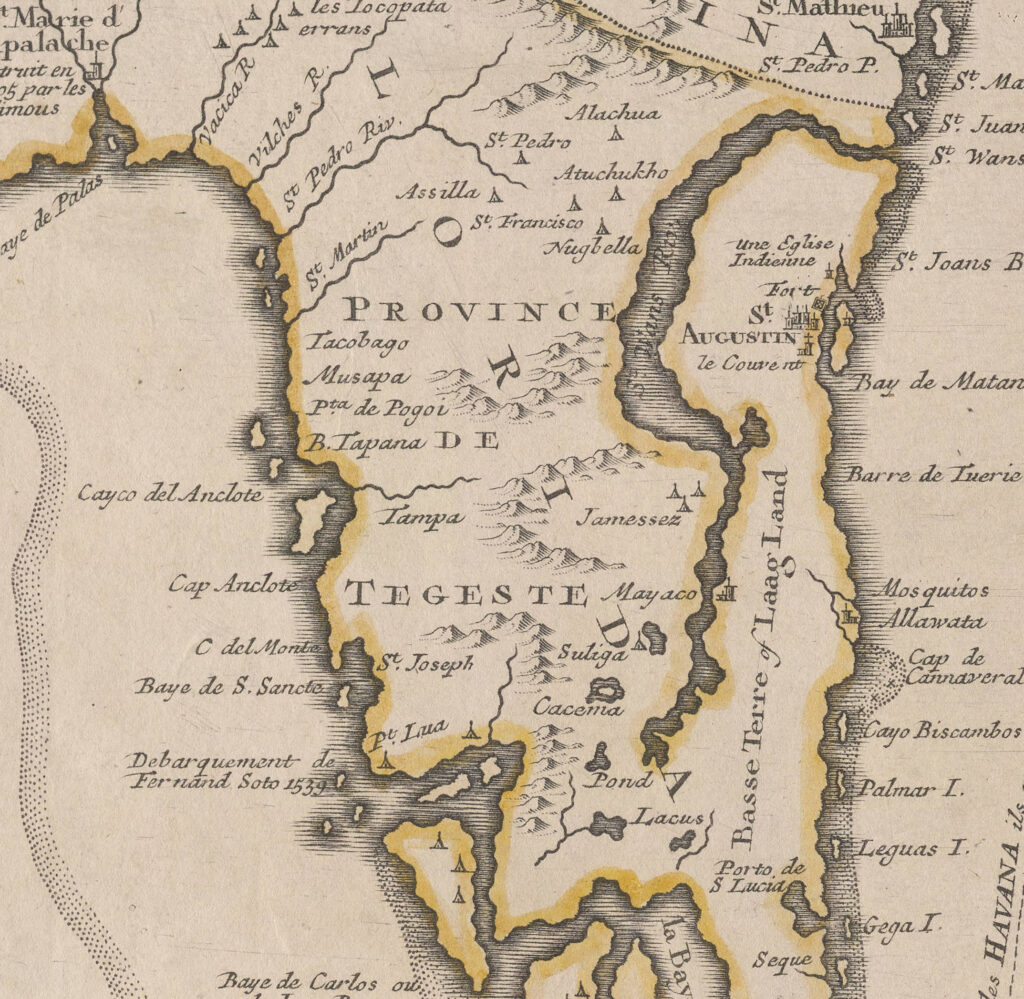
The Tequesta are the oldest known Native Americans to call Miami and its surroundings home. They lived mostly along the Miami Rock Ridge, in what are today the parts of Miami-Dade and Broward counties that are at the highest elevations. This high ground is found at the estuaries that flow east out of the Everglades into the Atlantic Ocean, with Tequesta settlements dotting the length of the South Florida coastline. Stretching from the upper Florida Keys, perhaps as far north as southern Palm Beach County, Tequesta villages were made up of clusters of wooden huts with raised floors and thatched rooves made from palm fronds. PAMM’s architecture is inspired by these original Tequesta homes. Archaeologists believe their largest settlement was at mouth of the Miami River, currently the site of Miami’s central business district. Some European maps produced in the 1700s label parts of the Florida peninsula as “Tegueste” due to their visible presence in the area at the time, as seen below.
Despite repeated Spanish attempts to set up a mission in present-day Miami during the 1600s and 1700s, Europeans largely avoided South Florida in favor of colonies they viewed as more “profitable,” like islands in the Caribbean, or present-day Mexico and Peru. However, even this limited contact with Europeans led to the eventual collapse of the Tequesta. This contact saw the introduction of European diseases to the Tequesta population, and also led to enslavement and resource competition with the Calusa, a related tribe from Southwestern Florida. By the late 1700s, the remaining Tequesta numbered in the hundreds. Many of them fled to Havana, supposedly to remain under Spanish rule as Florida became a British possession in 1763.
Amidst the towering condominium and office towers of Downtown Miami and Brickell, the remains of the largest Tequesta settlement were unearthed in 1998, and preserved by HistoryMiami as the Miami Circle. Scholars estimate the Tequesta presence in South Florida stretched over two thousand years before their erasure and disappearance from this land.
The Swaying Motion on the Bank of the River Falls
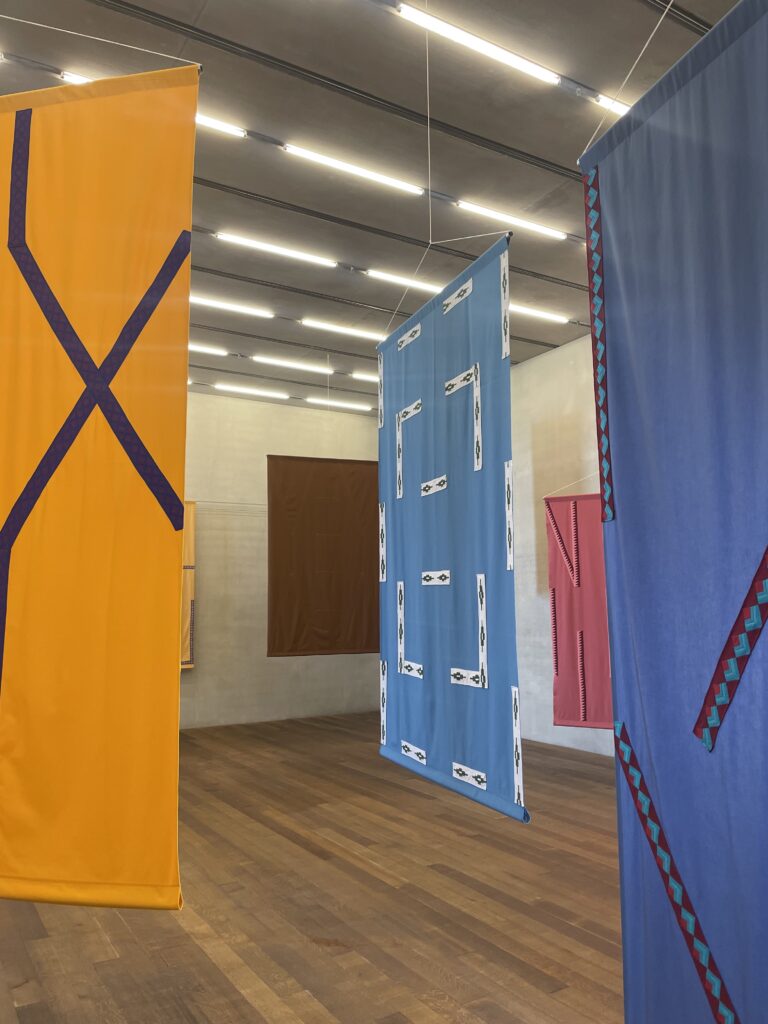
Felipe Mujica’s exhibition for PAMM, titled The Swaying Motion on the Bank of the River Falls, was created in collaboration with Khadijah Cypress, a member of the Miccosukee tribe. The majority of the Miccosukee currently live on federally recognized reservations in South Florida.
The Miccosukee are related to the Seminole Tribe of Florida, as they both share many historical, cultural, and linguistic traditions and traits.
Both tribes trace their ancestry to the Muscogee Creek tribes, and they formerly lived in present-day Tennessee and Georgia. As European colonial activity on the American continent began in the 1600s, this resulted in the active and passive removal and displacement of indigenous people. Examples of this are through violent conflict, as Europeans actively engaged Native Americans in warfare in order to move onto their lands, as well as through the unintended spreading of European diseases. The two tribes found themselves migrating further south as more European colonists pushed into the Carolinas and Georgia in the 1700s. By the turn of the 1800s, the ancestors of the Miccosukee and Seminole eventually settled in what is today northern Florida, at the time a Spanish colony.
Northern Florida became a refuge not only for the displaced Seminole and Miccosukee, but also for escaped enslaved Africans. Over time, many Black runaways were integrated into the Seminole tribe.
By the early 1800s, as the United States continued to expand southward, a series of violent conflicts known as the Seminole Wars occurred as then President Andrew Jackson pushed into Spanish-controlled Florida. This led to two lasting outcomes for these tribes. First, by the 1860s, the Seminole and Miccosukee moved further south along the Florida peninsula into the areas around Lake Okeechobee and the Everglades. The main reason was again, to escape white settler activity. More consequently, at the end of the Seminole wars, many Seminoles were forcibly moved to Oklahoma, originally organized as an “Indian Territory” by the U.S. Federal Government, where one Seminole reservation remains to this day.
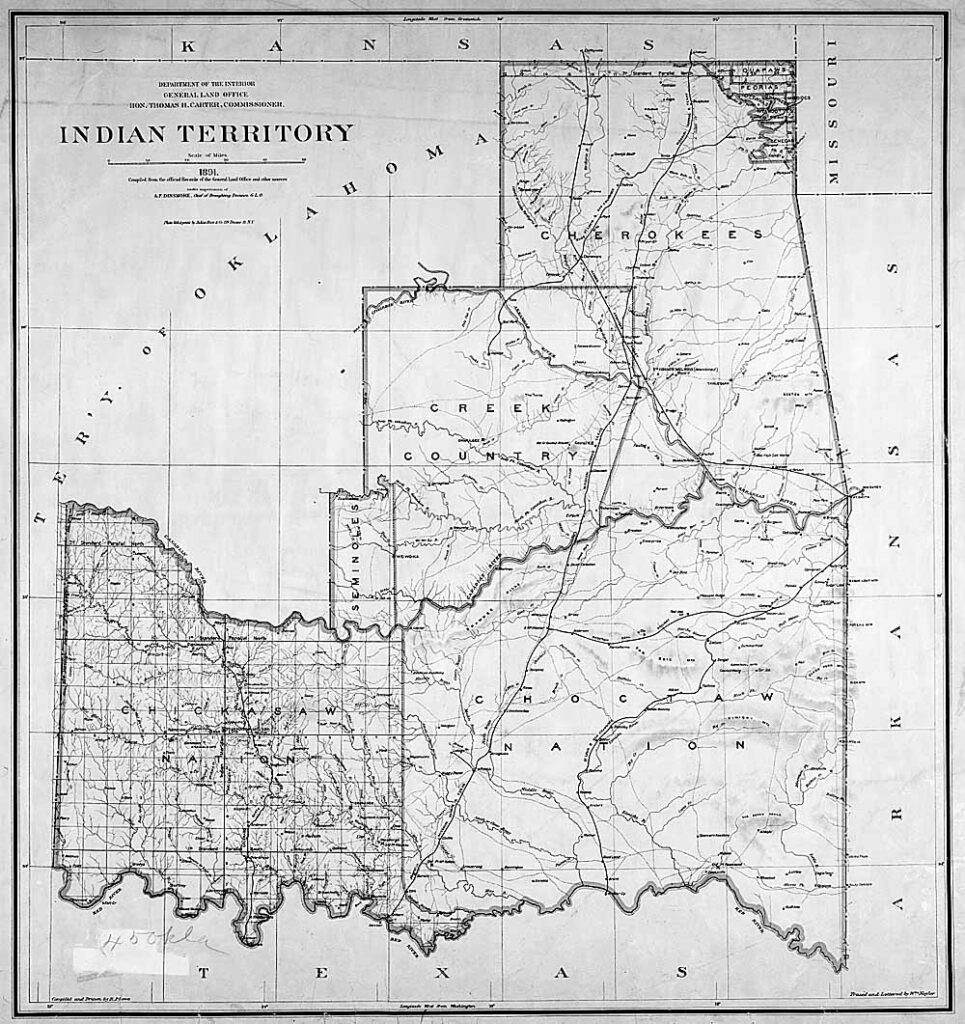
Below is a map produced by the U.S. Department of the Interior from 1891. This black and white map shows the borders of the reservations created by the Federal Government for Native Americans in what would become the State of Oklahoma in 1907. The Seminole reservation is a small rectangle located near the center of this map.
Acknowledgments
We at PAMM Education hope that Felipe Mujica’s artwork done in collaboration with Miccosukee artist Khadijah Cypress, and this tour, spark thoughtful curiosity in the lives and cultures of the indigenous people that call South Florida home.
We would also like to thank PAMM Associate Curator Jennifer Inacio for putting together this exhibition and for working hand in hand with PAMM Education to bring about this PAMM App-based tour.
To learn more about the Miccosukee or Seminole, please visit their websites below: https://tribe.miccosukee.com/ https://www.semtribe.com/stof
Feedback
We hope you enjoyed this Digital Exhibition Guide!
We appreciate you taking the time to submit feedback to us as we strive to make PAMM as engaging as possible. You may submit your feedback anonymously through this form or by emailing us directly at AppFeedback@pamm.org