
- 1/12 1. Introduction
- 2/12 2. La Hebra
- 3/12 3. Visual Description La Hebra
- 4/12 4. Mujer Con Gallo
- 5/12 5. Visual Description Mujer Con Gallo
- 6/12 6. Pescador
- 7/12 7. Visual Description Pescador
- 8/12 8. Mozambique
- 9/12 9. Visual Description Mozambique
- 10/12 10. La Naranja
- 11/12 11. Visual Description La Naranja
- 12/12 12. Feedback
La Hebra
The first stop on this tour focuses on La Hebra, a painting from early in Mariano’s travels and career. Spending the better part of the 1930s in Mexico, this painting is heavily influenced by the work of Mexican painters like Diego Rivera. This style is known for painting people with thick limbs, large facial features, and orange toned skin. Artists in Mexico at the time were creating a new, nationalistic style of Mexican art that incorporated indigenous heritage. It is in this unique blend of Aztec, Olmec, Toltec, Maya, and European, where the visual Mexican identity was constructed by artists like Rivera, and seen in Mariano’s work from this time as well.
From the perspective of continuity and change, to help understand this further, below is an image of a colossal head, carved by the Olmec peoples of central Mexico. Many art historians consider these large sculptures as influences on the Mexican painters of the 1930s. The large rounded features continue into the twentieth century, the difference is found both in the form, as a sculpture, and medium, being stone instead of paint on canvas.

Visual Description La Hebra
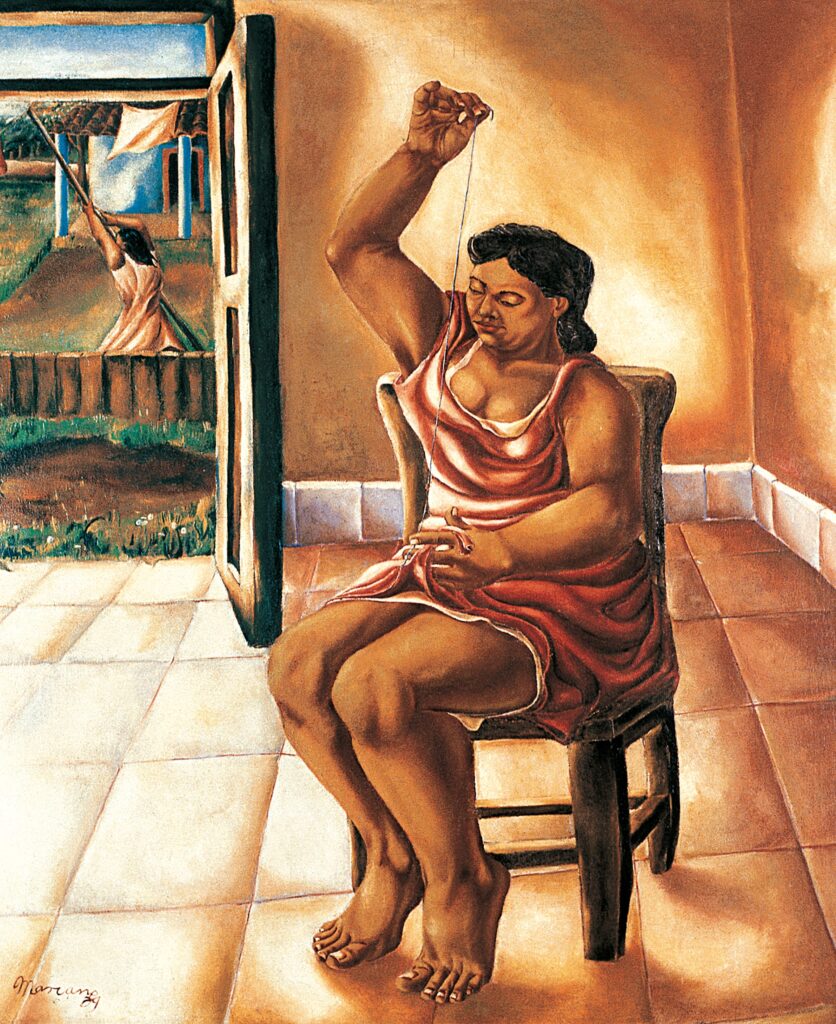
La Hebra by Mariano is an oil painting on canvas from 1939. It measures thirty-six inches tall and thirty inches wide, which is equal to three feet in height by two and a half feet wide. It hangs in a portrait-style orientation, meaning the shorter side runs parallel to the gallery floor.
This painting’s main feature is a seated woman pulling on a long thread. She is seated indoors, and the painting is dominated by warm orange and pink hues. The artist used the common technique of linear perspective to give the painting a sense of depth. Using differently angled lines, the artist able to create an illusion where it looks like the woman is in the foreground of the painting, and behind her are details that fill her environment. She is inside a room with a terracotta tile floor. To the viewer’s left, and her right, is an open door that looks out into a garden, furthering the depth of the painting. To the viewer’s right, and the woman’s left is the corner of the room she is seated in.
Starting with the principal figure, the woman is painted seated on a wooden chair. She is slightly turned toward the open door on the viewers left. Her knees are together and feet are angled downward, with only the balls of her feet and toes touching the tile floor. Her right arm, on the viewer’s left, is extended up past her head, slightly bent at the elbow. With this arm she pulls a long thin thread from the hem of her dress, which ends at mid-thigh before the bend of her knees. Her left arm, on the viewer’s right, is at her side, with the forearm resting on her lap. With her left hand, she holds the hem of the dress between her fingers. She wears a loosely fitting light red dress. The dress has many folds and highlights rendered in white paint, as the light source streaming from the open door brightens the room from the left side of the painting. The dress is sleeveless and short, exposing her arms and legs. Under the dress is a light white slip, barely seen under the folds of the dress’ fabric. The woman has a copper toned complexion, and wears her black hair in a short style, ending just below her ears. Her face is angled slightly downward as she looks intently to the repair she is making to her dress.
In the upper left corner of the painting, is a scene viewed through the open door. Here a small plot of dirt is visible beyond the threshold of the room. The dirt patch is painted in front of a wooden fence. Behind the fence is another woman seen working outside. She is painted in a dramatic pose facing right, caught in the middle of movement, with the folds of her dress painted moving away from her. She is wearing a similar simple tunic-style dress and she is standing with both arms extended behind her head. She is holding a long wooden-looking rod or post that extends diagonally behind her head, pointing toward the upper left corner of the canvas. She looks like she is lifting the post behind her in a strenuous way. Behind the working woman is a blue house with a terracotta shingled roof and an orange doorway.
Mujer Con Gallo
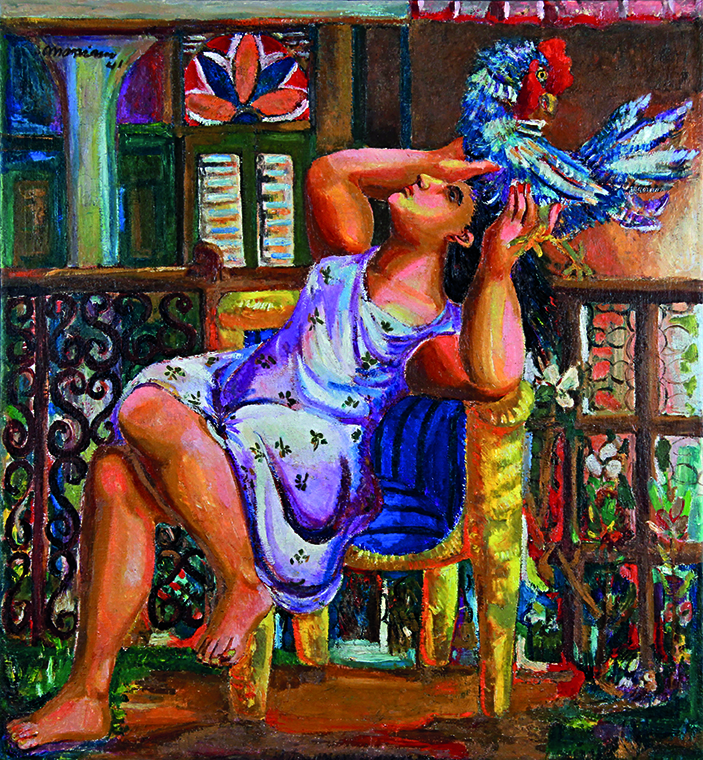
Mujer Con Gallo is painted in a style that follows a trend from European art of the early twentieth century known as fauvism. This term comes from the French word for “wild beast.” Some art critics considered the colors used in fauvist art as unnatural, and therefore used this term to describe their dislike of this style. In Mujer Con Gallo, the fauvist influence is seen in the purple and turquoise used to show shadows on the woman’s skin.
Once again, Mariano’s themes remain firmly rooted in the everyday of his life in Cuba, but the style he uses has shifted because he has shifted. By 1941, his influences started to come from Europe, by way of New York. In 1944, he was physically in New York, but he was consuming the art of and learning from French and other European artists. This period in his life is called “Paris in New York.” Many artists fled Europe and found themselves in New York expressly because of the rise of fascist and autocratic governments in Germany, Italy, France, and the Soviet Union.
Below is a German poster from 1938 advertising an exhibition for “degenerate art,” a term invented by the Nazis to categorize art they viewed “destroy or confuse natural form or simply reveal an absence of adequate manual and artistic skill…”
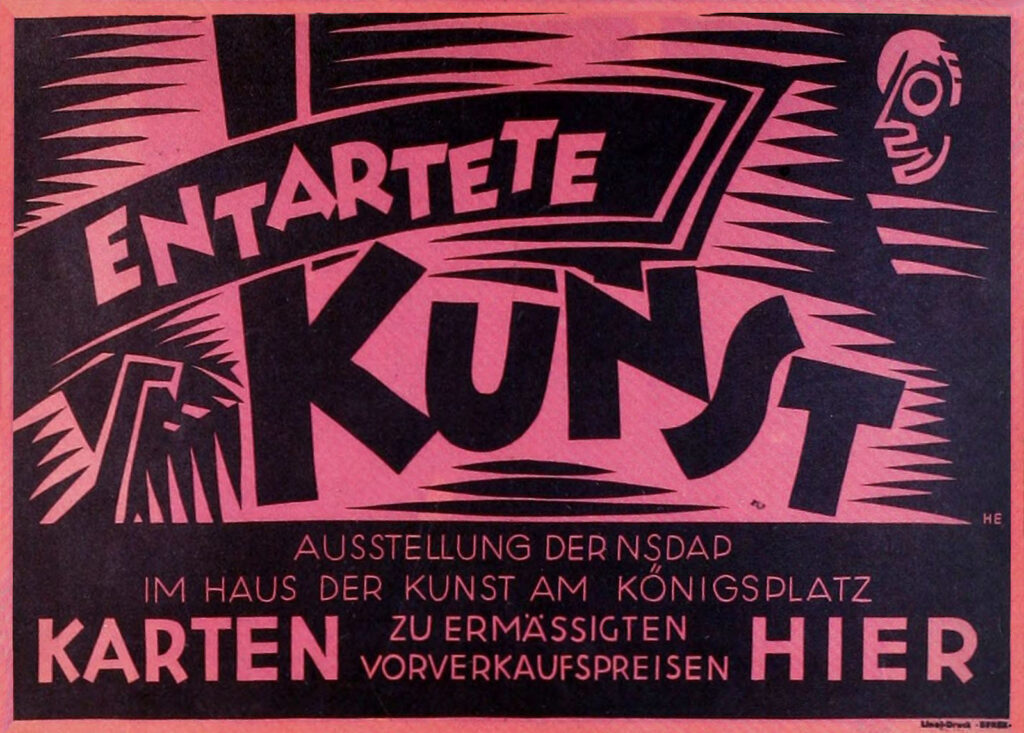
Fauvism fell into this category, as did many other modern visual and architect mural styles fascists thought were products of “lower races.”
Visual Description Mujer Con Gallo
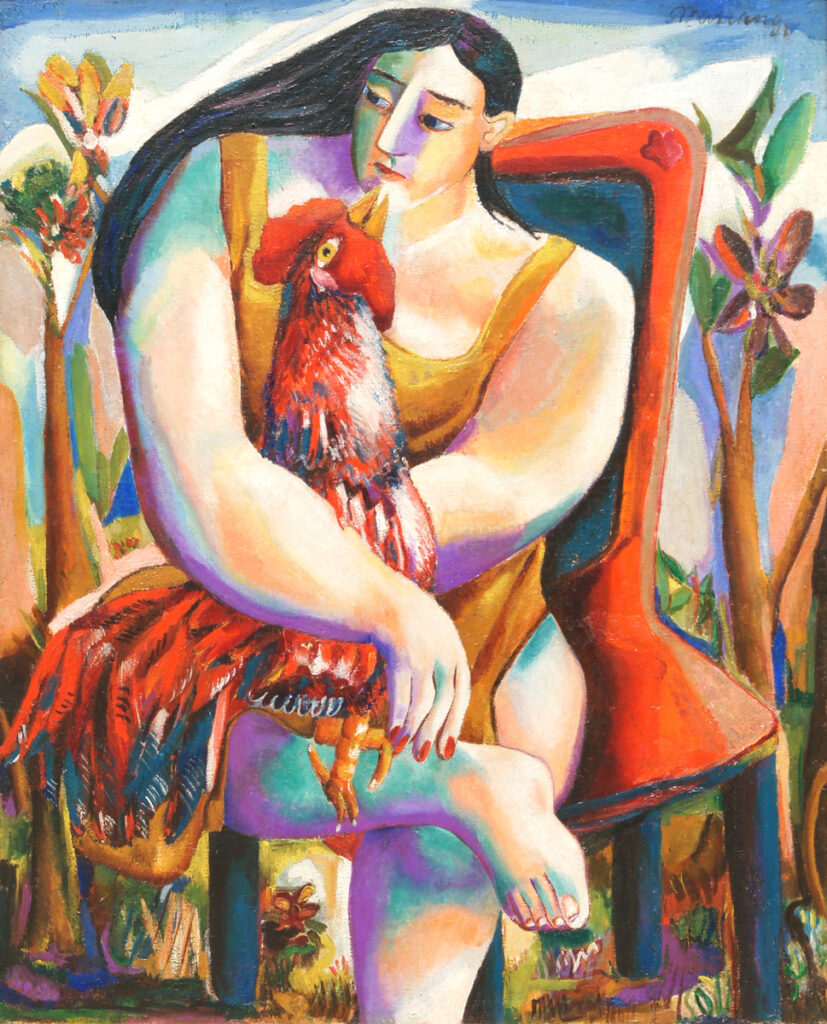
Mujer Con Gallo is an oil painting on canvas. It measures thirty-two inches tall by twenty-six inches wide. This equals around two and a half tall by a little over two feet wide. It hangs in a portrait-style orientation, meaning its shortest side runs parallel to the gallery floor.
This artwork shows a seated woman with a rooster on her lap. The painting is in a “fauvist” style, meaning the colors used throughout the composition are painted in strong, contrasting sections. Therefore, the colors take priority over the objects painted.
The seated woman dominates the majority of the canvas. The crown of her head nearly touches the top border of the canvas and her wide shoulders fill out the width of the space. At the bottom of the canvas, the right foot is crossed over her left knee, with her shin extending down to the bottom edge of the canvas. She has long black hair that extends past her right shoulder, on the viewers left. Her face is slightly turned and her eyes downcast toward the left edge of the canvas. She wears a neutral expression on her face. Just beneath her lips is the beak of the rooster that rests on her lap. The bird’s head and neck extend upward from its body to almost meet her face. The woman’s right arm, on the viewer’s left, is draped across the body of the bird. The rooster’s long and colorful tail feathers curve toward the bottom left of the canvas from under her arm. Her left arm is draped across her lap, behind the rooster.
The chair the woman sits in is orange with a blue upholstered back, and blue legs. The setting of the painting looks to be outdoors with several tall slender flowers and plants visible on either side of the chair, and foliage underneath the legs of the chair.
Overall, the colors chosen by the artist are bold and varied. The woman is painted in a combination of warm and cool hues that create a unique blend. Generally, shadows are painted purple, blue, and shades of teal and turquoise along the left side of the seated woman’s face, arms and legs. The right side of her body sees yellow, orange, and pink used to underscore the lit sides of body. All these colors lie under a white base layer that adds to the cool and warm gradients that make up her skin.
Pescador
Pescador by Mariano continues down the path of his travel and evolving artistic style. By the 1950s, frequent trips to New York exposed Mariano to a new group of artists. Their way of painting was different because it no longer focused on capturing objects or people as close as possible to their real-world equivalents. These artists placed more importance on the emotions communicated through the colors and shapes of their artworks. This is why they are remembered as abstract expressionists.
In keeping with this tour’s theme of continuity, or things staying the same, and change, El Pescador is another example of Mariano’s evolving style. This painting, named after the many fishermen seen on the shores of Cuba, to many viewers may not look like its namesake. However, Mariano’s style mirrors many of the abstract expressionists that worked in New York. The intricate lines and complex shapes become a place for viewers to think about perhaps the details of being a fisherman, than the image of a fisherman.
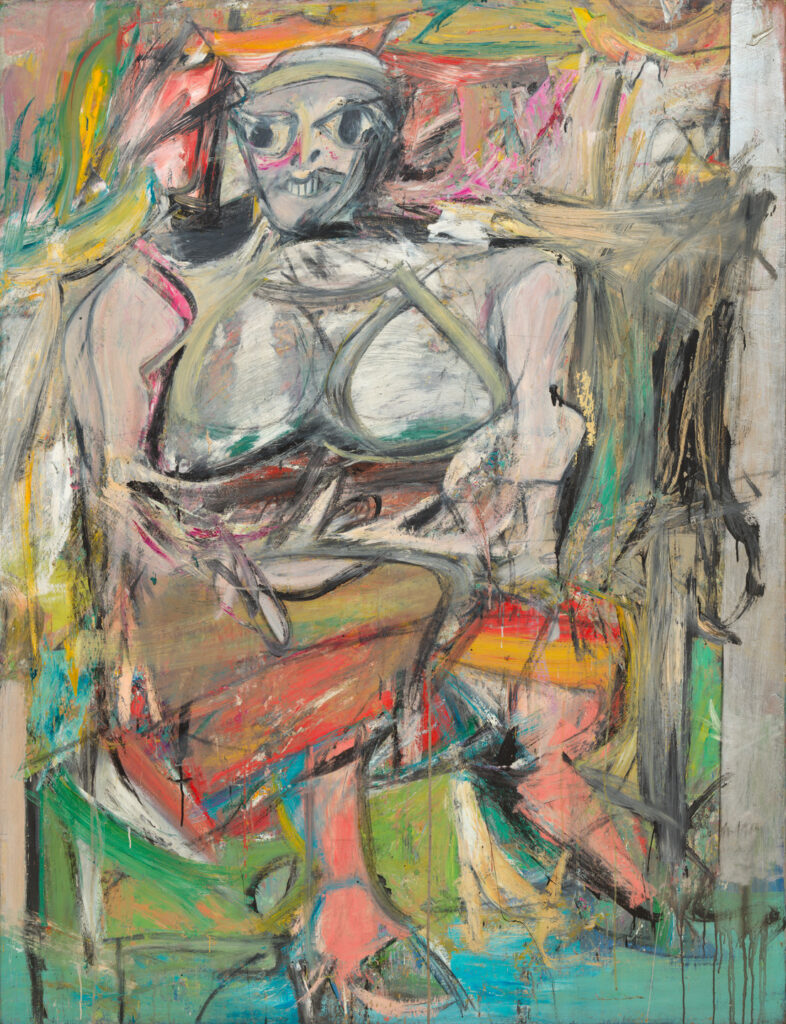
Below is a painting by William de Kooning, a Dutch-American painter named Woman I. This painting shows how abstract expressionists began moving away from exact representations of their subjects. Artists like de Kooning and Mariano put more emphasis on the power of their brush strokes and the clashes of color and shape to stress the emotions in their artworks.
Visual Description Pescador
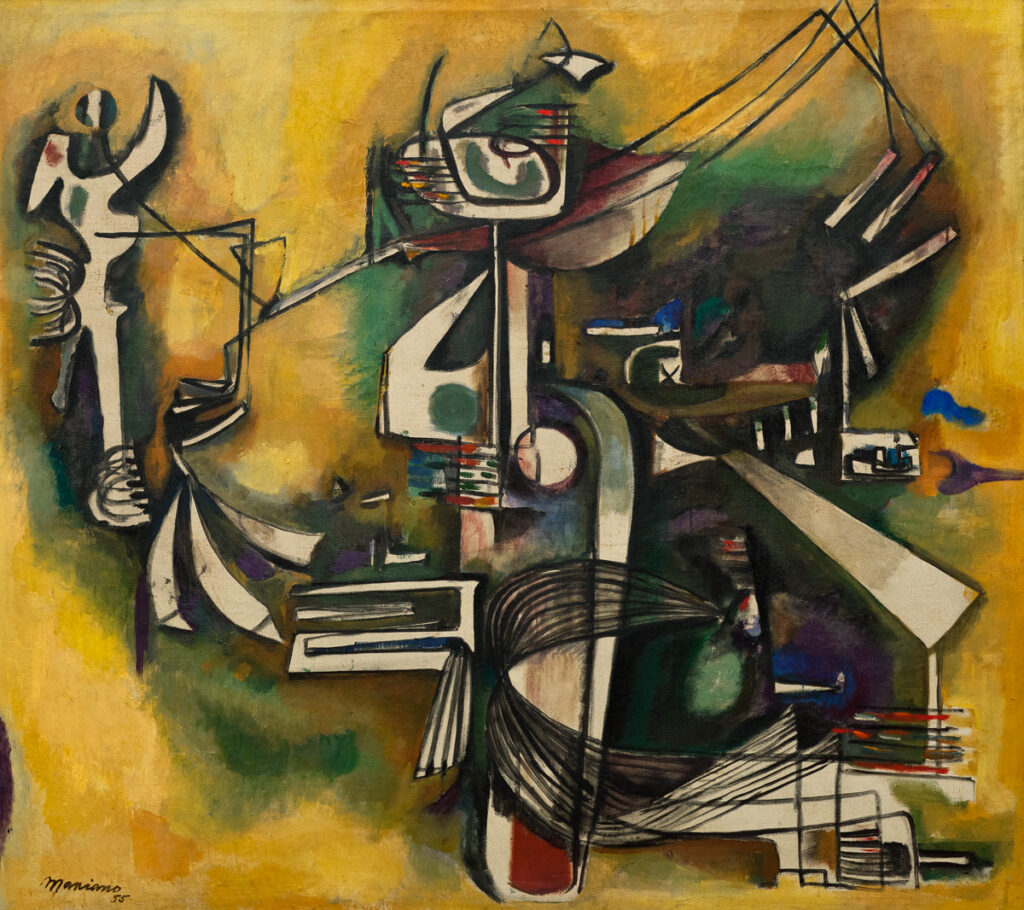
Pescador, by Cuban artist Mariano Rodriguez, is an oil painting on canvas. It measures thirty-five inches tall by forty inches wide. This is equal to about three feet tall by around three and a half feet wide. It is displayed in a landscape orientation, meaning that its longer side runs parallel to the floor.
This artwork is an example of abstraction. Abstract artworks do not try to accurately portray recognizable objects or figures. They are usually made up of various geometric or curved shapes, as well as a wide variety of lines and colors. Pescador has a yellow background that surrounds the abstract shapes painted across the width and length of the canvas. Starting along the center line of vertical symmetry, the painting has a large rod-like vertical shape. This central shape divides the painting in two halves. On the left half, starting in the upper left corner, is another long thin shape, not unlike a monkey wrench. This shape runs parallel to the left edge of the canvas and is half the total height of the painting. It is white with a black outline and a drop shadow behind it, darkening the yellow background of the painting. There are semi-circular black lines that look like half of a coil, at its base and on the shape’s left flank. Two black lines connect the monkey-wrench shape to an angled projection from the center column.
Moving right, the center of the painting is again dominated by a large abstract vertically oriented shape. At the top the shape has a rounded parallelogram at the end of a long thin white rod, like a golf club sticking straight up. The bottom half of the shape takes mirrors that of a wine bottle. The “neck” of the bottle-like shape widens to a quarter-circle shape. The outline of the bottle extends in a vertical line down toward the bottom of the canvas. Swirling around this composite shape are waves of concentric curved lines, like fishing nets being cast into the ocean.
Moving to the right half of the painting, the yellow background is blanketed by a black and purple shadow that fills in more of the space around the abstract shapes. Striking out diagonally toward the lower right corner, is a long and thin white triangle. Its top point pierces the black background color, giving the shape and the artwork a three-dimensional appearance. There is also a trio of black lines that dangle like power lines from the upper right corner of the artwork, connecting to the central shape.
Visual Description Mozambique
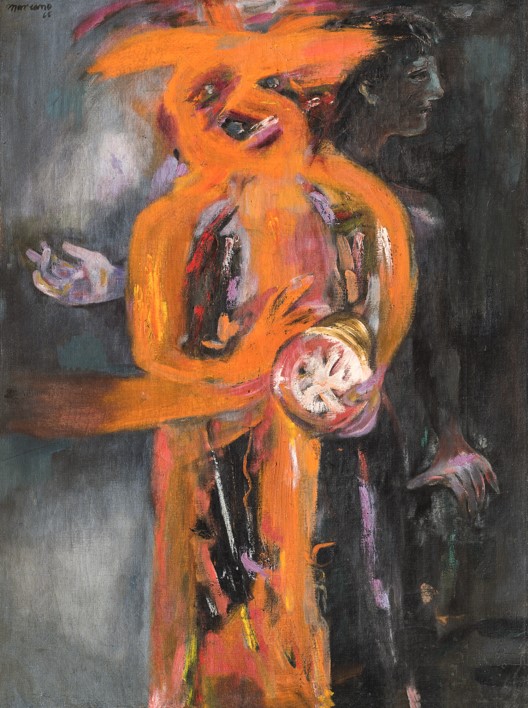
Mozambique is an oil painting on canvas. It measures thirty-five inches tall by thirty inches wide. This equals to close to three feet tall and around two and a half feet wide. It hangs in a portrait-style orientation, meaning its shorter side runs parallel to the gallery floor.
This painting has elements of veristic, or traditional painting styles, that try to accurately represent real world figures or objects. This painting also has elements of abstraction. That means the artist chose to emphasize shape, color, and emotion over accurate physical representation.
Mozambique is dominated by two human-like figures, seen standing and facing the viewer. One is more realistic, and easily recognized as the silhouette, or outline, of a human. The other is more abstract, and painted in brighter colors and with broader and less precise brushwork.
The abstract human outline stands in front of the more realistic human silhouette, occupying the painting’s foreground and vertical line of symmetry. The figure is painted in thick strokes of bright orange paint. The orange strokes form the outline of the figure’s face, shoulders, and hands. To the viewer’s right, in the orange figure’s left hand, they cradle the top of a drum against their waist. With their right hand, the lively orange brushstrokes indicate that the figure is about to strike the drum. Two columns of unevenly applied orange paint serve as the figure’s legs, reaching down to the bottom edge of the canvas.
To the right of the orange figure, the face and left arm of the outlined person are painted in pale blue and lavender lines against the black background of the painting, giving the realistic human a ghost-like appearance. The figure’s left arm, on the viewer’s right, is at their side, their knuckles indicated by a faint white brush stroke. The majority of the outlined person’s torso and right arm is hidden from view by the orange figure. The right hand is seen to the left of the orange figure, almost touching the left edge of the canvas. The ghost-like human’s left leg is a thin line of lilac paint against the painting’s black background.
La Naranja
In the earlier parts of Mariano’s life, Cuba was always the theme being influenced. By the 1970s, Cuba and the Caribbean are both the theme and the influence. In The Orange, the themes of Caribbean are visible in the gradients of the deep red background and the large citrus fruit, floating like a hot humid sunset. Women and female nudes also feature heavily in Mariano’s works, like the laying nude woman along the bottom of this painting. This woman’s placement reinforces the idea of Cuba, and this stage in his career, as being places of pleasure and enjoyment when seen from the male gaze. Yet, the painting also is dreamlike and hazy, like a mirage. Is it real or a figment of an old man’s wanting imagination?
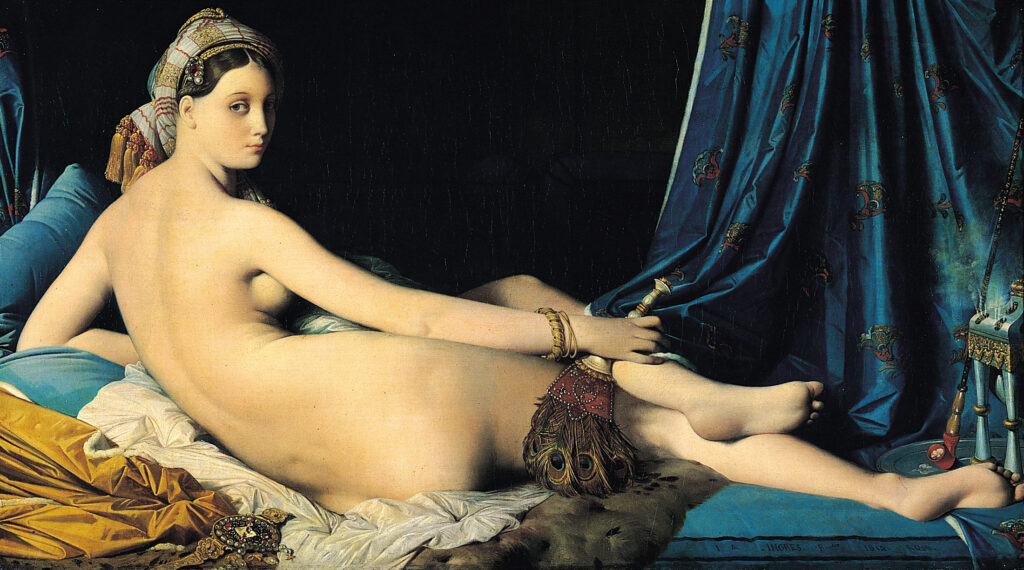
Mariano was a man that lived through the greatest upheavals of the twentieth century, and took in the influences around him to produce an enormous body of varied work. However, we can reach back further to see that the influences have their own influences. Below is a nineteenth century painting by French painter Jean Auguste Dominique Ingres, heavy with meaning, as it portrays an idealized woman from a man’s perspective. The Grande Odalisque is a European male’s idea of a woman that personifies an exotic and distant land filled with pleasure, with little thought given to the subject of the painting, and her thoughts and desires. Perhaps even at his truest self, Mariano was still offering us variations on a theme.
Visual Description La Naranja
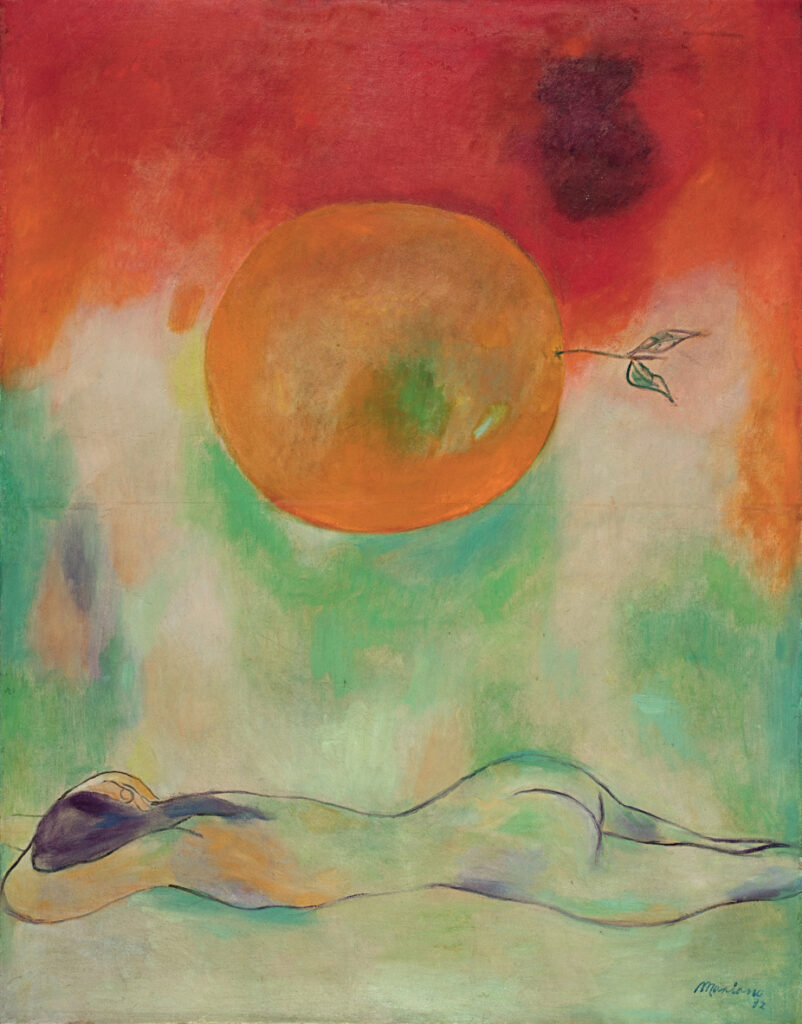
La Naranja is an oil painting on canvas, by Cuban painter Mariano Rodriguez. This painting measures fifty-one inches tall by thirty-nine inches wide. This is equal to around four feet tall by a little over three feet wide. This painting hangs in a portrait orientation, meaning its shorter side runs parallel to the gallery floor.
This painting has two major elements, a large orange fruit and a nude woman. The upper third of the canvas is painted in a deep red paint. In the upper right corner, the red darkens to a mulberry color, around an irregular shape, almost like a bruise on the canvas. This topmost band of red paint also has some orange as it reaches the remaining two thirds of the canvas. There is a large circular orange floating on the upper third of the canvas, impaling the red paint with its upper half. A short brown, horizontal twig-like stem with two leaves at its end grows out the orange’s right side, along its horizontal diameter. It runs parallel to the top and bottom of the canvas as the leaves point to the right edge of the canvas. The orange is painted in its namesake color, the center of the round shape featuring some green and areas of lightened orange paint.
The bottom two thirds of the canvas feature a background made up of disconnected areas of green and white. Along the bottom third of the canvas is the nude outline of a woman. The color of the outline is purple, and there are areas of purple shading applied to areas of her body. Starting from the left, she is face down, with her head buried in the bend of left arm. She wears her hair in a ponytail, which rests on her back. The outline of her back narrows to form her waist. The lower half of her body is slightly twisted, showing both of her glutes and the cleft between them, as well as the backs of both of her legs to the viewer. From the waist, the outline rises to take in the curved volume of her buttocks. The outline of her legs then falls diagonally to trace her hamstrings and finally calves, which are cut off at the right edge of the canvas.
Feedback
We hope you enjoyed this Digital Exhibition Guide!
We appreciate you taking the time to submit feedback to us as we strive to make PAMM as engaging as possible. You may submit your feedback anonymously through this form or by emailing us directly at AppFeedback@pamm.org
Related Content



Panel Discussion: Mariano Rodríguez

Mariano: Variations on a Theme

