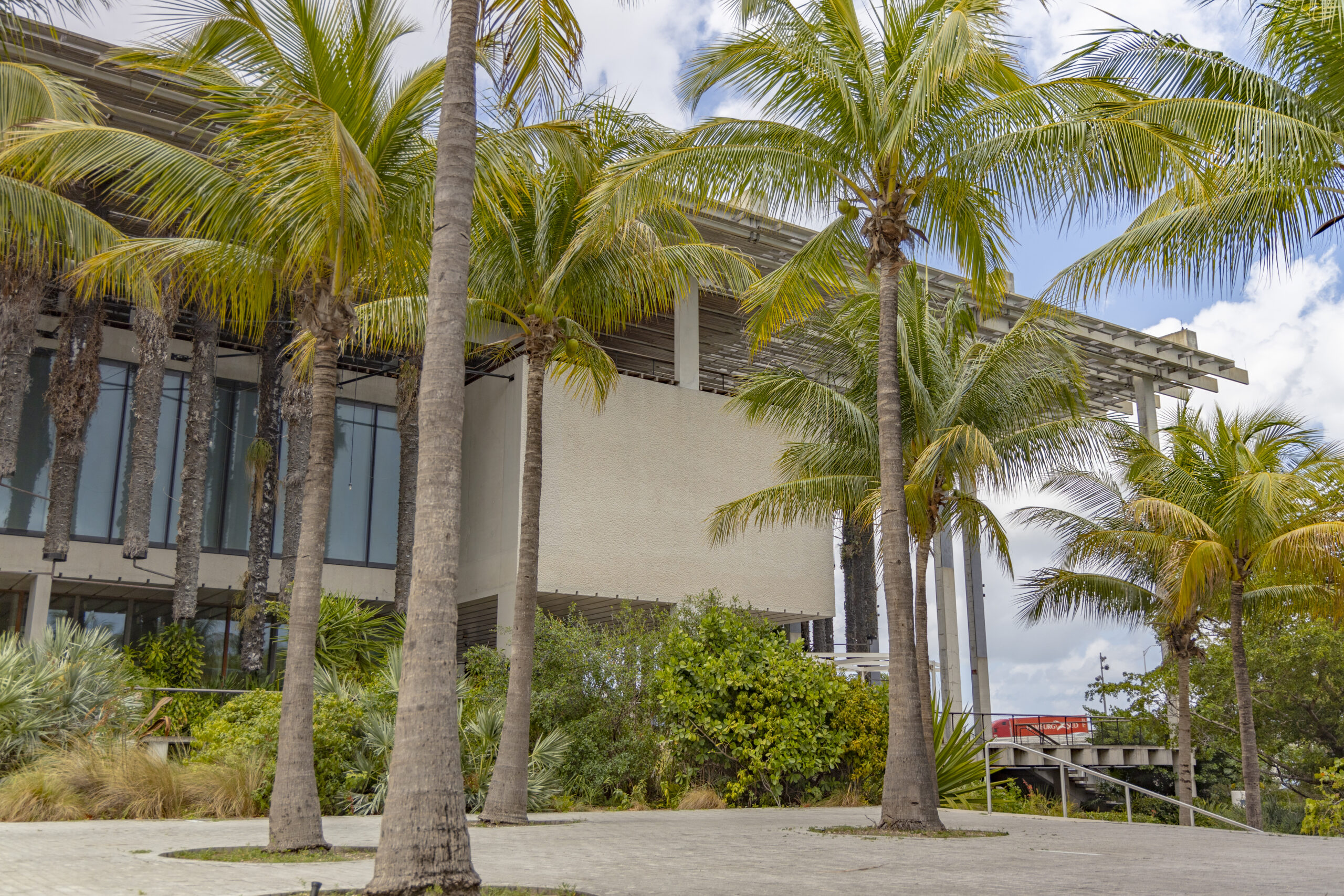
- 1/13 1. Introduction
- 2/13 2. Dinner Date
- 3/13 3. Visual Description: Dinner Date
- 4/13 4. The Kennedy Family
- 5/13 5. Visual Description: The Kennedy Family
- 6/13 6. John Wayne
- 7/13 7. Visual Description: John Wayne
- 8/13 8. Silver Clouds
- 9/13 9. The Party
- 10/13 10. Visual Description: The Party
- 11/13 11. Portrait of Sidney Janis Selling Portrait of Sidney Janis
- 12/13 12. Visual Description: Portrait of Sidney Janis Selling Portrait of Sidney Janis
- 13/13 13. Feedback
Introduction
“In 1968 art critic Lucy Lippard defined New York Pop as “art determinedly of the present.” She claimed that Pop art, which drew inspiration from popular and commercial sources, was created by “the New York Five”: Andy Warhol, Roy Lichtenstein, Tom Wesselmann, James Rosenquist, and Claes Oldenburg. These five white men remain the most celebrated artists of the early Pop movement. Yet, Lippard’s writing left out a central figure: Marisol Escobar, who’s solo exhibitions in the 1960s garnered major press and drew record crowds, with thousands flocking to her gallery shows in New York. Marisol and Warhol Take New York seeks to recover Marisol’s place, alongside Warhol’s, as one of the protagonists of Pop and reveal, for the first time, the influence they shared.”
– Read by PAMM Assistant Curator, Maritza Lacayo, who co-organized this exhibition on behalf of PAMM.
This PAMM Education Audio Tour seeks to demystify the enigmatic Marisol, a Venezuelan-American woman artist absent from the center of Pop Art. Working in close collaboration between PAMM’s Curatorial, and Educational staff, this tour will attempt to answer some of the basic questions that come to mind when first encountering Marisol. This tour is in many ways an interrogation, a basic attempt at information finding, as well as a tool to help visitors place Marisol and Warhol’s work in context. Each of the stops on this tour will provide one potential answer to the who, what, where, when, why, and how, of Marisol, and her relationship to Pop art and Andy Warhol. Additionally, this app provides visual descriptions of selected artworks in this exhibition. These visual descriptions can be read by screen readers, as well as listened to by visitors with low vision or visual impairment. All guests are encouraged to listen too.
We hope you find this audio tour informative, useful, and most importantly, that it sparks curiosity.
Dinner Date
Dinner Date by Marisol Escobar will help answer the question of who? Who was Marisol?
Marisol was born Maria Sol Escobar in Paris on May 22nd, 1930 to wealthy Venezuelan parents. She grew up in a financially privileged family that frequently traveled between Europe, Venezuela, and the United States. At some point in her childhood, she started using the nickname Marisol.
Despite the privileges afforded by her family’s financial status, Marisol at an early age endured her mother, Josefina Escobar’s suicide. After studying in boarding schools and prestigious art schools in France and the USA, Marisol started to make a name for herself in the New York art world.
By the early 1960s, Marisol was firmly considered a “pop” artist. Moreover, she was seen a celebrity in popular American culture, a unique achievement for a Latin American and woman artist.
In Dinner Date, Marisol is commenting on her status as a single woman in male-dominated 1960s American culture. She was very aware both of how she was viewed, as a woman, and also of the image she projected. Publicly demure, Marisol was known for her reserved, shy nature. This enigmatic persona made the public and press only all the more curious about her.
Below is an image of Marisol from 1963, as she looks on the work of another artist.
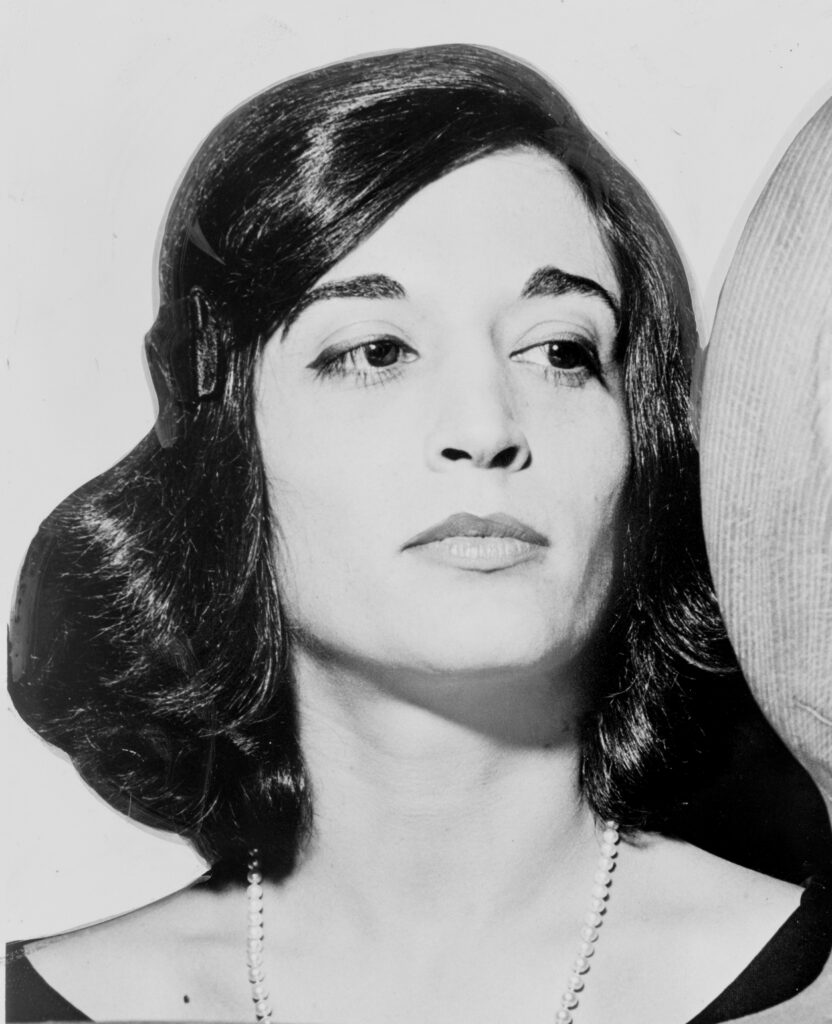
Marisol Escobar, cropped from photo of “Venezuelan-born society sculptress Marisol Escobar looks quizzically at the head of a woman by British sculptor Henry Moore at new Marlborough-Gerson Gallery / World Telegram & Sun photo by Herman Hiller.” (Cropped due to copyright of Moore sculpture)., Date, 1963. Source, Library of Congress Prints and Photographs Division. New York World-Telegram and the Sun Newspaper Photograph Collection. http://hdl.loc.gov/loc.pnp/cph.3c22877. Author, New York World-Telegram and the Sun staff photographer: Hiller, Herman, photographer. Permission (Reusing this file), PD [1
Visual Description: Dinner Date
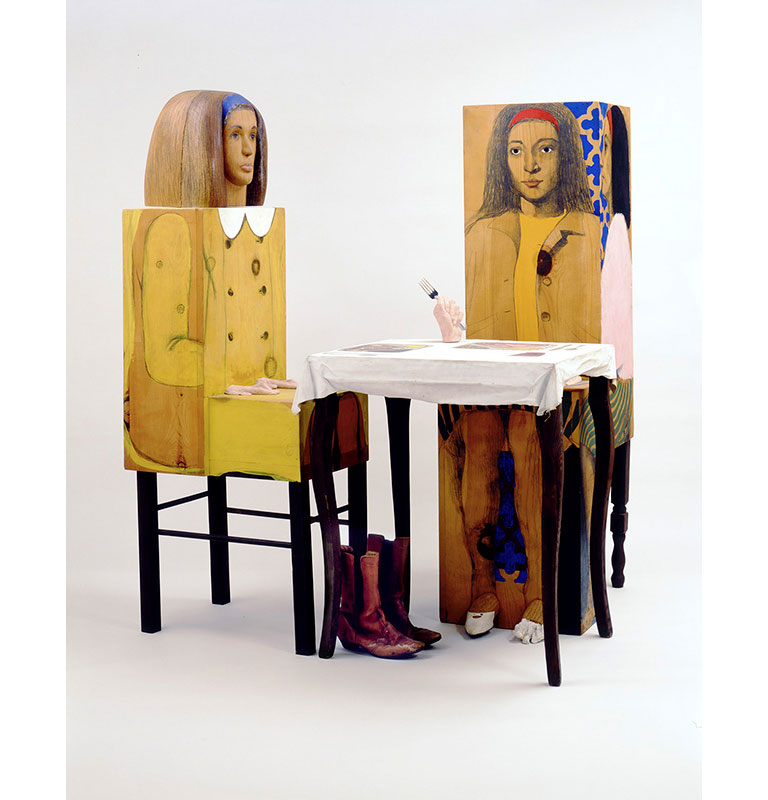
Dinner Date by Marisol is a sculpture made in 1963. It is made of painted wood, plaster, textiles, oil paint on canvas, a metal fork, leather boots, paint, and graphite. It measures roughly four and a half feet tall by four and a half feet wide with a depth of roughly three and a half feet.
The sculpture features two figures depicting Marisol having dinner with herself.
The two Marisols are seated at a small wooden table with four long, dark brown legs. The table top is covered in a square piece of white canvas. Painted on the canvas are two small TV Dinners, a glass of wine, a metal knife, and a metal fork. Placed on top of the table is a hand gripping a fork. The hand is made of plaster and the fork is made of metal. Behind the plaster hand, one of the Marisols is drawn onto a rectangular block of wood in graphite. Her hair reaches her shoulders and is black in color. She wears a bright red headband. She is wearing a yellow shirt with an overshirt that is left unpainted. Her skirt reaches her knees and has a simple striped pattern. Behind her legs, a pattern made of crosses and “X” shapes is painted black and blue. Her feet protrude from the otherwise flat block of wood. The foot on the left is wearing the tip of a white shoe while the other is bare and painted white. On the right-hand side of this block of wood, another Marisol is painted in profile. She also wears a red headband but her shirt is pink and her skirt is made of green stripes against the exposed wood. The blue pattern continues behind her. The block of wood cuts off at her knees and creates the shape of a chair. At the back two leg chairs complete the structure.
The other Marisol is made of three rectangular blocks of wood placed on the four legs and base of a chair that are painted black. This Marisol’s torso and knees are drawn onto the flat pieces of wood. She wears a long coat that is painted in a light yellow which makes it possible to see the wood underneath. The coat has six buttons separated into two rows that go down the length of her torso. The collar to the blouse she is wearing underneath flows over the coat and is white in color. Her head is made of carved wood. Her hair also reaches her shoulders and is light brown. She wears a blue headband and has blue eyes. Her hands are made of plaster and are rested on her lap. She does not have legs but two brown leather boots sit in front of her, completing her body.
The Kennedy Family
The Kennedy Family by Marisol will help answer the question of ‘when?’ When was Marisol?
Marisol’s work started coming into the American mainstream as the 1960s began. This decade is also coincidental with the rise of Pop art as a major artistic movement, and the immense social, political and economic revolutions that would change the world.
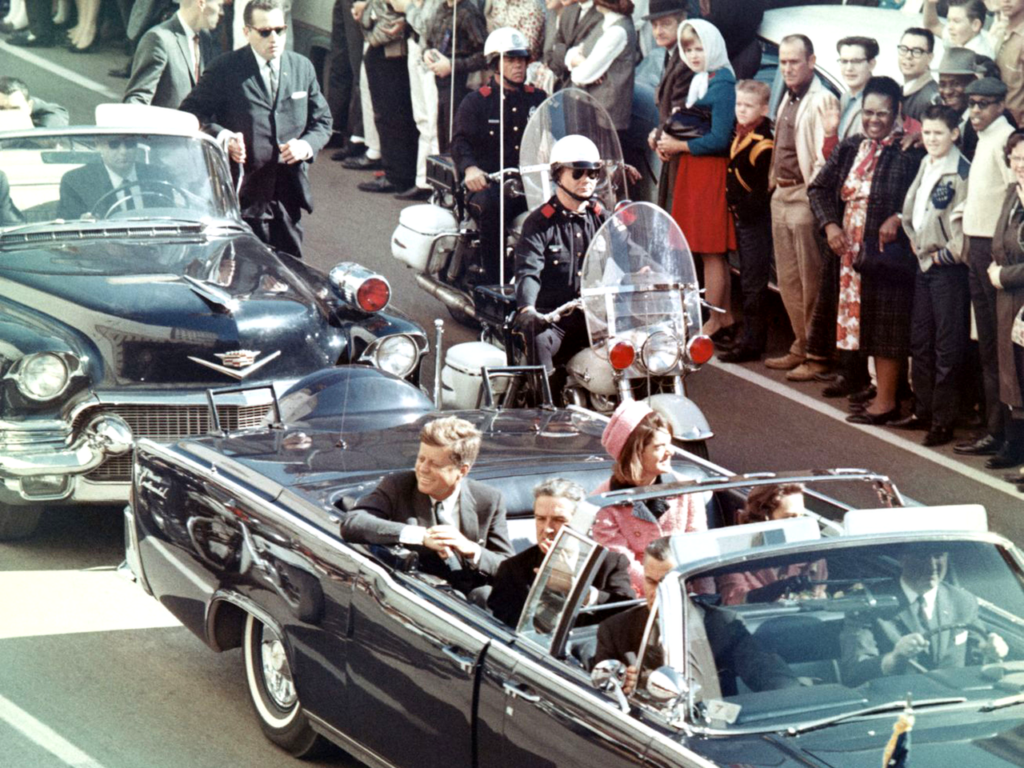
Coming out of the demographic and economic boom decade of the 1950s, the United States of the 1960s quickly confronted many historic events that would shock and dramatically alter the course of humanity. Created in 1961, years before his assassination, The Kennedy Family embodies the optimism and promise of a young, handsome president and his fairytale-like rise to prominence. Nearly a thousand days into his administration, the young president would meet his death in a dramatic and public assassination on November 22nd, 1963 in Dallas, Texas. The image below was captured minutes before the president’s death.
Visual Description: The Kennedy Family
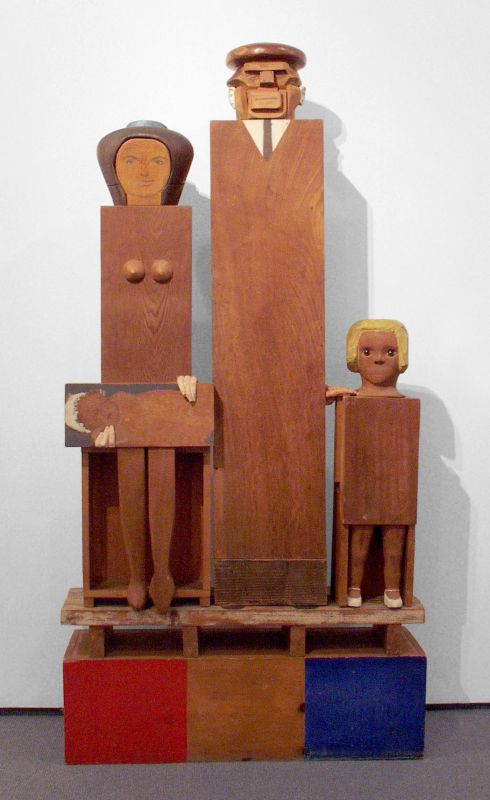
The Kennedy Family by Marisol is a sculpture from 1961. It is made of mixed materials. It measures roughly six and a half feet tall by four and a half feet wide and twelve inches in depth.
The sculpture depicts President John F. Kennedy, First Lady Jacqueline Kennedy and their children, Caroline and John Jr.
The sculpture is primarily made of several rectangular blocks of wood. Starting from its base, a block of wood is painted red on the left-hand side and blue on the right while it is left unpainted in the center. Four small and equally spaced pieces of wood connect the base with a thinner plank of wood. The family stands on this plank. On the left-hand side the First Lady stands while holding the newborn John Jr. Her head is made of a carved piece of wood. She is wearing a small blue pillbox hat. Her face is drawn on to the wood in graphite. Two small round pieces of wood are placed on her torso to resemble breasts. Her torso has no other features and is a solid piece of wood. Her hands are made of white plaster. Three fingers from each hand are visible as they hold the newborn. She holds the newborn at her waist. The newborn is drawn onto a flat plank of wood. He is wearing a white cap and is asleep. From her knees toward her feet, the First Lady is made of a hollowed-out block of wood resembling a cabinet or side table. Her legs are carved out and seem to hover over the pedestal she is standing on.
To her side is the President. He is made of a long rectangular block of mostly unpainted wood. At his neck, a small triangle is painted white with a black stripe resembling a shirt and tie. His head is made of cut pieces of wood placed together with his features drawn on them in graphite. His left hand is made of plaster and is resting on the shoulder of his daughter, Caroline.
Caroline stands on the right-hand side of the pedestal. Her torso is made of a sold piece of unpainted wood. Her head is carved. Her eyes are brown and her ear-length hair is painted yellow. Like her mother, her bottom half resembles a cabinet with her two feet carved out. She is wearing white shoes with small ankle straps.
John Wayne
John Wayne by Marisol will help answer the question of “what?” What about Marisol?
This sculpture was commissioned by and appeared in the December 1963 issue of Life magazine. Life ran an article about the popularity of Westerns in movies and television. At the time, Marisol was already a well-known artist, which probably influenced the magazine’s choice for their artistic needs.
The key words here are “popularity” and “well-known,” as they very simply explain ‘what is Pop art?’ Pop art portrays subjects and images that are instantly recognizable by the masses. In order to do so, pop artists took their references from popular, or pop culture, in its myriad forms. Whether it was the well-worn image of the cowboy, as seen in this sculpture, or Warhol’s famous paintings of soup cans, these were goods and images easily recognized by the millions, as opposed to the few.
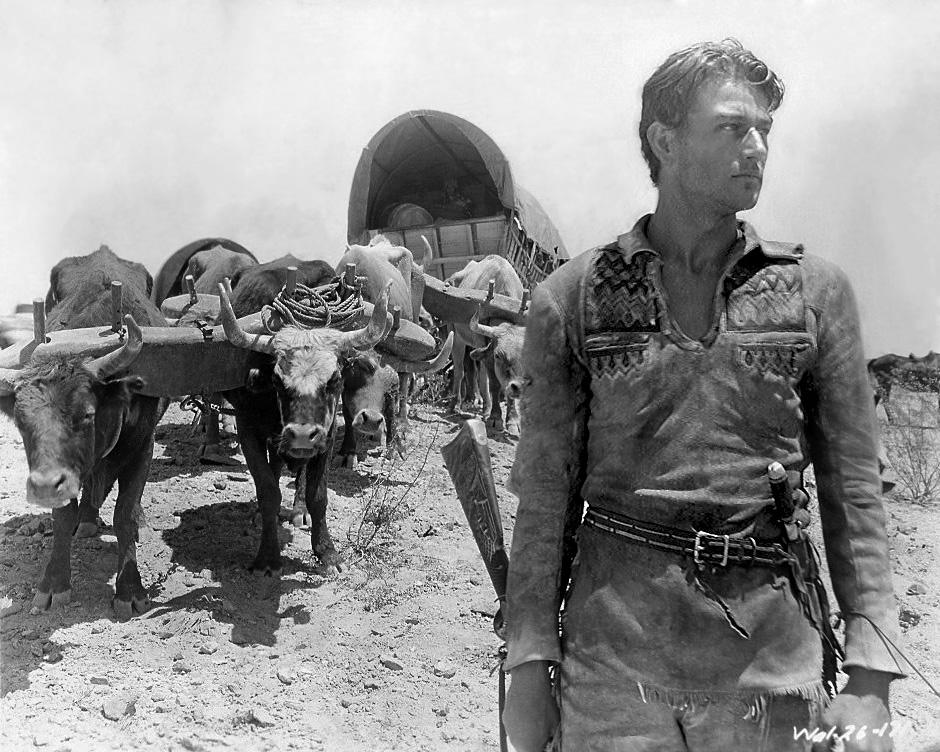
By 1963, John Wayne had starred in Westerns for at least thirty years. Below is an image of him in the 1930 film The Big Trail.
Visual Description: John Wayne

John Wayne by Marisol is a sculpture from 1963. It measures roughly eight feet tall by eight and a half feet wide and fifteen inches in depth. It is made of wood, pencil, oil, paint, plaster, and steel.
The sculpture references and depicts the American actor John Wayne on a horse.
The sculpture is made of various pieces of wood that are joined together to create the full body of the actor. Starting from the top, Wayne is wearing a yellow cowboy hat. His head is a wooden cube and on two of the cube’s sides there are two different depictions of his face drawn in pencil and black paint. The face on the left is in profile and appears to be smiling. His skin is left unpainted, exposing the wood underneath. The face to the right is turned slightly toward the viewer. His black and white eyes are squinting and his mouth appears to be in the process of opening.
Continuing downward, the torso is made of a long rectangular block of wood. Like the face, two sides are drawn on, creating two different torsos. The one on the left is flat and depicts a black tuxedo jacket with a white pocket insert and black tie. The shirt and other small details are left unpainted. The torso to the right is mostly unpainted with just a triangle at the top center, depicting a collar in profile. Fixed to this torso is another piece of wood that becomes the toro’s arm. The wrinkles of a jacket are drawn on to it and it is bent upward. The hand is made of plaster and painted to resemble Caucasian skin tone. It is holding a silver-colored gun.
The following section is a long piece of wood that is cut into the shape of a horse in full stride. All four of its legs are extended. It has no face and is painted red with several smaller green and red dots along its back. The horse’s mane and tail are painted black while its hooves are unpainted. The saddle in which John Wayne is sitting is painted white with a small outline left unpainted. At the top of the saddle and in front of the figure there is a piece of wood sticking up with a plaster hand resting on it.
The legs of the figure are painted onto the wood that makes the horse’s body. They are wearing blue pants. At the waist another hand made of plaster rests while holding a silver gun. Below the knee the legs separate from the wood making the horse’s body. The two legs are separate. He is wearing cowboy boots that are brown. The entire sculpture is held up by a steel rod with legs that is painted black.
Silver Clouds
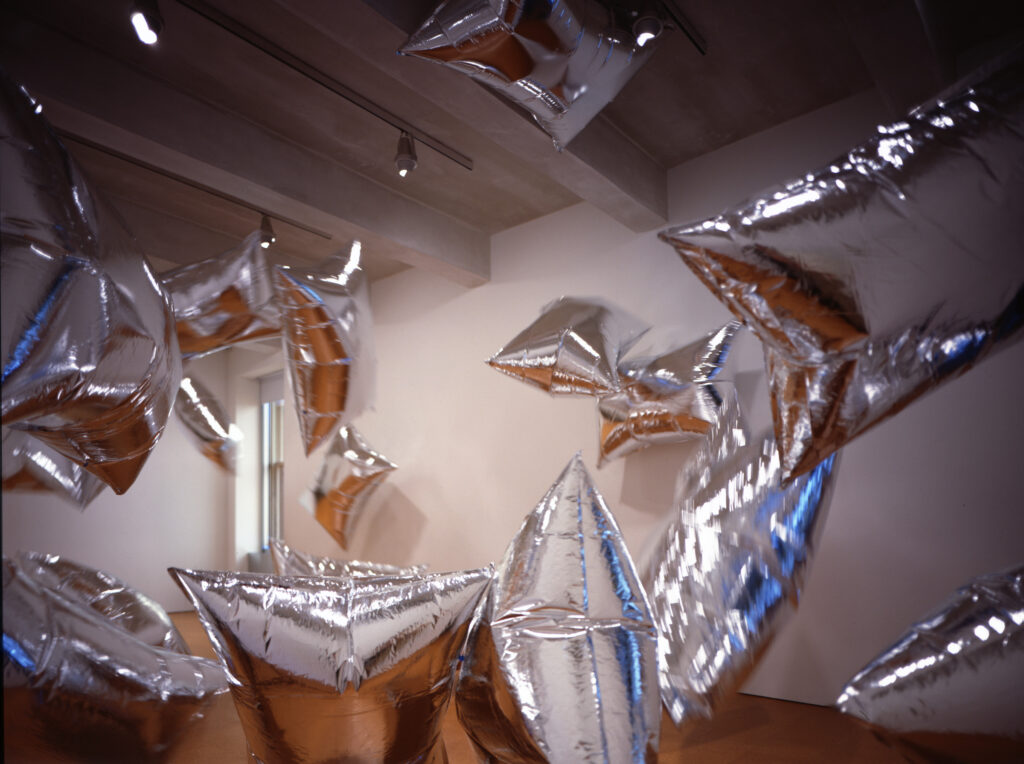
Silver Clouds debuted in 1966 in Andy Warhol’s second solo exhibition at the Leo Castelli Gallery in New York City. This installation is made up of several metallic “floating pillows” which hover in this space thanks to a mixture of air and helium. Marisol also debuted a major installation in 1966, The Party, which can be seen toward the end of this exhibition.
PAMM invites up to three visitors at a time to gently interact with this installation. Please do not strike the art objects in the direction of other visitors and please be courteous. This artwork is on generous loan from The Andy Warhol Museum in Pittsburgh, Pennsylvania.
Silver Clouds by Andy Warhol is an installation piece from 1966. Its dimensions are variable. It is made of light metalized plastic film filled with helium and oxygen.
An installation is a type of art work that attempts to utilize the specific space it is exhibited in to achieve the artist’s goal or vision.
The piece has over a dozen floating objects that resemble pillows. Inside the room, a fan blows on these floating objects, causing them to move across the space. The floating pillows are metallic in finish, causing them to be shiny and reflective. Viewers are allowed and encouraged to interact with the piece, creating an experience that is constantly changing.
The Party
The Party by Marisol will help answer the question of ‘where?’ Where was Marisol?
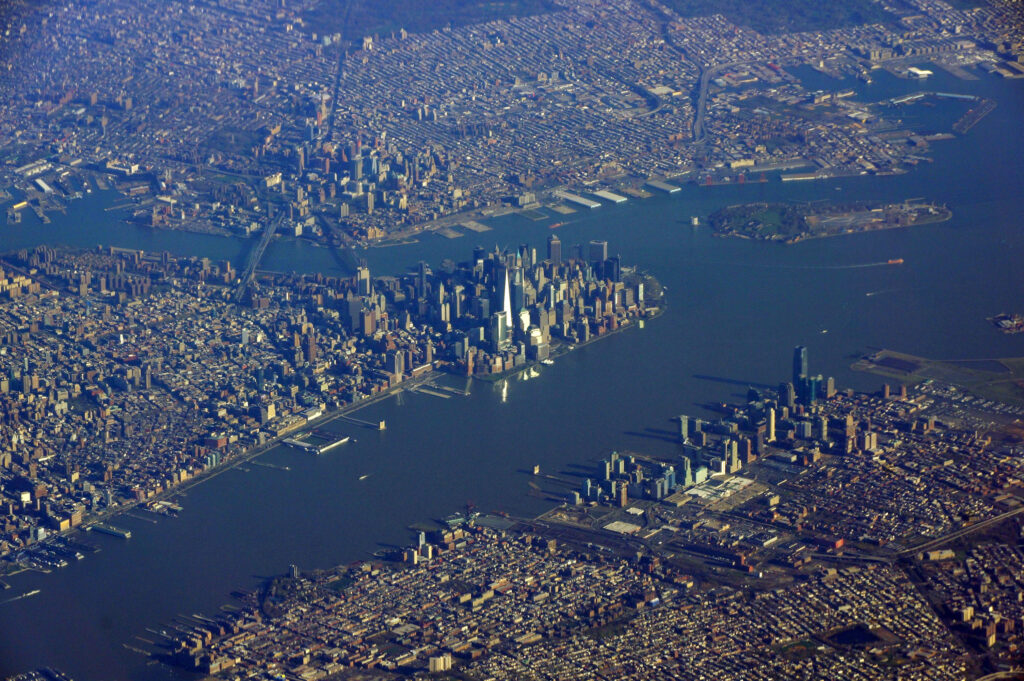
This large assembly of multiple women saw Marisol sculpt herself in a variety of different materials and found objects. The Party debuted in 1966, toward the latter half of Marisol’s time in New York. By 1968 she would leave at the height of her fame for reasons many can only guess at. Her time in New York, however, was shaped not only by her friendship with Andy Warhol, but by the city itself. New York was perhaps the only place in the United States Marisol and Warhol could have crossed paths. In the 1960s, New York City towered over other American cities in social, economic, and cultural areas, much more so than today.
New York’s development as a center of trade grew around its natural harbor and geography, starting in the 1700s. By the 1800s, canals and railroads made New York City the primary destination for goods and immigrants entering the United States. By the middle of the twentieth century, jet transportation and modern finance gave New York City an unchallenged global reach.
Below is an image, looking southeast, of Lower Manhattan and Upper New York Harbor.
Visual Description: The Party
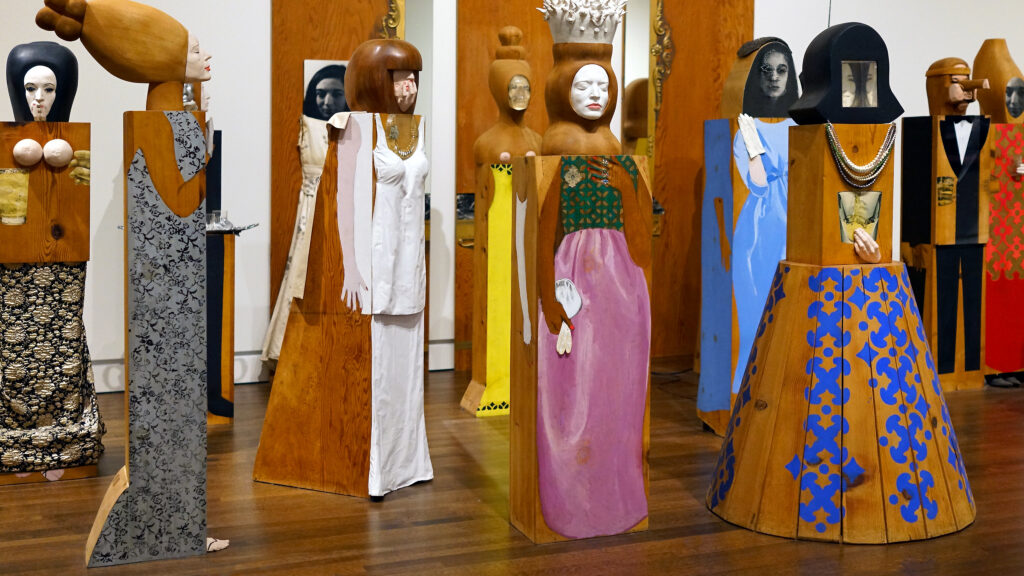
The Party by Marisol is a sculpture made between 1965 and 1966. Its dimensions are variable and it is made of painted and carved wood, mirrors, plastic, clothes, shoes, and television set.
The sculpture depicts fourteen figures gathered for a party.
The sculpture is made of fourteen individual figures made of wood standing in front of a backdrop of an ornate fireplace. The fireplace is made of three panels of rectangular shaped wood that are separated. The two outer panels have a small vertical section of mirror that is outlined by an ornate and gold colored trim. In front of the fireplace fourteen figures are gathered and most of them appear to be women dressed in elegant clothing. Two of the figures appear to be servers as they are holding trays with glass cups on them. While all the figures are decorated differently, they all share a common trait in their construction. Their torsos are made of one to two solid and flat pieces of wooden blocks while their heads are separate and often carved into more complex shapes that resemble hair, headdresses, or hats. The clothing of the figures varies from being actual articles of clothing to being painted and range in color from pinks, yellows, blues, reds, whites, and often untreated and exposed wood. The faces of the figures also vary from pasted images to sculpted plaster and plastic.
Portrait of Sidney Janis Selling Portrait of Sidney Janis
Portrait of Sidney Janis Selling Portrait of Sidney Janis by Marisol, by Marisol will help answer the question of ‘why?’ Why Marisol?
Sidney Janis played a major role in the promotion of Pop artists and their works in 1960s New York. His gallery on East 57th street would be the launch pad for many artists whose names are always mentioned in the same breath as pop art. Artists in PAMM’s collection, like George Segal and Robert Rauschenberg count themselves among those exhibited by Janis. This is also true of both Marisol and Andy Warhol.
However, where Warhol’s fame and stardom rise through the following decades in New York and globally, Marisol is absent from popular memory. Despite early successes in both the world of art galleries, New York social life, and popular media, in 1968, Marisol leaves New York.
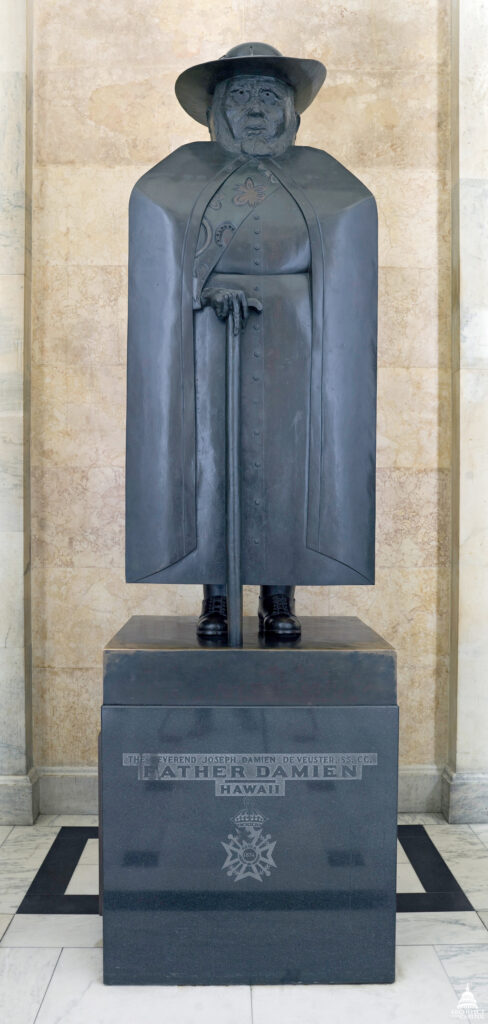
She continued to work in Latin America and in the Pacific, shifting to bronze sculpture and producing more work in the 1970s than ever before. Marisol is one of the few woman artists to have an artwork featured in the United States Capitol as part of the National Statuary Hall Collection. Seen below is her 1969 sculpture of Father Damien, a Catholic priest who lived and work in the state of Hawai’i, is representative of the geographic and material changes in Marisol’s life and work.
Visual Description: Portrait of Sidney Janis Selling Portrait of Sidney Janis
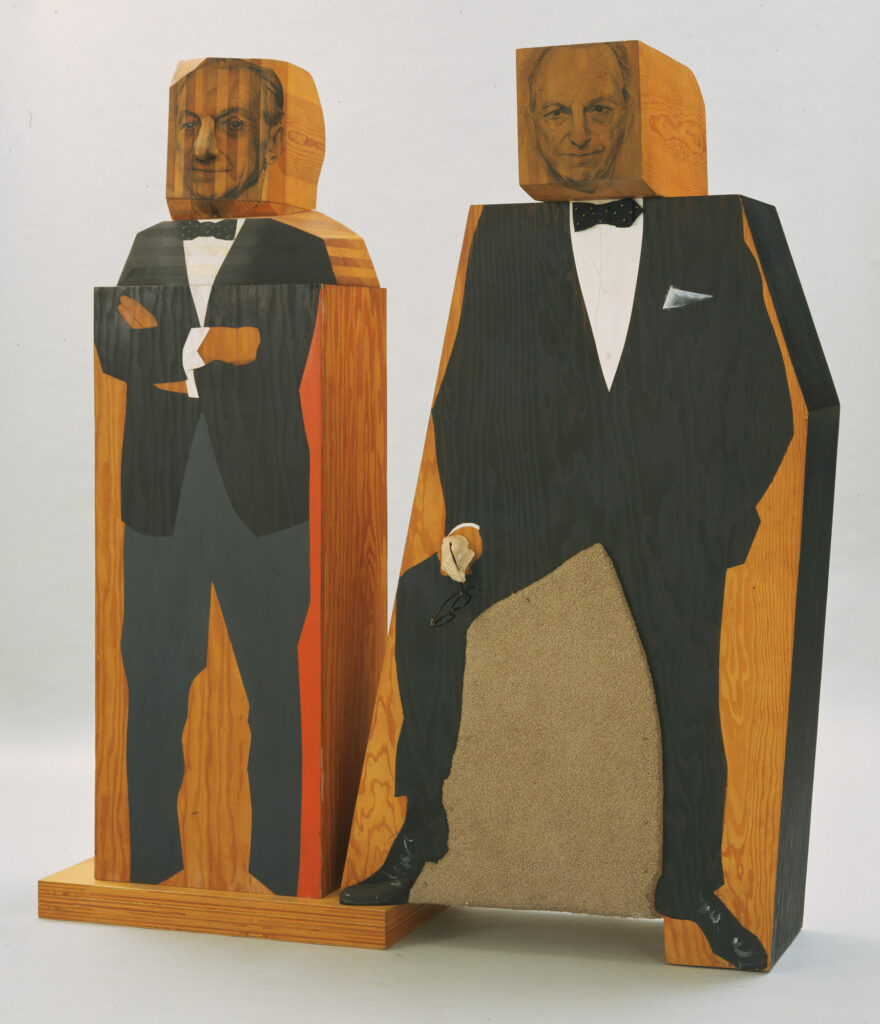
Portrait of Sidney Janis selling Portrait of Sidney Janis by Marisol is a sculpture made between 1967 and 1968. It measures roughly five and a half feet tall by five feet wide and has a depth of roughly two feet. It is made of wood, a bow tie, carpet, eyeglass rims, and plaster.
The sculpture depicts two full body portraits of Sidney Janis standing next to one another.
The portrait on the left is made of four pieces of wood. Starting from the top, the head is carved to give a rough impression of the shape of a head. However, the face is flat. On the flat surface, the face of Sidney Janis is drawn with graphite. The sides of the head are left untreated. Moving down, the shoulders are made of another piece of wood that is also carved into the rough outline of shoulders. The figure is wearing a black tuxedo with white shirt, black bowtie, and black trousers. His hands are crossed and rest against his torso. The third section of wood begins just underneath the shoulders and is flat on all sides. The figure has no feet. The fourth and final section of wood serves as a platform for the sculpture to stand on.
The figure to the right is constructed in a similar way. The head is carved and, on the front facing side which is flat, the face of Sidney Janis is drawn in graphite. The head rests on a large and irregularly shaped block of wood. This large block of wood serves as the entire body of the figure. The body is painted on the flat surface. He wears a black suit with white shirt, white pocket square and black trousers. The bowtie he is wearing is black with small white dots. It is a real bowtie fixed onto the wood. The hand on the left is resting on his knee and is made of plaster. The plaster hand is holding black eyeglass frames. The other hand is hidden inside the pocket of his trousers. The leg on which the figure rests his hand is bent and the foot is resting on the platform of the figure on the left. The shiny black shoe he is wearing protrudes from the flat surface and appears to be a real shoe. The other foot rests on the floor. In between the legs there is a piece of brown carpet cut into the shape the space creates.
Feedback
We hope you enjoyed this Digital Exhibition Guide!
We appreciate you taking the time to submit feedback to us as we strive to make PAMM as engaging as possible. You may submit your feedback anonymously through this form or by emailing us directly at AppFeedback@pamm.org
Related Content



Art Talk: Jessica Beck and Angie Cruz on Marisol


Marisol and Warhol Take New York

