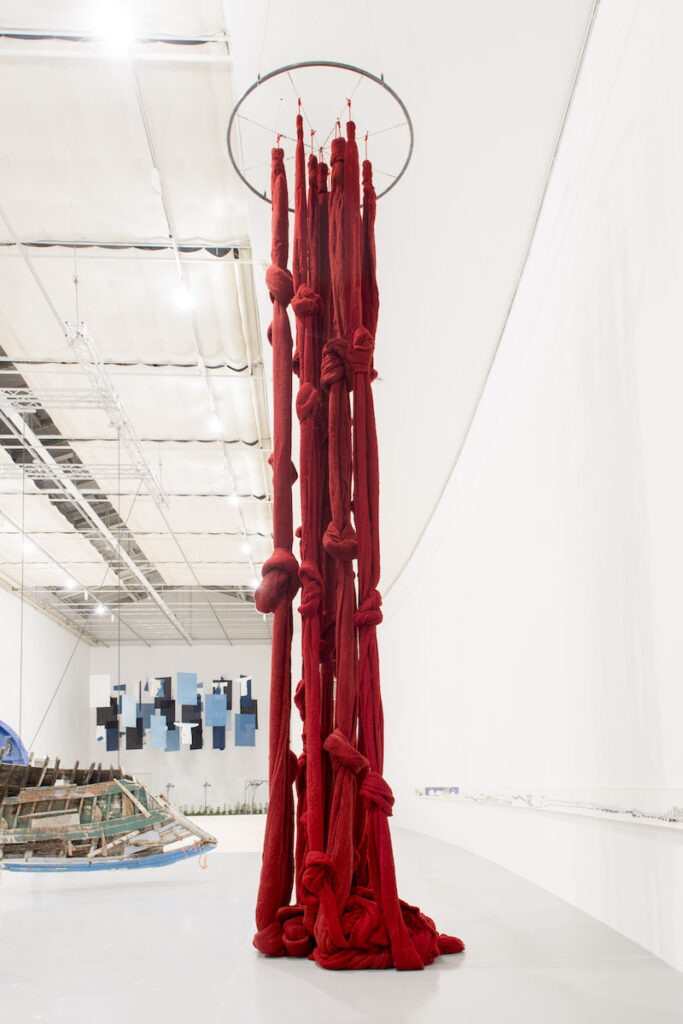
Cecilia Vicuña is a poet and artist who grew up in the Chilean commune of La Florida, in the Maipo Valley. Born to a family of artists and intellectuals, Vicuña grew up hearing about the persecution and incarceration of individuals who struggled for social justice in the wake of increasingly conservative government agendas. While attending the Slade School of Fine Art in London on a British Council Award in 1972–73, a coup d’état led by General Augusto Pinochet, commander-in-chief of the Chilean army, ushered in a seventeen-year military dictatorship. This led Vicuña to remain in London on a self-imposed exile, where she exhibited her work at the Institute of Contemporary Arts and published her first book, Saborami (1973). At the time, she was largely focused on political activism directed against fascism and human rights violations in Chile and other countries.
In 1975, she returned to South America to live in Bogotá, Colombia, where she embarked on a path of creative rediscovery focused on Indigenous art and culture. Vicuña’s interest in the quipu (“knot” in Quechua) was reignited at this time and has remained a constant source of inspiration. A quipu is an ancient Andean communication technology that uses knotted strings to record information, a practice that was banned by the Spanish during the colonization of South America. In 1965, Vicuña first referenced the quipu in her journal in the phrase, el quipu que no recuerda nada (“the quipu that doesn’t remember anything”). Knowledge, wisdom, and memory are embedded in her creative and poetic conception of the quipu, inspiring subsequent iterations and manifestations of this ancient communication device.
Quipu Gut is part of a larger family of red quipu structures the artist has created since Quipu Menstrual in 2006; the color is meant to associate the works with the “blood of the glaciers” destroyed by mining. The red quipus also ruminate on water, blood, and womanhood manifested as poetic strands and energy flows. Quipu Gut (2017), is one of two quipus commissioned for documenta 14; it was shown at documenta Halle in Kassel, Germany; Quipu Womb (2017), the second commissioned work, was shown at the National Museum of Contemporary Art in Athens. Both were created “in honor of a syncretic religious tradition that—via the umbilical cord of menstrual symbolism—connects Andean mother goddesses with the maritime mythologies of ancient Greece. Mythology is spiritually manifest in Vicuña’s self-described “poem in space,” constructed out of fifty large strands of unspun wool, dyed red and knotted rhythmically along its almost thirty-three-foot length, bridging shared histories, Indigenous weaving practices, ritual, and environmental activism.