


The first major institutional Baldessari survey in South Florida brings together nearly 40 works spanning five decades, drawn from the Craig Robins Collection. August 20, 2026–May 9, 2027.
© John Baldessari 1990. Courtesy Estate of John Baldessari © 2025. Courtesy John Baldessari Family Foundation. Courtesy Sprüth Magers.
(MIAMI, FL — June 3, 2026) — Pérez Art Museum Miami (PAMM) is pleased to present John Baldessari: The End of the Line, a major survey spanning five decades of work by one of the most influential figures in conceptual art, opening August 20, 2026. Drawn largely from the Craig Robins Collection, the exhibition marks the first significant institutional presentation of John Baldessari in South Florida and the first iteration of the exhibition in the United States, following presentations in Argentina and Uruguay.
A pivotal figure in postwar contemporary art, John Baldessari (1931–2020) fundamentally redefined what art could be, shifting emphasis away from craftsmanship and technical mastery and toward ideas, language, and systems of meaning. Abandoning a career in traditional painting in the late 1960s, he favored text, found photography, film stills, and appropriated imagery to develop a practice that combined deadpan humor with philosophical rigor to challenge conventions surrounding authorship, originality, and how images convey meaning.
Bringing together nearly 40 works across painting, photography, video, and installation, The End of the Line traces Baldessari’s enduring investigation into the relationship between image and language. Organized across three thematic sections, the exhibition explores the artist’s early foundational works, his serial and experimental photographic methodology, his iconoclastic engagement with mass media and popular culture, and the wide-ranging artistic and literary influences that informed his approach.
Among the exhibition’s early highlights is Clement Greenberg (1966–68), a seminal text painting that encapsulates Baldessari’s challenge to artistic authorship and modernist orthodoxy: rather than painting the work himself, he hired a commercial sign painter to reproduce the opening lines of an essay praising Abstract Expressionism, collapsing distinctions between artist, fabricator, and idea. This radical reconsideration of artistic practice culminated shortly thereafter in Baldessari’s landmark Cremation Project (1970), in which he burned the paintings he had created between 1953 and 1966 and transformed their ashes into commemorative objects, symbolically marking a decisive break from traditional painting and the beginning of a new direction.
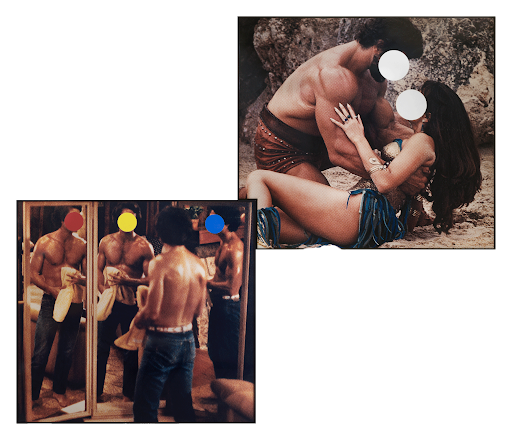
John Baldessari, Kissing Series: Simone. Palm Trees (Near), 1975.
Craig Robins Collection. © John Baldessari 1975. Courtesy Estate of John Baldessari © 2025. Courtesy John Baldessari Family Foundation. Courtesy Sprüth Magers.
The exhibition also foregrounds Baldessari’s groundbreaking use of photography as a conceptual tool. Works such as Blasted Allegories (1978) and Kissing Series: Simone. Palm Trees (Near) (1975) disrupt traditional compositional logic through repetition, fragmentation, and absurd juxtaposition, encouraging viewers to reconsider how meaning is constructed through images.
Throughout his career, Baldessari assembled an expansive visual archive drawn from cinema, advertising, newspapers, and popular culture, freely incorporating appropriated and found imagery into his work. In Miami—a city deeply shaped by spectacle, media, design, and cinematic visual culture—these works take on renewed resonance, offering a sharp and playful reflection on the images that structure everyday life.
Positioned between conceptualism and Pop art, Baldessari profoundly influenced subsequent generations of artists with his blending of intellectual rigor, figuration, and wit. His influence carried through his teaching at California Institute of the Arts and University of California, Los Angeles, where students including Barbara Bloom, Mike Kelley, David Salle, and Tony Oursler would go on to define the ensuing decades.
“I am thrilled that PAMM has the opportunity to present such a significant body of work by John Baldessari, one of the most influential American artists of the 20th century. With three works by Baldessari in PAMM’s collection, this exhibition offers a deeper look at his expansive practice and enduring impact on contemporary art. It is difficult to understand the work of many artists today without acknowledging Baldessari’s radical contributions to image-making, language, and conceptual art,” said José Carlos Diaz, PAMM senior director of curatorial affairs & chief curator.
“Craig Robins began collecting Baldessari’s work in 1993, and in nearly three decades has assembled one of the most significant holdings of his art anywhere in the world, right here in Miami. Baldessari, in turn, made this city part of his practice with the permanent public commissions he created in the Miami Design District in 2014. To bring this exhibition to PAMM feels like a homecoming of sorts, a local story finally told in full, and I look forward to seeing audiences engage with work that has, in many ways, been part of this city for a long time,” said Karen Grimson, curator of the Craig Robins Collection.
John Baldessari: The End of the Line will be accompanied by a bilingual publication with color reproductions of all the works in the show, an illustrated chronology, and essays by Craig Robins, Karen Grimson, José Carlos Diaz, Analia Saban, Alejandro Cesarco, David Lamelas, and Dorit Cypis. The catalogue will be available for purchase at the PAMM Shop.


ABOUT PAMM
Pérez Art Museum Miami (PAMM), led by Sandra and Tony Tamer Director Franklin Sirmans, promotes artistic expression and the exchange of ideas, advancing public knowledge and appreciation of art, architecture, and design, and reflecting the diverse community of its pivotal geographic location at the crossroads of the Americas. The 42-year-old South Florida institution, formerly known as Miami Art Museum (MAM), opened a new building, designed by world-renowned architects Herzog & de Meuron, on December 4, 2013 in Downtown Miami’s Maurice A. Ferré Park. The facility is a state-of-the-art model for sustainable museum design and progressive programming and features 200,000 square feet of indoor and outdoor program space with flexible galleries; shaded outdoor verandas; a waterfront restaurant and bar; a museum shop; and an education center with a library, media lab, and classroom spaces.

