Miami, FL
89°F, light rain
guide
John Baldessari: The End of the Line

Pérez Art Museum Miami presents the first major survey in South Florida devoted to John Baldessari (1931–2020), a leading pioneer of conceptual art. The exhibition brings together forty works spanning painting, photography, video, and installation, drawn largely from the collection of Craig Robins, a close friend and longtime champion of the artist.
This digital guide follows the exhibition’s four parts. It begins with Baldessari’s foundational works from the 1960s, including the 1970 incineration of nearly all the paintings he had made over the previous thirteen years, an act that marked his turn toward conceptual art. From there, it traces his serial approach to photography, his recurring use of text and repetition, and his later sculptural work, each continuing his lifelong investigation into the relationship between language and image.

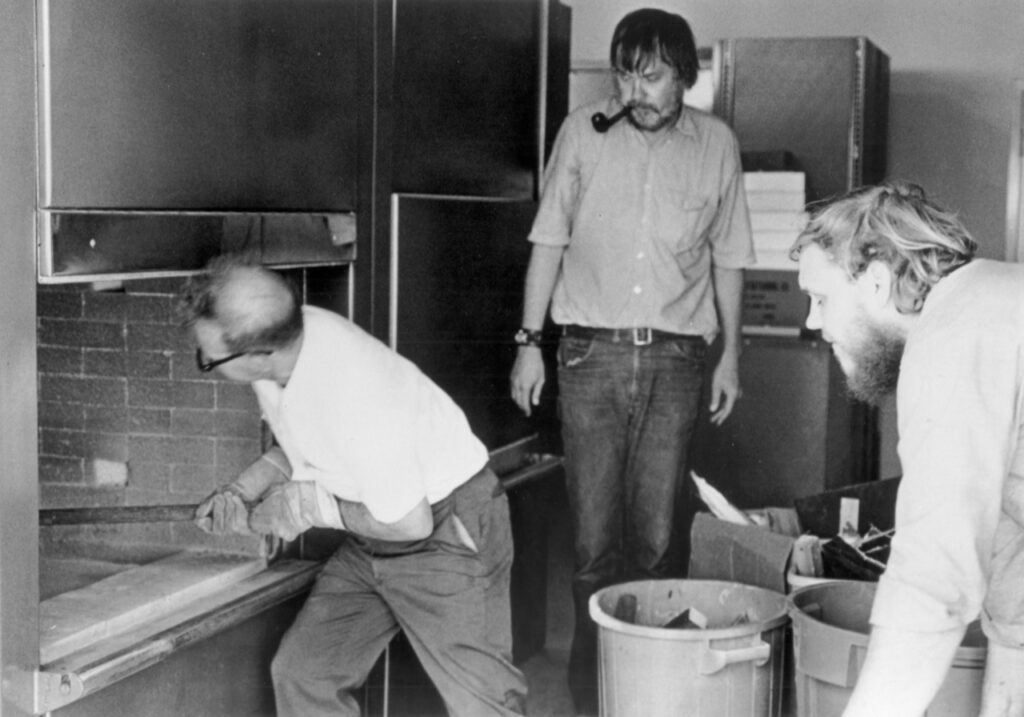
In 1970, John Baldessari and five of his friends took all the paintings the artist had in his possession from 1953 to 1966 and incinerated them. The exact number of paintings that were part of the Cremation Project are unknown, but the ashes filled ten large boxes. The resulting ashes were turned into various objects, including cookies. To understand why an artist would destroy their own work, it is important to understand the landscape of art at that time.
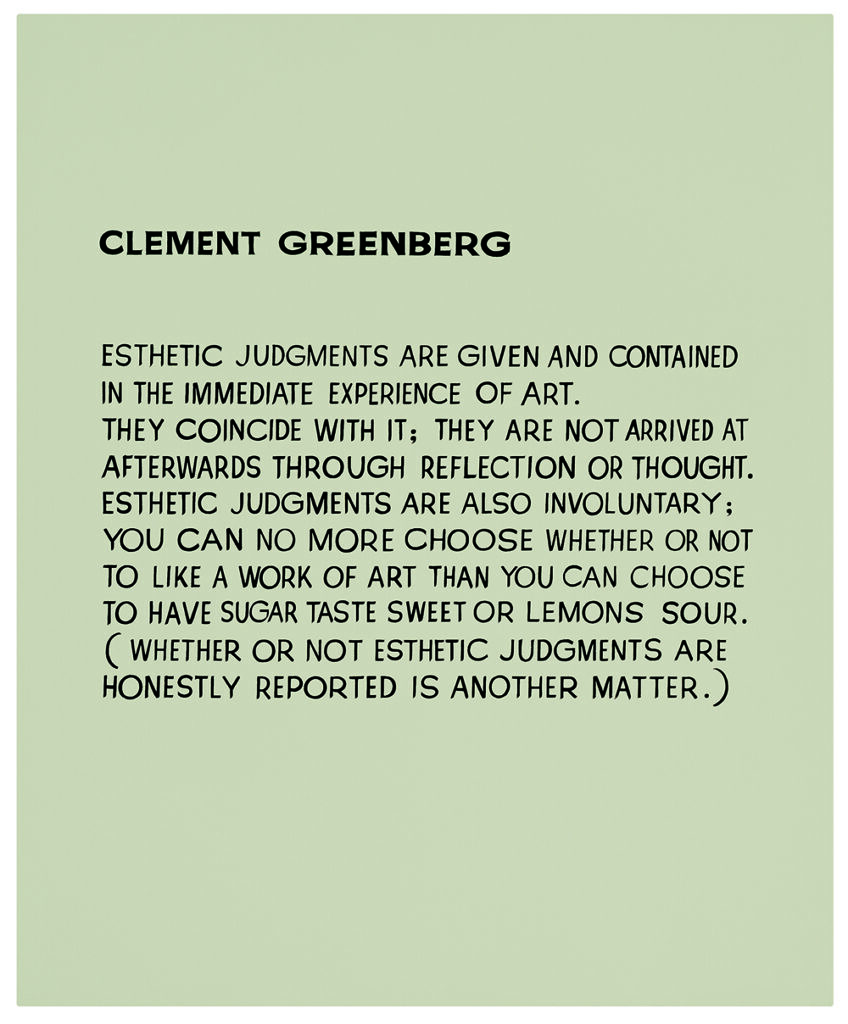
In 1966-68, Baldessari made the piece that greets visitors at the entrance of this exhibition, Clement Greenberg. The piece is a large painting with Greenberg’s name at the top followed by a quote from the famous art critic himself:
ESTHETIC JUDGMENTS ARE GIVEN AND CONTAINED IN THE IMMEDIATE EXPERIENCE OF ART. THEY COINCIDE WITH IT; THEY ARE NOT ARRIVED AT AFTERWARDS THROUGH REFLECTION OR THOUGHT; ESTHETIC JUDGEMENTS ARE ALSO INVOLUNTARY; YOU CAN NO MORE CHOOSE WHETHER OR NOT TO LIKE A WORK OF ART THAN YOU CAN CHOOSE TO HAVE SUGAR TASTE SWEET OR LEMONS SOUR. (WHETHER OR NOT ESTHETIC JUDGEMENTS ARE HONESTLY REPORTED IS ANOTHER MATTER)
Clement Greenberg
What Greenberg argues is that our experience of art has no attachment to our thoughts but that our decision to like or not like a work of art is immediate, involuntary, and innate. Baldessari chose to turn those very words into an art object themselves, in essence using the critic’s words against him by forcing viewers to have no aesthetic connection to the painting but rather an entirely conceptual one. This becomes an example of conceptual artists like Baldessari beginning to question why a painting needs to be a painting at all and what other rules are prescribed to art and language that are arbitrary.
Baldessari’s reaction to the idea that art is defined and prescribed is what led to the realization that the paintings he had made up until that point were following a set of rules he no longer felt were necessary. In questioning why a painting must be a painting at all, it led him to the conclusion that maybe a painting could be a cookie.

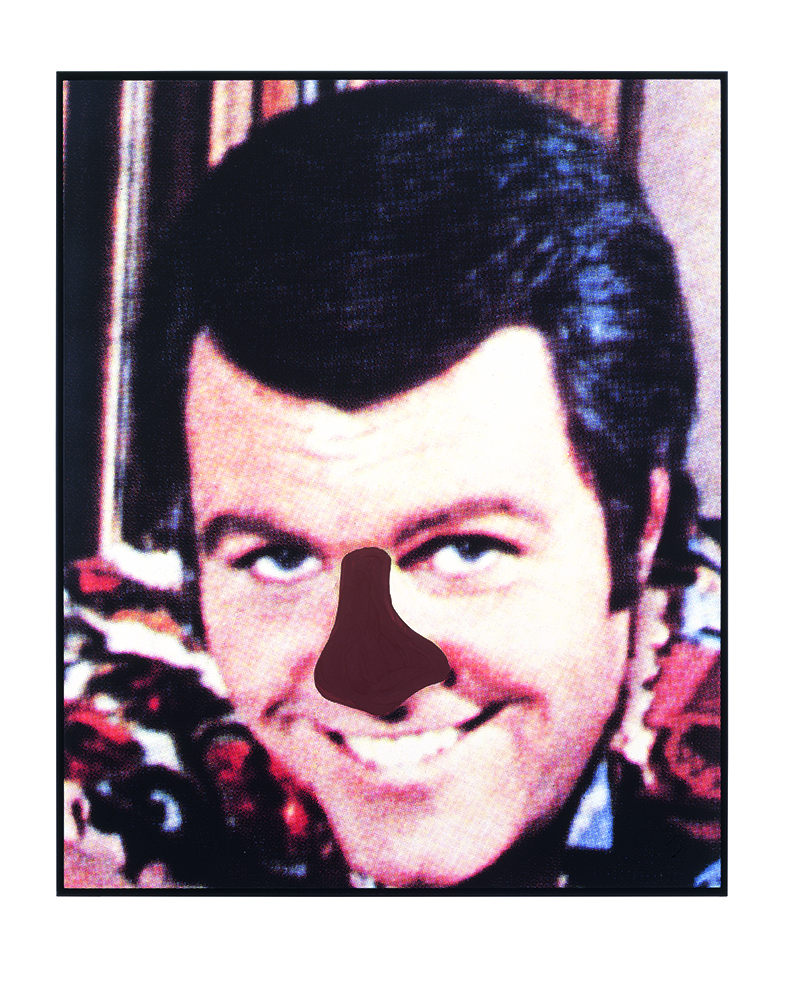
Face (With Brown Nose) by John Baldessari is an artwork made with an inkjet print and acrylic paint on canvas. Created in 2006, the artwork is taller than it is wide, measuring 47¾ inches tall and 38¾ inches wide. A large, close-up photograph of a man’s face fills almost the entire canvas. Over the center of the photograph, a flat area of brown paint covers the man’s nose.
The background is crowded and partly hidden by the man’s head. Along the upper edge, narrow areas of tan, cream, brown, and black can be seen behind him. Similar colors and blurred shapes appear along the left and right sides of the image. The photograph has a grainy surface made up of many tiny colored dots, like an image enlarged from a printed page.
Moving forward, the man’s head fills most of the composition. Thick, dark hair covers the upper part of the image. It is brushed back from his forehead and curves around both sides of his head. His face is brightly lit in shades of pale peach, pink, and cream. Only a small amount of space remains between his head and the edges of the canvas.
Near the center, two dark eyebrows curve above his eyes. His eyes look upward and slightly toward the left side of the image. Dark shadows outline the eyes, while small areas of white make them stand out against his skin. Below, his cheeks curve toward a wide smile. His lips are slightly open, revealing a narrow row of white teeth.
At the center of the face, the man’s nose is completely covered by a solid shape of dark brown acrylic paint. The painted shape sits directly on top of the photograph and follows the general form of a nose. It begins as a narrow, rounded section between the eyes and grows wider as it moves downward. Near the bottom, the shape spreads outward into uneven curves before ending above the man’s upper lip. Unlike the grainy photograph beneath it, the brown area appears solid and smooth, making it stand forward from the printed face.
The brown painted nose becomes a strong point of focus within the image. It blocks an important part of the photographed face while leaving the man’s eyes, hair, cheeks, mouth, and smile visible around it. The contrast between the detailed photograph and the simple painted shape makes the added nose easy to notice, while also changing how the face can be seen.

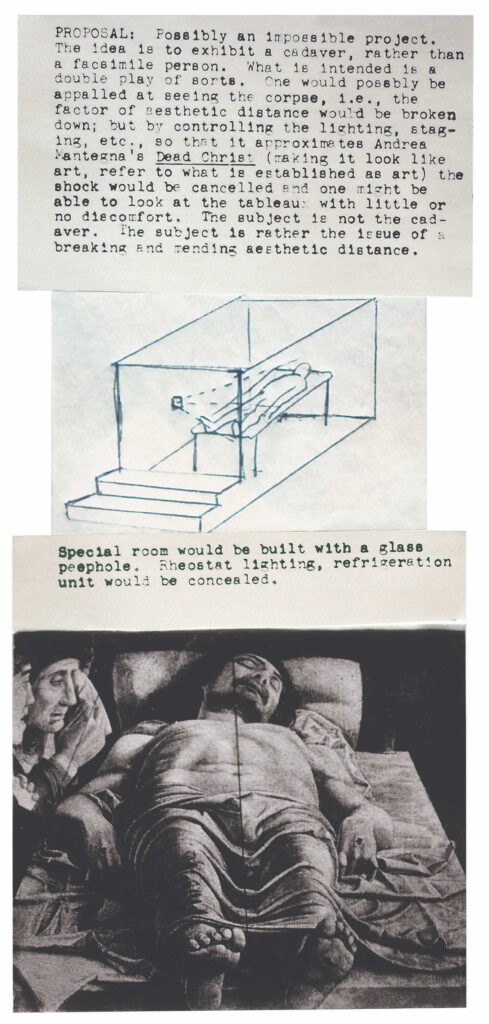
Baldessari’s questioning of art’s rules extended beyond finished works, into proposals for pieces that were never built. Below is the full text of one such proposal, submitted for the 1970 exhibition Information. The text of this work reads:
“PROPOSAL: Possibly an impossible project. The idea is to display a corpse, rather than a human facsimile. What is being attempted is a double play. One could possibly be horrified at the sight of the corpse, in which case the aesthetic distance factor would be broken; but by controlling the lighting, staging, etc., so that it approximates Andrea Mantegna’s Dead Christ (making it look like art, referring to what is established as art) the stupor would be canceled, and one could look at the scene without, or with little discomfort. The issue is not the corpse. The issue is, rather, the question of breaking and repairing aesthetic distance. A special room would be built with a glass peephole. Rheostat lighting and cooling would be hidden.”
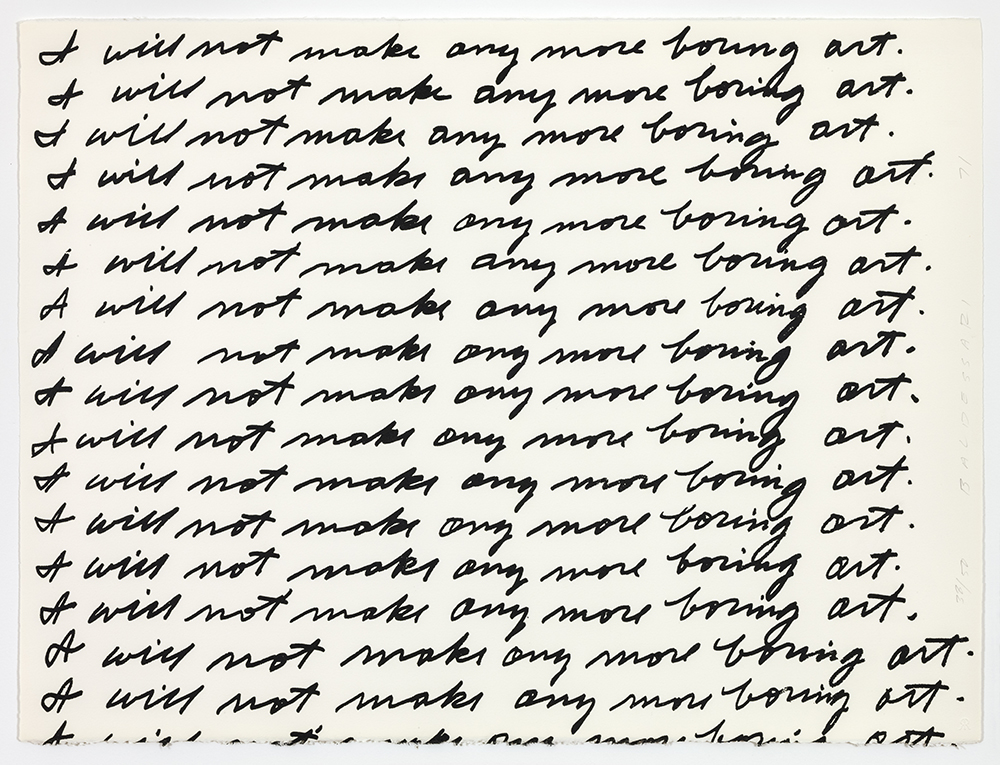
The year following the cremation of his paintings, Baldessari created a piece with a simple declarative statement: I Will Not Make Any More Boring Art. Instructing students at the Nova Scotia College of Art and Design to cover gallery walls with the statement, and then to make prints of the photographs. The act of asking someone else to make the art continued the questioning of the nature of art that Baldessari started with pieces like Clement Greenberg and The Cremation Project. By separating himself from the process of making the physical object, he continued to question if art was the object or the idea itself. This question about the nature of art is the foundation of conceptual art and one that continues to be asked by artists today.
Many in Miami will remember the piece Comedian by Maurizio Cattelan. The infamous banana duct taped to the wall at the 2019 edition of Art Basel Miami. This piece is an example of contemporary conceptual art that continues with the legacy of artists like John Baldessari who questioned the nature of art and its rules while implementing comedy.
The comedy in I Will Not Make Any More Boring Art comes from its contradiction. He instructs students to repeat a boring and menial task repeatedly. This repetitive process creates a piece of art that is then visually boring while declaring that it isn’t. The video version of the work shows Baldessari writing the phrase himself in a notebook repeatedly as well, almost as if doubling down on boredom. What adds yet another layer to the work is the relationship the task of writing a phrase repeatedly has within education. It serves as a form of punishment. In this case, it becomes a criticism of what art education does to artists as it forces them to adhere to rules and practices that Baldessari saw as arbitrary.

I Will Not Make Any More Boring Art is a vinyl wallpaper copy of a lithograph created by John Baldessari in 1971. The work changes size depending on where it is installed. In this installation, the main work consists of black cursive text that appears to be handwritten on a cream background spanning floor to ceiling. The text “I will not make any more boring art” is repeated and arranged in the composition book style, row above row. Each word in the repeated sentences has varied shapes and sizes, giving the feeling of being done by hand.
Two screens (CRT TV monitors) also accompany the work, playing video works. If you are facing the work to your left side is the screen with the work title “I Am Making Art” 1971, where the artist Baldessari stands centered on the screen with a white backdrop where he repeats the name of the work “I Am Making Art” for 2 minutes while moving his body into various positions, and to the right the work titled “Baldessari Sings LeWitt” 1972 where the artist sits in front of the camera and sings sentences written by American artist Sol LeWitt about conceptual art. The Repositories, a multi-object case, is included with these two video works and stands in front of the artwork.
In its original iteration, after being invited to exhibit his work by Nova Scotia College of Art and Design, Halifax, the artist proposed that art students at the school assist him in the creation of this work and write “I will not make any more boring art” on the gallery walls for the duration of the exhibition. Having the students participate in this way was Baldessari’s attempt at critiquing art schools and how they encourage students to imitate and not experiment and innovate.
The transcript below is the full audio from Baldessari Sings LeWitt, in which the artist performs Sol LeWitt’s 1969 “Sentences on Conceptual Art.” LeWitt’s sentences were widely circulated among conceptual artists at the time, and Baldessari’s decision to sing them, rather than read or exhibit them as text, extends the same interest in language and performance seen throughout I Will Not Make Any More Boring Art.
I'd like to sing for you some of these sentences that Sol LeWitt has written on conceptual art. I feel this is a tribute to him in that I think that these sentences have been hidden too long in the pages of exhibition catalogs and that perhaps that by my singing them for you, it'll bring these sentences to a much larger public.
I'll use the same ordering and numbering that he has. I'll try to pause between each statement for clarity. It may be that occasionally I'll have to sing one sentence over more than once and that I might not get the phrasing correct.
Conceptual artists are mystics rather than rationalists. They leap to conclusions that logic cannot reach.
Number 2: Rational judgments repeat rational judgments.
Number 3: Illogical judgments lead to new experience.
Number 4: Formal art is essentially rational.
Number 5: Irrational thoughts should be followed absolutely and logically.
Number 6: If the artist changes his mind midway through the execution of the piece he compromises the result and repeats past results.
Number 7: The artist's will is secondary to their process he initiates from idea to completion. His willfulness may only be ego.
Number 8: When words such as ‘painting’ and ‘sculpture’ are used, they connote a whole tradition, and apply a consequent acceptance of this tradition, thus placing limitations on the artist, who would be reluctant to make art that goes beyond the limitations.
Number 9: The concept and idea are different, doo dah, doo dah. The former implies a general direction while the latter are the components. Ideas implement the concept.
Maybe that wasn't too clear and I should do it over. The concept and idea are different, doo dah, doo dah. The former implies a general direction, while the latter are the components. Ideas implement the concept.
I'll try it again.
The concept and idea are different, doo dah, doo dah. The former implies a general direction, while the latter are the components. Ideas implement the concept.
Number 10: Ideas alone can be works of art. They are in a chain of development that may eventually find some form. All ideas need not be made physical.
Number 11: Ideas do not necessarily proceed in logical order. They may set one off in unexpected directions. But an idea must necessarily be completed in the mind before the next one is formed.
Number 12: For each work of art that becomes physical, there are many variations that do not.
Number 13: A work of art may be understood as a conductor from the artist's mind to the viewers. But it may never reach the viewer, or it may never leave the artist's mind.
Number 14: The words of one artist to another may induce an idea's chain, if they share the same concept.
Number 15: Since no form is intrinsically superior to another, the artist may use any form, from an expression of words written or spoken, to physical reality equally.
Number 16: If words are used, and they proceed from ideas about art, then they are not --then they are art and not literature. Numbers are not arithmetic.
Maybe I should do that one again, too.
Number 16: If words are used, and they proceed from ideas about art, then they are art and not literature. Numbers are not arithmetic.
Number 17: All ideas are art if they are concerned with art and fall within the conventions of art.
Number 18: One usually understands the art of the past by applying the conventions of the present, thus misunderstanding the art of the past.
Number 19: The conventions of art are altered by works of art.
Number 20: Successful art changes our understanding of conventions by altering our perceptions.
Number 21: Perception of ideas leads to new ideas.
Number 22: The artist cannot imagine his art and cannot perceive it until it is complete.
Number 23: One artist may misperceive, understand it differently than the artist, a work of art, but still be set off in his own chain of thought by that misconstrual.
Number 24: Perception is subjective.
Number 25: The artist may not necessarily understand his own art. His perception is neither better nor worse than that of others.
Number 26: An artist may perceive the art of others better than his own.
Number 27: The concept of a work of art may involve the matter of the piece, or the process in which it is made.
Number 28: Once the idea of the piece is established in the artist's mind a final form is decided, the process is carried out blindly. There are many side effects that the artist cannot imagine. These may be used as ideas for new works.
Maybe I should do that one again too.
Once the idea of the piece is established in the artist's mind and the final form is decided, then the process is carried out blindly. There are many side effects that the artist cannot imagine. These may be used as ideas for new work.
Number 29: The process is mechanical and should not be tampered with. It should run its course.
Number 30: There are many elements involved in the work of art. The most important are the most obvious.
Number 31: If an artist uses the same form in a group of works and changes the material, one would assume the artist's concept involved the material.
Number 32: Banal ideas cannot be rescued by beautiful execution.
Number 33: It is difficult to bungle a good idea.
Number 34: When an artist learns his craft too well, he makes slick art.
Maybe that was too fast.
Number 34: When an artist learns his-- when-- when an artist learns his craft too well, he makes slick art.
Number 35, and the last one: These sentences comment on art, but are not art.
Thank you.
John Baldessari. Baldessari Sings LeWitt, 1972. Black-and-white video, with sound, 12 min., 38 sec. © 1972–2026 John Baldessari Family Foundation. Courtesy Estate of John Baldessari; Sprüth Magers; Electronic Arts Intermix, NY
“Thinking about art history, it seems that lips and eyeballs have been getting a lot of attention, but I haven’t seen many examples of ears and noses. I suppose they just don’t separate very well. I mean, floating eyeballs and lips seems to work okay, but not noses and ears, so I decided to free the nose and ear.”
John Baldessari in conversation with Hans-Ulrich Obrist, Miami, 2006
© 2006–2026 John Baldessari Family Foundation. Courtesy Estate of John Baldessari; Sprüth Magers
Continuing with the questions his work raised about the nature of art and perception, Baldessari began to obscure the faces in images he had gathered from photographs, newspaper clippings, screen captures, and more. His most recognizable work exploring this idea are his pieces of dots on faces. Baldessari even said, “A hundred years from now, I will probably be remembered as the guy who put dots on faces.” In a similar vein, the pieces in this exhibition Face (With Brown Nose) and Face (With Blue Nose) from 2006, continue to explore what we pay attention to and ignore in images. By adding color to the nose, it becomes an abstraction and essentially removed from the face and this process makes an otherwise ignored facial feature the primary focus of the piece. Baldessari, who spent much of his career teaching, would often tell his students not to look at things but to look in-between things. By taking his own advice, Baldessari continued the process of questioning the rules of art, language, and the nature of perception that became prevalent in his work in 1966.

Clement Greenberg by John Baldessari is an artwork made with Acrylic on framed canvas, approximately 68 inches tall x 56 inches wide. The work is a conceptual text painting featuring hand-painted, lettered text quoting the influential art critic Clement Greenberg on the involuntary and immediate nature of aesthetic judgments.
The text reads:
“CLEMENT GREENBERG
ESTHETIC JUDGMENTS ARE GIVEN AND CONTAINED IN THE IMMEDIATE EXPERIENCE OF ART.
THEY COINCIDE WITH IT, THEY ARE NOT ARRIVED AT AFTERWARDS THROUGH REFLECTION OR THOUGHT, ESTHETIC JUDGEMENTS ARE ALSO INVOLUNTARY, YOU CAN NO MORE CHOOSE WHETHER OR NOT TO LIKE A WORK OF ART THAN YOU CAN CHOOSE TO HAVE SUGAR TASTE SWEET OR LEMONS SOUR. (WHETHER OR NOT ESTHETIC JUDGEMENTS ARE HONESTLY REPORTED IS ANOTHER MATTER.) “
In 2002, Baldessari created a series of works titled Repository using the shape of a ceramic bedpan. The works were made in different color combinations, including orange and blue, red and green, and violet and yellow. The bedpan is an everyday medical object that was designed to hold bodily waste. By recreating the object in ceramic and presenting it as a sculpture, Baldessari changed its original purpose and placed it within the context of art. The title Repository refers to a place where something is stored or kept, connecting the name of the work to the original function of the object.
The use of an everyday object in Repository can be connected to Marcel Duchamp and his readymades. Duchamp famously presented ordinary manufactured objects as art by placing them in an artistic context. Baldessari continued this questioning of what can be considered art by using an object that would normally have little connection to the art world. This approach also connects Repository to Baldessari’s earlier works like Clement Greenberg, I Will Not Make Any More Boring Art, and Face (With Brown Nose). Repository continues this movement away from traditional painting by using an everyday object as the artwork itself.
The use of the bedpan also continues Baldessari’s use of comedy in his work. The choice to present an object related to human waste is deliberate. However, the work is not only about the humor of displaying a bedpan. Like many of Baldessari’s works, the humor helps him question the rules surrounding art. By taking an object that was made for a specific practical purpose and presenting it as art, he continues to ask the question that appears throughout his work and this exhibition: what makes something art?

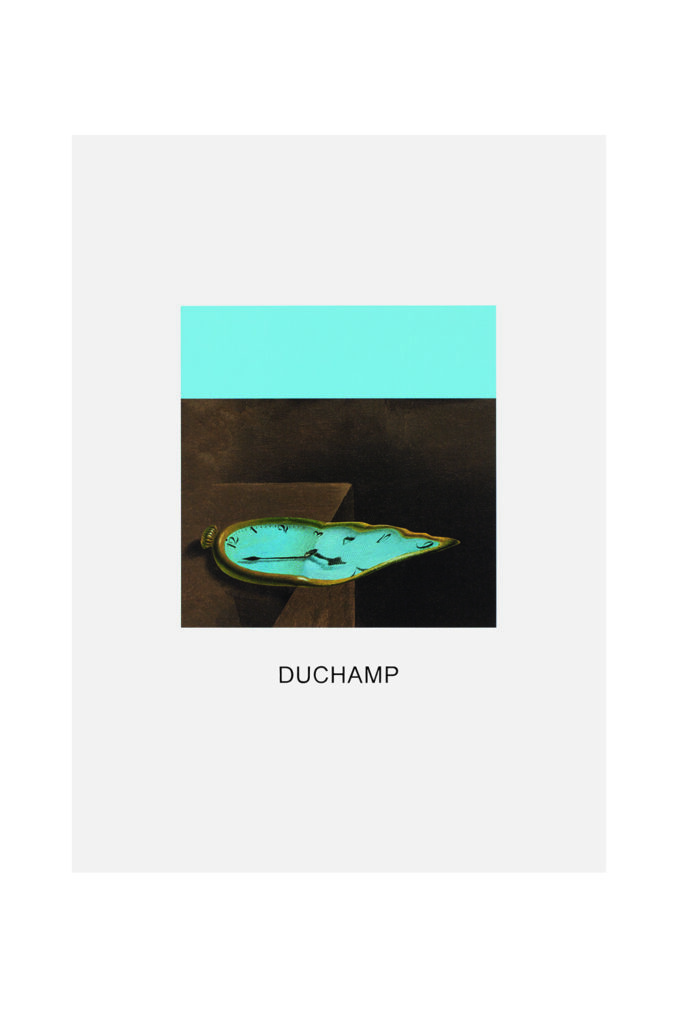
Double Vision: Duchamp is an artwork by John Baldessari made with an inkjet print and enamel paint on canvas. Created in 2011, the artwork is taller than it is wide, measuring 74½ inches tall and 54 inches wide. A large white border surrounds a smaller printed image near the center of the canvas. Below the image, a single word is printed in black letters. The artwork combines printed and painted surfaces, giving it the appearance of both a painting and a printed poster.
The background begins with a large white area that fills most of the canvas. This wide white border frames the image on all four sides, leaving open space above, below, and along each edge. The smooth white surface draws attention toward the picture in the center.
Near the middle of the canvas is a rectangular image. Across the top is a bright blue rectangle that looks like a clear sky. Below is a dark brown space that fills the lower half of the picture. A straight horizontal line separates the blue and brown areas, creating a simple background.
Moving into the scene, a brown platform extends from the left side of the image. Its straight edges and angled surfaces suggest the corner of a table, shelf, or pedestal. Areas of light and shadow give the object the appearance of depth.
Resting across the platform is a pocket watch that looks soft and melted instead of hard and round. The watch stretches from left to right, with about half of its body resting on the brown platform and the other half extending beyond its edge, suspended in the dark space of the picture. This position makes the watch appear to balance across the edge of the platform. A thin gold border outlines its uneven shape. On the left side is a small winding knob, while the right side narrows into a pointed tip.
The face of the watch is painted a bright turquoise blue. Its color is similar to the clear blue sky above, creating a repeated area of blue within the image. Black numbers curve around the edge of the clock, following its stretched shape. Two thin black clock hands rest across the center of the face. Because the watch appears to melt, the numbers and hands no longer sit inside a perfect circle. The smooth blue surface stands out against the dark brown background.
Below the image, centered within the white border, is the word “DUCHAMP” printed in bold, black, capital letters. The single word sits alone in the open white space beneath the picture, much like a title beneath a photograph or poster.
We hope you enjoyed this Digital Exhibition Guide!
We appreciate you taking the time to submit feedback to us as we strive to make PAMM as engaging as possible. You may submit your feedback anonymously through this form.