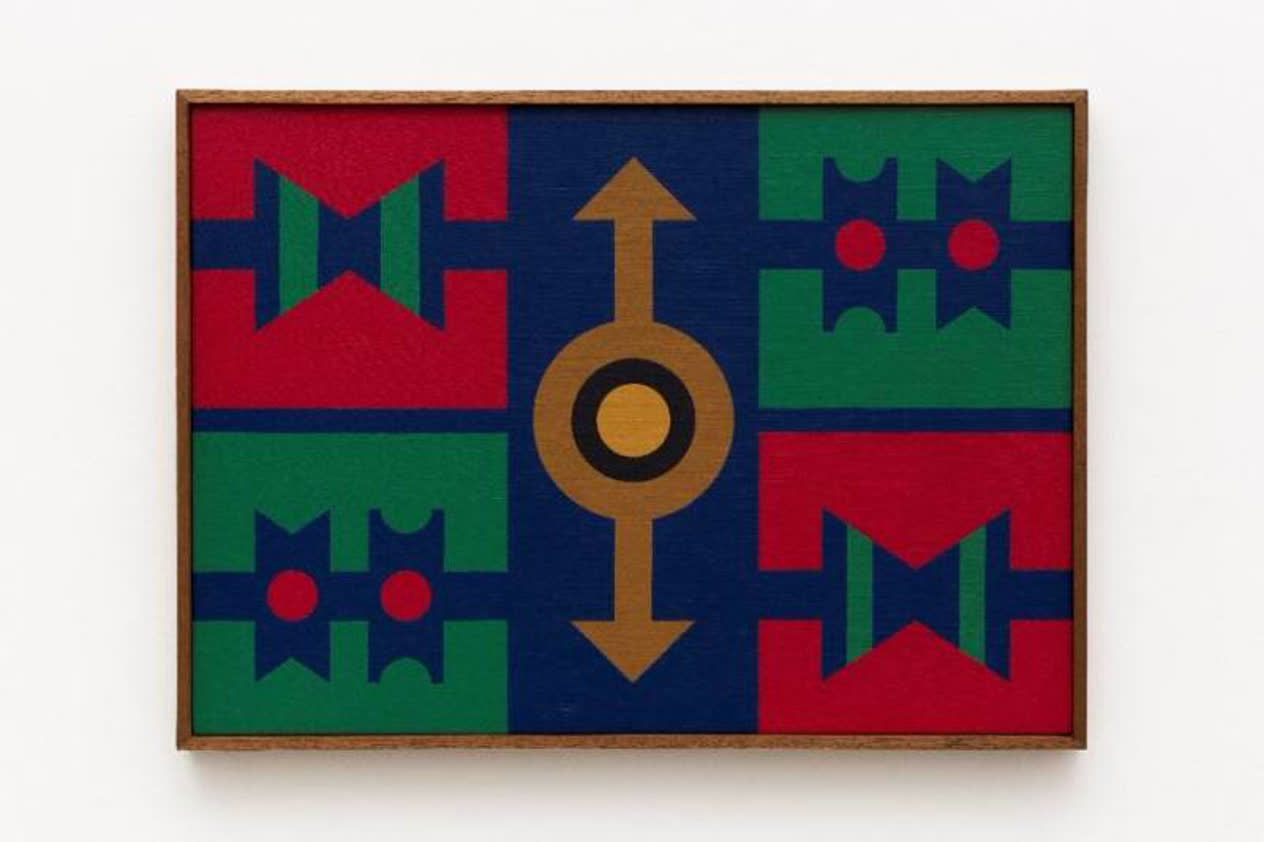
Rubem Valentim Emblema 79 (Emblem 79) 1979
© Rubem Valentim. Courtesy the artist and Mendes Wood DM São Paulo, Brussels, New York

Brazilian painter and sculptor Rubem Valentim began his career as a self-taught artist. In the 1950s, he started to observe the geometric symbols found in the realm of Afro-Brazilian religions and comparing them to modern, constructivist geometric forms. In this way, the artist delved deep into the European artistic language that controlled the art production in Brazil in order to generate a new language that blended geometric abstraction, constructivism, and concretism with drawings and diagrams of the deities from Afro-Brazilian religions—known as orishas.
In Emblema 79 (1979), Valentim creates a balanced and almost symmetrical composition with pure and strong chromatic investigations. The circular shape in the center is perhaps a reference to Orula—the orisha of divination and supreme oracle, representing wisdom and intelligence—while the triangles pointed at each other is a direct reference to Shango’s double-edged axe. Valentim fully and ambitiously undertook the renowned 1928 Manifesto antropofágico (Anthropophagic Manifesto) —an essential Brazilian modernist text by Oswald de Andrade (1890–1954) that suggests native intellectuals and artists to eat and digest the European influences in order to create hybrid Brazilian works that merged indigenous, African and European references. By following this thought process, Valentim executed a radical approach in the history of Brazilian art, subjecting the European language to an Afro-Brazilian culture while generating a powerful symbolic vocabulary of decolonization.
Identification
Title
Emblema 79 (Emblem 79)
Production Date
1979
Object Number
2020.010
Credit Line
Collection Pérez Art Museum Miami, museum purchase with funds provided by Jorge M. Pérez
Copyright
© Rubem Valentim. Courtesy the artist and Mendes Wood DM São Paulo, Brussels, New York
https://www.pamm.org/en/artwork/2020.010
Copy artwork link
Physical Qualities
Medium
Acrylic on canvas
Dimensions
19 3/4 x 27 1/2 inches