Daniel Lind-Ramos Vencedor #2, 1797 (Victor #2, 1797 ) 2017–20
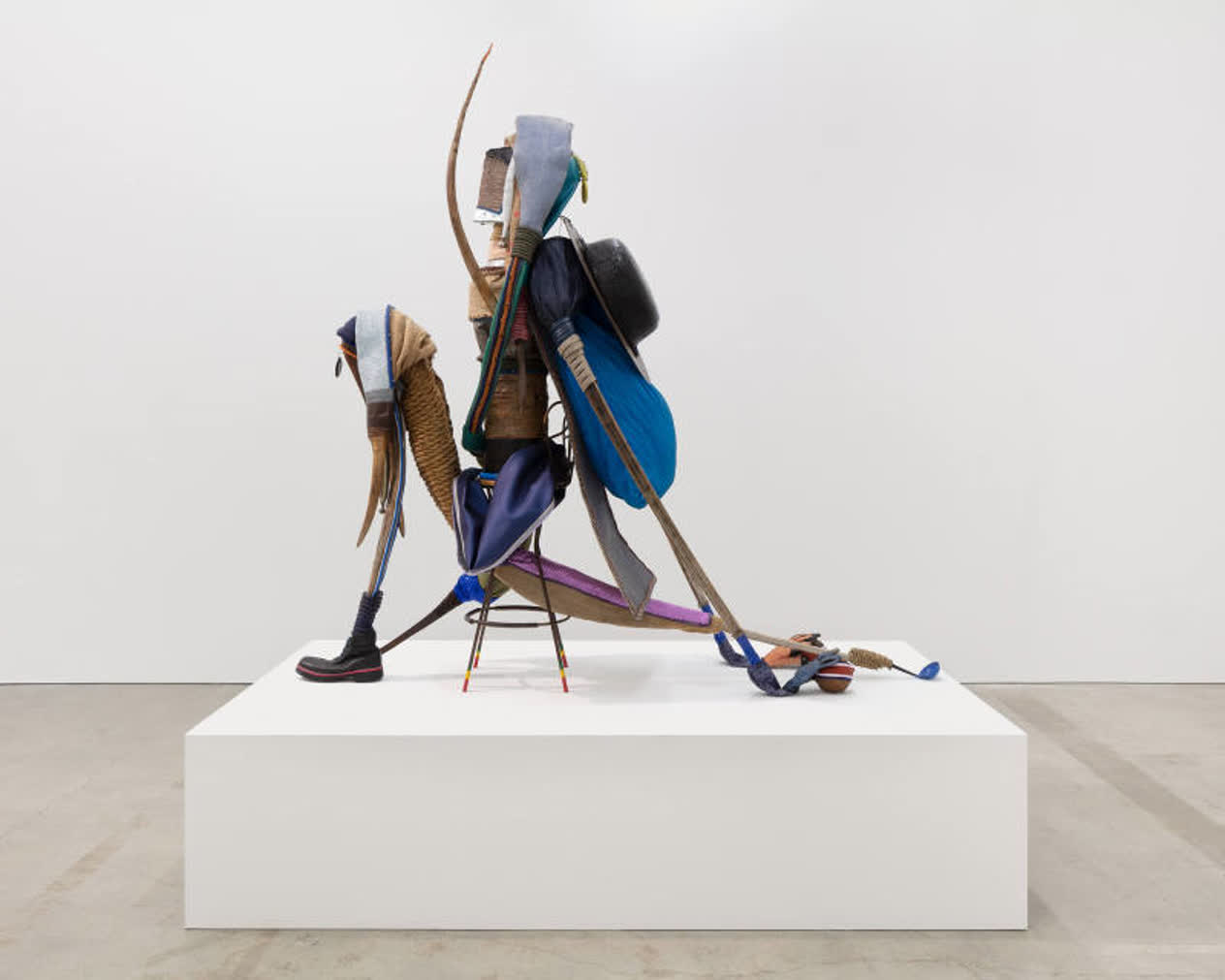
© Daniel Lind-Ramos. Photo: Pierre Le Hors

Daniel Lind-Ramos’s assemblage works embody the legacy of the African diaspora in Latin America and the Caribbean. Lind-Ramos takes on a subject that is under-explored in mainstream Latin American and Caribbean cultures, pointing to specific communities and historical events that have global implications for the region. His installations and sculptures are made with found organic and industrial materials gathered from the coastline of his hometown of Loíza, a predominantly Black town in Puerto Rico. Merging African political, mystical, and spiritual motifs from the area, Lind-Ramos’s dynamic sculptures honor the role black people have played in Latin America and the Caribbean.
Vencedor #2, 1797 (Victor #2, 1797) is a large-scale assemblage sculpture of a warrior commemorating the successful 1797 battle in which free Black soldiers, fighting alongside Spanish soldiers, defeated a British attempt to take control of Puerto Rico. The sculpture presents a warrior who appears to be kneeling while holding the blade of a machete. Lind-Ramos used found materials, referencing the economies and cultures of that community, which are still prevalent today, such as coconut, charcoal, metals, textiles, and Afro-Caribbean religious objects. The artist focuses on a very specific political history to highlight the contributions that Black people have made to our cultures. Highlighting Caribbean narratives, Vencedor pays homage to a group of Black soldiers who stood up to the most powerful military in the world at that time in an attempt to preserve their freedom.
Identification
Title
Vencedor #2, 1797 (Victor #2, 1797 )
Production Date
2017–20
Object Number
2020.205
Credit Line
Collection Pérez Art Museum Miami, museum purchase with funds provided by Jorge M. Pérez
Copyright
© Daniel Lind-Ramos. Photo: Pierre Le Hors
https://www.pamm.org/en/artwork/2020.205
Copy artwork link
Physical Qualities
Medium
Steel, aluminum, nails, palm tree branches, dried coconuts, branches, palm tree trunks, burlap, machete, leather, ropes, sequin, awning, plastic ropes, fabric, pins, duct tape, and acrylic
Dimensions
70 x 70 x 33 inches
Visual Description
Vencedores 1797 #2 (Victors 1797 #2) is a large-scale assemblage sculpture that Daniel Lind-Ramos began in 2017 and then completed in 2020. It is made with a variety of found materials including steel, aluminum, nails, palm tree branches, dried coconuts, branches, palm tree trunks, burlap, machete, leather, ropes, sequin, awning, plastic ropes, fabric, pins, duct tape, and acrylic. It measures just short of six feet tall by six feet wide and three feet deep.A metal armature forms the base of the sculpture, with three rods that protrude from the bottom like the legs of a stool. The tips of the metal legs are painted with green, yellow, and red stripes. Around this metal armature, a cylinder wrapped in glossy lacquered coconut bark forms the sculpture’s main body with a cone shape wrapped in rope at its head. This head is covered in various folded fabrics that are baby blue, turquoise, and yellow with orange polka dots. They are folded and wrapped neatly with different colored ropes, resembling headbands as they drape down and carefully wrap around the main body. Closer to the head, a carefully shaved branch curves upward in a graceful arc, as if were an arm raised in victory with the last inch of its pointed tip painted bright orange.Beneath, a stick wrapped in raw burlap swoops in from behind the sculpture, moves through the metal legs, and widens up as it arcs upward and stops at a third of the overall height of the sculpture. Between the main body and this arching burlap branch, a piece of navy-blue leather with a white border resembles a saddle, as if were resting on the body of a horse or another animal. The head of this arching burlap shape is covered by another neatly folded piece of white burlap that mimics a hood. Its sides drape down and are attached to a set of wooden elephant tusks on either side. This structure is propped up by a straight branch that is inserted into a black leather boot.On the back, the sculpture contains a bright blue sack. A charcoal-colored steel stew pot sits on top resembling a shield. Supporting this steel pot, there is another, smaller bundle of indigo blue leather. A flat piece of pale gray fabric with a zipper at its edge peeks out from underneath. Supporting it are two branches that ascend from the ground and form a V, as they connect with a bundle of neatly wrapped gray-blue leather. At the base of these two branches, connecting them to the ground, there is a set of orange and dark blue gardening or utility gloves holding onto two painted coconut seeds.