
In 2025, PAMMTV launched INTERTIDAL, a biennial exhibition celebrating South Florida’s contributions to contemporary media art, featuring five landmark video works that expand the boundaries of media art through the lens of Miami. This interview series is one of four bringing together artists featured in INTERTIDAL, whose practices reflect the forces that shape our shared and personal worlds. In this installment, hear directly from artist Keisha Rae Witherspoon.
Interview Date: May 28, 2025
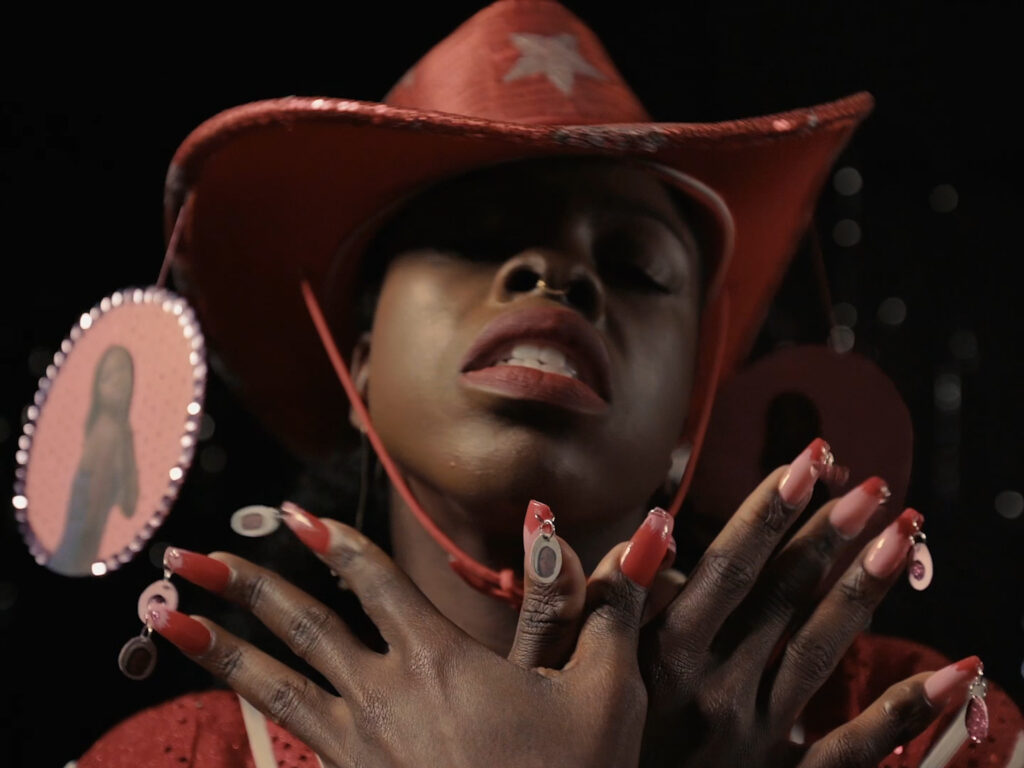
Pérez Art Museum Miami (PAMM): Can you introduce yourself and talk a bit about the story behind your piece T (2019), including its title, which is in PAMMTV’s Intertidal 2025?
Keisha Rae Witherspoon: I’m a Miami-born, Jamaican American creative. I grew up in a Caribbean household, and art wasn’t really the focus so much as Medicine and Law. The art part of my life was something I suppressed for a very long time. In terms of T, it was around the time of the Trayvon (Martin) killing. Trayvon is part of the T symbolism and the hyper visibility of Brown and Black death at the hands of law enforcement. And there was something about the body cams revealing these things very consistently, and there not being any, or at least not satisfactory justice for what we were seeing. I can’t really say I have a genesis or an origin story, so much as my brain thinks of images, blips, and symbols.
I dreamt up this imaginary ball where people would celebrate the deceased of that year—like an annual ritual for loved ones who were killed. I didn’t want it to be completely fictional, so it was an actual invitation to the community to come out, dance, and celebrate. I merged real community members with the performers that we brought on as a cast. A lot of people also don’t know that T is completely scripted. It is a hybrid documentary piece that I wanted to have a structure for but leave all the room in the world for improvisation by characters or performers. T is also Tupac, T is also the crucifix. It’s, again, an extension of these blips that I have in my mind.
PAMM: Can you expand on your relationship with South Florida? In what ways does the region influence your practice and modes of working?
KRW: South Florida is such a melting pot and a conglomerate of all these different communities; we have our meeting places usually around food and music. It’s a unique cultural phenomenon by extension of the Caribbean; we are an international hub. We just find ourselves with these clusters of individuals that are so different. I grew up bilingual, with a Puerto Rican sitter, Jamaican mother, and a white American father. My mom was a shop owner; she ran a Jamaican restaurant in Opa-locka, a very unique city on the outskirts of Miami proper. If you know anything about it, it’s seven square miles of Moorish revival architecture. Again, in terms of how I grew up, with all these almost isolated pieces that shape who I am. I was a shop owner’s kid who was also a people watcher at a very early age. I think that’s a broad strokes matrix of my Miami experience.
PAMM: On that note, how do you render a piece finished? When do you experience that sense of satisfaction or success?
KRW: There’s just always another edit, it feels like, but there comes a point where it’s almost maybe a spiritual decision where you know that it has to be released. You made the thing, there is love and effort, collective effort imbued in the work and intentionality, and there just comes a point where you have to let it go. A lot of times, filmmakers, I don’t know if justifiably, but compare it to having a child in a way where you have to let the child go, and there’s a point where you just really have to. You did all you could do, and now you send the child off into the world, and were you perfect at it? Not necessarily, but you did your best, and the clock is ticking.
It’s almost as if the work is sending itself and asking you to be finished with it already and to go out into the world. I should note that T was on a shelf for a year. I wasn’t confident in what I filmed, and it took a producer, Monica Sorelle, to finally shake me out of it and send the footage to an editor for a first pass. And that’s why T is in the world right now, in part. It really is a testament to the power of collaboration and having really creative, amazing people on your team because without that move, I might’ve actually just shelved the project.
PAMM: Do you ever think about the audience as a filmmaker?
KRW: I’ll start specifically, and it’ll go off into a broader answer. I know with T, I definitely was thinking about the communities that I was portraying in the film. So, Black folks see themselves in the media with a sort of constant air of suffering. I wanted to alchemize that image into something that was joyful. In a way, the audience, yes. But I think anyone with a heart who has any degree of empathy and care could love it, you know, or love anything that’s about that.
I know that I enjoy, and I want to see pieces that are very nuanced and specific, you know, and I still feel a collectivity and a shared humanity. I actually think it amplifies that message: seeing someone who’s very different from me, who speaks a completely different language and has a completely different experience, and still being able to feel care, love, and compassion. I would say that some works are probably specific to an experience, but I do yearn to have broad audiences who can feel something; maybe a type of compassion and understanding can emerge from that observation, you know.
I think coming back to that shared humanity, I would say any artist who maybe is making work from a real, authentic place, in some way it’s about reconnection. I went to see one of my favorite filmmakers, Apichatpong Weerasethakul, he’s a Thai director, and Uncle Boonmee Who Can Recall His Past Lives (2010), one of my favorite films. I garden a lot, and I remember someone asked him what art is, and his response was “art is made to connect us back to nature, to reconnect us to nature.”
PAMM: As keen observers of the Miami landscape and cultural fabric, what advice would you offer to the younger generation in South Florida interested in documenting their surroundings?
KRW: I want to be careful because advising sometimes can be a little tricky. I can feel the difference right now with content and how content is received. Everything is so fast paced that probably my biggest piece of advice would be to find nature as much as possible.
I guess I really am coming back to this nature piece. The digital space is still new in the context of human history. Yesterday, I was watching Adam Curtis’ new documentary and found myself wanting to pivot a few times because there were a couple of slower scenes. Even though I was enjoying it, I was like, “Oh, that’s the sort of dingy brain that is used to speed.” As a 1980s kid who had a lot of slow time and all of that, I can feel this rewiring of my brain, and I had to consciously say, “Wait, no, I don’t want to grab my phone and check my emails or whatever.” And there was so much enjoyment in me just sitting with the film, which I usually do, but, you know, it’s just a bit of an anecdote of just like how, you still get trapped in the constant carousel and speed of information and newness; like a new shiny thing that sort of floats in the room. If I were to summarize that, it would be to make space and time for slowness and for nature.
You’re a filmmaker and an artist, but you also founded the Third Horizon Film Festival. What prompted you to create a film festival? Why in South Florida?
KRW: Thank you for the question. Third Horizon was right off the heels of myself, Jason Fitzroy Jeffers, and a group of friends who had just made a short documentary in Haiti called Papa Machete, directed by Jonathan David Kane. This short doc was about the last one of the few remaining teachers of Haitian Machete fencing, which was one of the techniques used by Haitian revolutionaries to defeat the French as they took the fencing technique and used machetes that they were tilling the sugar cane fields with, and that was part of how, they were able to remove the French and expel them. Then, Jason walks and says, “We need a Caribbean Film Festival.” I knew from the statement that there was space for it. In Kingston, Jamaica, South Florida is often referred to as “Kingston 21”, an honorary district of sorts, owing to how many Jamaicans have emigrated here over the decades.
I think sometimes it’s just a matter of realizing that there’s a need and deciding on it, even knowing how much work is ahead, but still doing it anyway. One of the more consistent things we hear from people is that they didn’t know they needed the space until they got there. It’s such an enriching, safe, and inclusive festival. Miami serves as an ideal location, and an accessible location. We really do our best to fly in artists as much as possible for conversations and so on. The artists are just so grateful to have a space that feels like it’s theirs.
PAMM: Do you have anything else you would like to share with our audience?
KRW: I hope I can touch on universal themes and the concepts around repetitive violence and cyclical violence, but ideally with a degree of illumination, and I hope for transcendence at the end. If there’s a broader message and a broader feeling that I hope to always be a continuum through the work, it is that anything is possible and good is possible, you know, and peace is possible and so on.
Thank you to Keisha Rae Witherspoon for this conversation. Stay tuned for more artist interviews from INTERTIDAL.
Related Content


PAMMTV Intertidal Artist Interviews


