
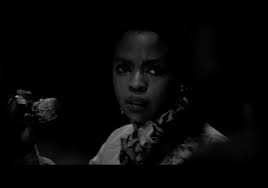
Over the course of more than 30 years, Arthur Jafa (b. 1960, Tupelo, Mississippi; lives in New York) has examined prevailing assumptions about race and identity through an interdisciplinary practice that combines film, installation, sculpture, and performance. His much-celebrated 2016 video Love is the Message, the Message is Death (recently acquired by Pérez Art Museum Miami through the PAMM Collectors Council) captures the powerful emotions that underlie the African American experience, past and present. Encompassing scenes of heightened beauty and humor, as well as instances of tragedy and horrific violence, the work testifies to the immense cultural achievements of African Americans while alluding to the pain that black people have endured throughout this country’s history.
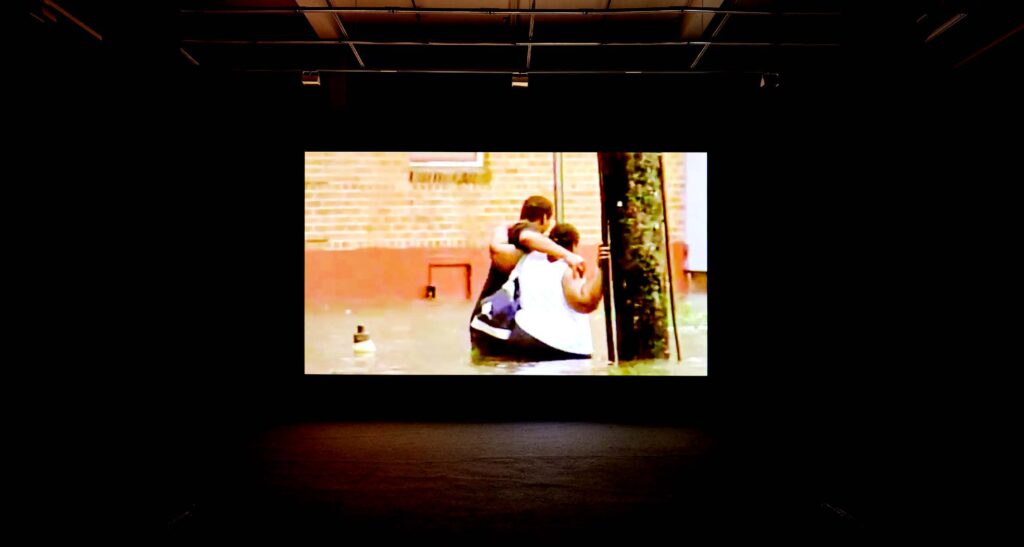
Jafa’s densely layered, seven-and-a-half-minute montage consists entirely of found film and video footage from the early 20th century through the civil rights era to the present day. It comprises a rapid-fire onrush of moving pictures: President Barack Obama breaking into the hymn “Amazing Grace” while delivering his eulogy for the parishioners gunned down by white supremacist Dylann Roof in Charleston in 2016; a raucous dance party; a civil rights protest march; the murder of Walter Scott, who was shot in the back while running away from a police officer (one of several episodes of police brutality that appear in the video); excerpts from D. W. Griffith’s blatantly racist 1915 film The Birth of a Nation; Serena Williams dancing on a tennis court; a family wading through muddy floodwater in the aftermath of Hurricane Katrina; James Brown falling to his knees, so overcome with theatrical emotion that he is unable to go on with his show. Jafa confronts the spectacular way in which black people are often represented within our visual culture while subverting the tendency of this kind of representation to reinforce racist paradigms. In the process, he imbues such depictions with a new emotive force, reversing the operations by which viewers become desensitized to them by dint of their constant repetition in our media-saturated world.
Jafa has stated that his primary aim is to “replicate the power, beauty, and alienation of black music” in the context of visual art. In Love is the Message, the Message is Death, he enacts this nuanced transposition from sound to image by means of meticulous editing, riffing on the complex syncopation that characterizes many African American musical legacies through the work’s intricate pacing and rhythm. Jafa’s reliance on preexisting footage drawn from disparate sources— including Hollywood films, cable news, documentary archives, and viral YouTube videos—also correlates with the layering and sampling that distinguishes various lineages of African American music, from jazz to hip-hop. Jafa set the video to the soaring, gospel-inspired 2016 song “Ultralight Beam” by Kanye West, the lyrics of which redouble the sense of hope, suffering, transcendence, and totality that envelops the entire project. West’s voice is heard, insisting: “Deliver us serenity, deliver us peace, deliver us loving. . . . This is a God dream, this is everything, everything.”
Addressing the work, the esteemed writer, musician, and producer Greg Tate, a close friend of the artist, writes: “There is at work here a poetic convergence of sublimated rage, lyrical image-making, ethnic Pop-ism, scar-tissued ‘flesh memories,’ and horrifically zeitgeist-citizen reporting—a retelling (per [James] Baldwin’s mandate) of the myriad ways black lives are victimized by state-sanctioned terrorism and yet somehow continue to resist with style, joy, sex, smarts, footwork, and snark.”1 Profoundly moving from beginning to end, Love is the Message, the Message is Death stands out among recent artistic productions as a contemporary masterpiece.
René Morales — Curator
Biography
A graduate of Howard University, Washington, DC, Jafa has had solo exhibitions at the Serpentine Sackler Gallery, London; Museum of Contemporary Art, Los Angeles; and the Vinyl Factory, London, among others. His work has been included in group shows at the Met Breuer, New York; Hammer Museum, Los Angeles; Institute of Contemporary Art, Philadelphia; Westfälischer Kunstverein, Münster, Germany; Whitney Museum of American Art, New York; Castello di Rivoli, Museo d’Arte Contemporanea, Italy; and the Vancouver Art Gallery. Jafa’s work is included in the collections of the Metropolitan Museum of Art, New York; Whitney Museum; and Pérez Art Museum Miami, among other public institutions. He directed the videos for Solange Knowles’s “Don’t Touch My Hair” and “Cranes in the Sky” (both 2016), and Jay-Z’s “4:44” (2017); he also worked on Beyoncé Knowles’s video “Formation” (2016). He shows regularly at Gavin Brown’s enterprise, New York/Rome.