Introduction
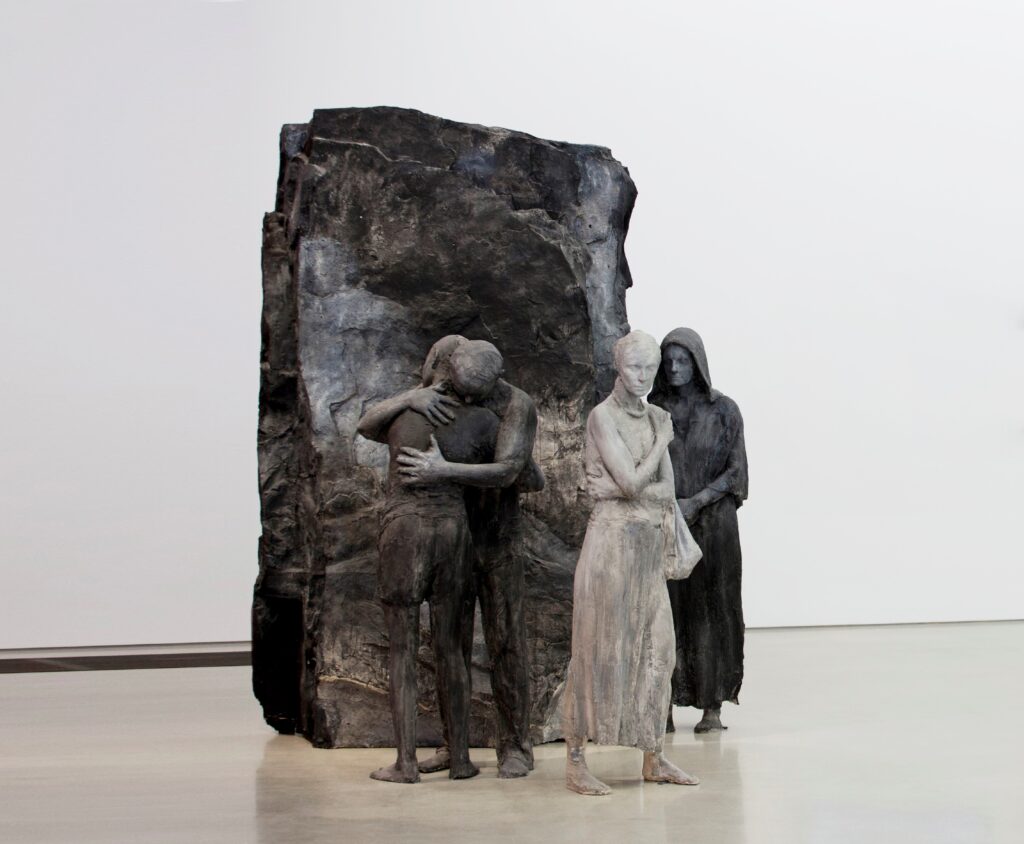
Abraham’s Farewell to Ishmael, a sculpture by George Segal is part of a series of works made between 1978 and 1987 that are based on biblical stories found in the book of Genesis. The sculpture was gifted to the museum by the George and Helen Segal Foundation in 2001 and was restored in 2017. The restoration was made possible by a generous grant from the Bank of America Art Conservation Project.
Visual Description Abraham’s Farewell to Ishmael
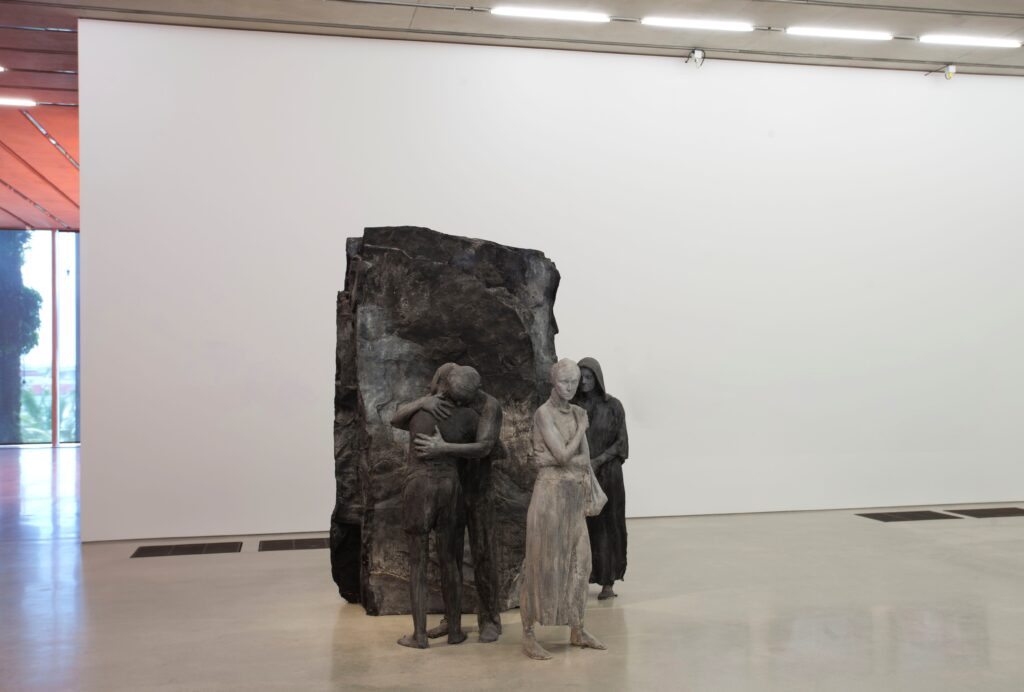
The piece consists of a nine-foot-tall rock, and four figures. It is made of acrylic paint and gypsum cement, otherwise known as plaster. This kind of material is often used by medical professionals to create casts when bones are broken and need to remain static to heal. In order to restore the piece, the large centerpiece rock was carefully brought to a restoration facility in two halves. The inside was reinforced with new wooden armatures to strengthen the foundation. The two halves were rejoined and further strengthened by adding wooden supports to ensure the sculpture would stand on its own. The seam was then covered with more gypsum cement and painted, giving the impression of an untouched sculpture.
The Inspiration
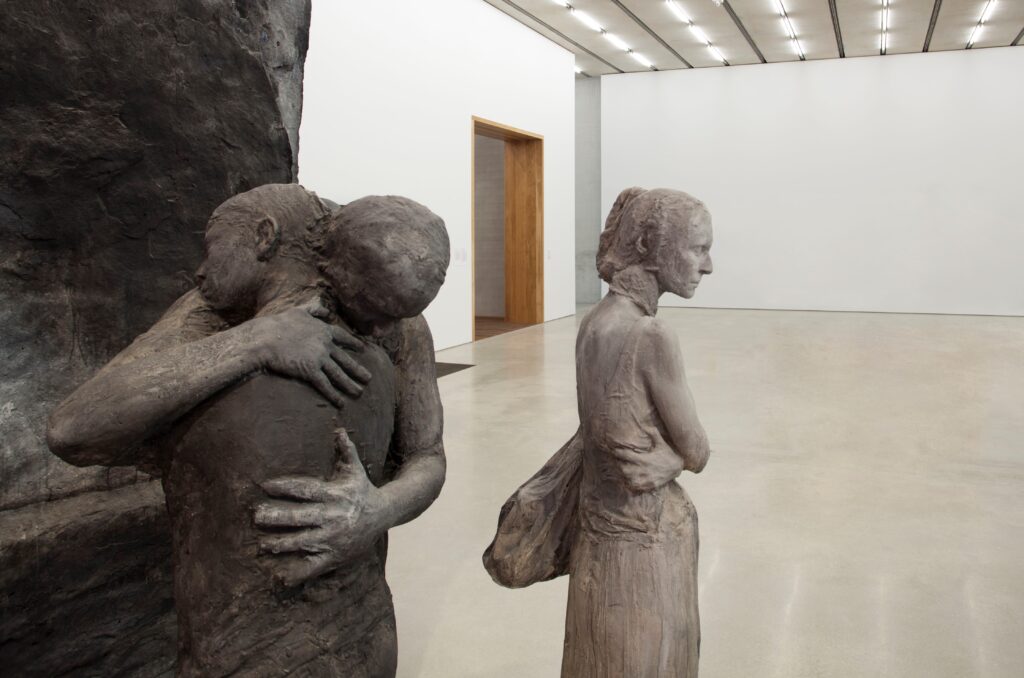
The inspiration behind the sculpture is the story of Abraham, his son, Ishmael, and their forced parting. The story is found in the book of Genesis in the Hebrew Bible and Old Testament. According to these scriptures, Abraham received a prophecy he would father a son despite he and his wife Sarai’s advanced age. Sarai had the idea of offering her younger handmaiden, Hagar, to her husband in order to bear him a child. Hagar and Sarai began to dislike one another and as a result, Hagar fled to into the desert. She returned when The Angel of the Lord told her she was with child and that she was to return to her mistress, Sarai, and submit to her. The child she would give birth would be named Ishmael. When Ishmael was 13, God told Abraham that Sarai would give birth to a child who would be named Isaac. While celebrating Isaac’s transition from infancy to early childhood, Ishmael made fun of Isaac and as a result Sarai asked Abraham to expel Ishmael and his mother, Hagar. Abraham reluctantly agreed after God told him that both his children would prosper. At age 14, Ishmael and his mother were dismissed and sent away with a supply of bread and water. In many Muslim traditions, the story of Hagar is well known and celebrated as well, forming one of many links between the world’s major monotheistic religions of Judaism, Christianity, and Islam.
George Segal
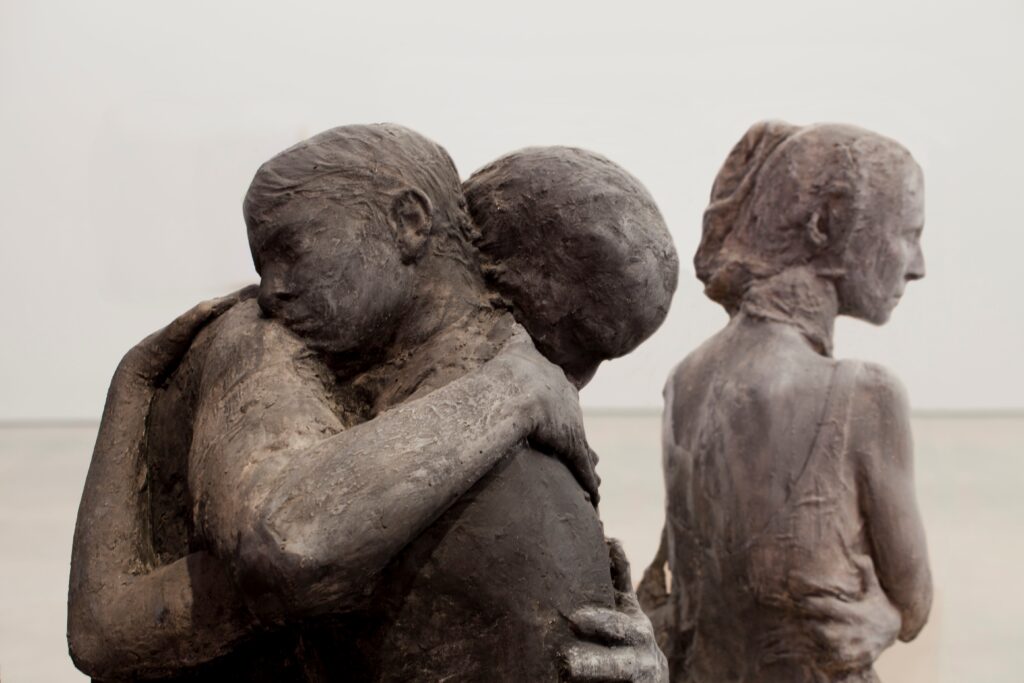
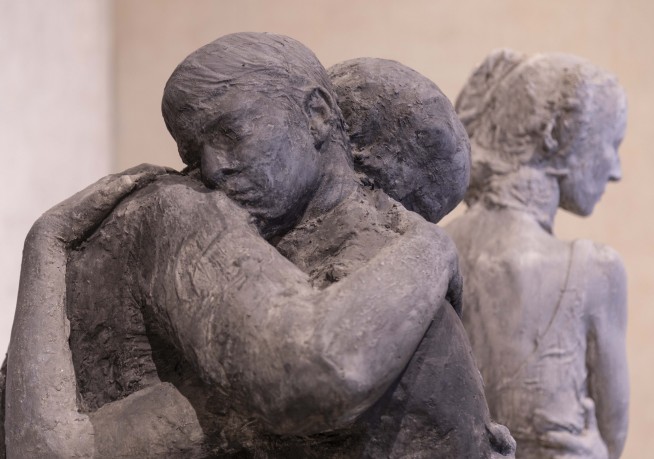
The sculpture is an example of the work that George Segal is best known for. Segal would work with live models, often his friends or relatives, and wrap them in plaster strips. When hardened, the plaster would be removed and then joined together to create the sculptures. Like much of his other work, Abraham’s Farewell to Ishmael, is limited in its use of color and tonality. This creates the effect of ghost like figures that seem frozen in time. The muted greys and blacks, coupled with the emotional embrace between Abraham and his son, sets a tone of grief and loss. As one walks around the piece, we feel as if we are a part of this intimate and overwhelming moment. We are invited to consider the perspective of all the figures: Hagar embracing herself as she is cast away, Sarai watching over the expulsion, and Abraham embracing Ishmael. No one seems happy. The tall rock becomes more ominous as the emotions settle and it begins to feel as if this structure is the physical embodiment of the pain we are witness to.
Abraham’s Farewell to Ishmael
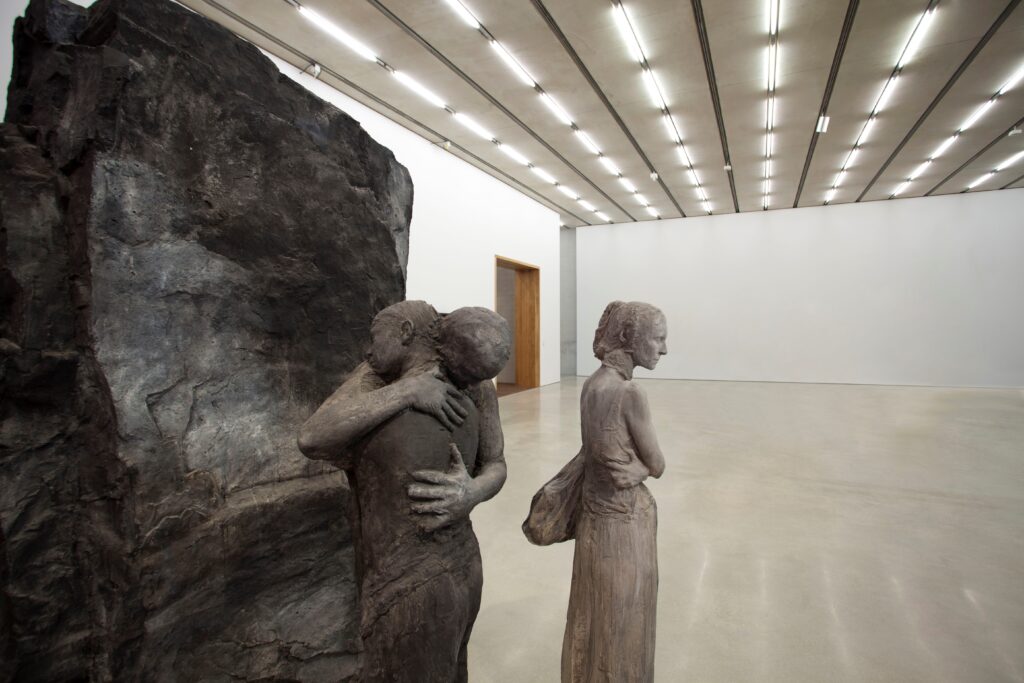
Originally commissioned to create a sculpture in response to the events of the Kent State Massacre, A violent event that took place in 1970 where four people were killed and nine more injured during a protest against the Vietnam War at Kent State University, Segal continued to make pieces inspired by religious scriptures that relate to current events. Abraham’s Farewell to Ishmael is part of this series of sculptures depicting religious events with people dressed in contemporary clothing. Although made roughly 30 to 40 years ago, the piece still serves to speak about traumatic events in our lives. Witnessing the separation of a family remains relevant as families continue being separated as they cross into the US border. This sculpture offers us a glimpse into what those moments may look and feel like in a physical space that may also serve to make the experience feel more real than a photograph could. While enlightening to know the story that inspired this sculpture, it is not necessary to connect with these figures. The sculpture asks us to find empathy for others’ traumas while also asking us to revisit our own.
Feedback
We hope you enjoyed this Digital Exhibition Guide!
We appreciate you taking the time to submit feedback to us as we strive to make PAMM as engaging as possible. You may submit your feedback anonymously through this form or by emailing us directly at AppFeedback@pamm.org