

- 1/22 1. Introduction
- 2/22 2. Who profits from the spectacle?
- 3/22 3. Hank Willis Thomas, Guernica
- 4/22 4. What if we saw ourselves as powerful?
- 5/22 5. Emma Amos, Hurdlers I
- 6/22 6. What if we honored different kinds of excellence?
- 7/22 7. Jean Shin, Everyday Monuments I
- 8/22 8. What do we trade for glory?
- 9/22 9. Samuel Fosso, Self-Portrait (Muhammad Ali)
- 10/22 10. How do we reclaim a space?
- 11/22 11. Derek Fordjour, Open Swim
- 12/22 12. How can tenderness be powerful?
- 13/22 13. Hugh Hayden, Nubian Queen
- 14/22 14. What does endurance look like?
- 15/22 15. Catherine Opie, Diana
- 16/22 16. At what point does a game belong to the world?
- 17/22 17. Ben Sakoguchi, Global Baseball
- 18/22 18. Whose labor makes the game possible?
- 19/22 19. Ronny Quevedo, astro and all star
- 20/22 20. How do our bodies keep the score?
- 21/22 21. Tabitha Soren, Net Impact
- 22/22 22. Feedback
Introduction

Welcome to Get in the Game: Sports, Art, Culture. This digital exhibition guide highlights ten artists whose work explores the deep connections between athletic performance, artistic expression, and cultural identity. From neighborhood basketball courts to international stadiums, the works gathered here reflect on how sport shapes the way we see ourselves and each other. Artists have long found in games a powerful lens for examining race, labor, resistance, and belonging.
The entries are organized in the order you will encounter the works in the gallery, so you can move through the guide alongside the exhibition itself. As you explore, you’ll find reflective prompts alongside each entry. These questions are designed not to have a single answer, but to open up conversation and invite you to bring your own experiences into the room. We hope they encourage you to look slowly, think deeply, and find yourself in the arena.
Who profits from the spectacle?
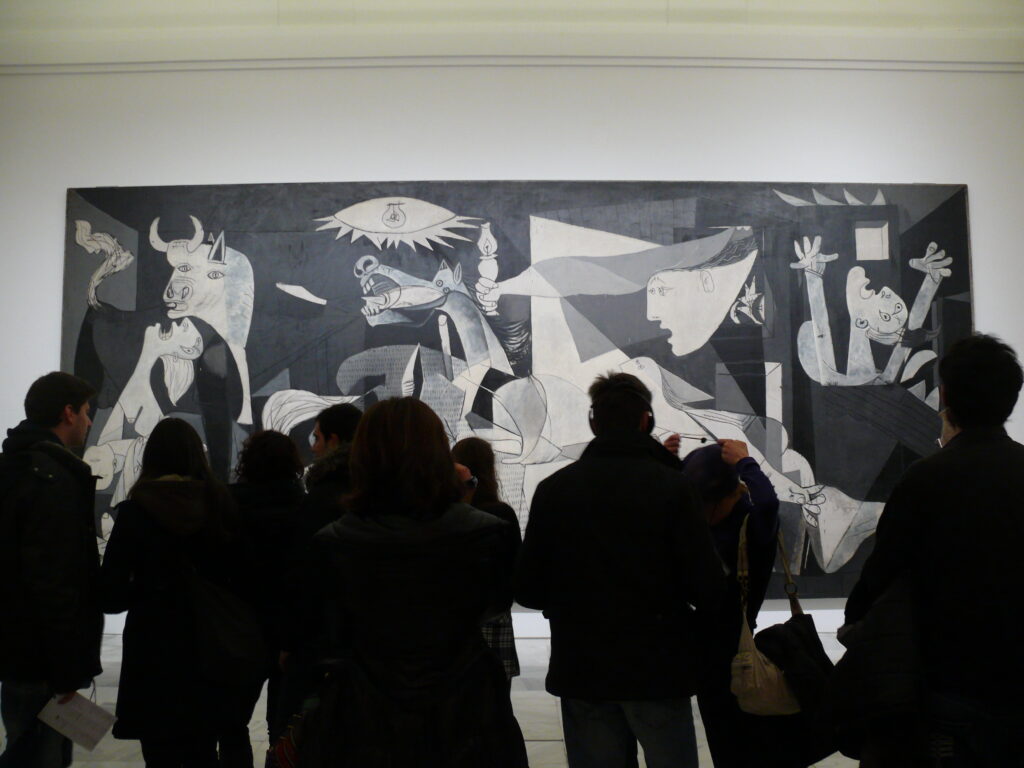
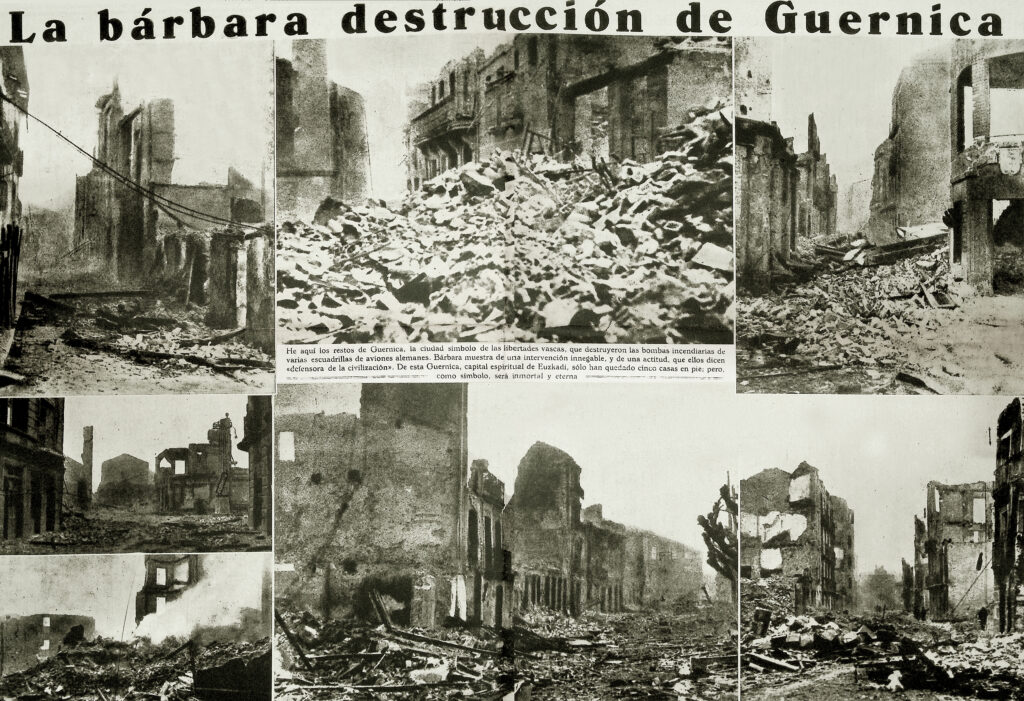
Guernica by Hank Willis Thomas takes its title and compositional framework from Pablo Picasso’s monumental 1937 painting of the same name, created in response to the bombing of the Basque town of Guernica by Nazi Germany and Fascist Spain during the Spanish Civil War. The war, which lasted from 1936 to 1939, pitted a democratically elected Republican government against a Nationalist military uprising led by General Francisco Franco, backed by fascist forces from Germany and Italy. The bombing of Guernica in April 1937, carried out by the Nazi German air force at Franco’s request, killed hundreds of civilians and became a symbol of the brutal toll of fascism on civilian life.¹ Picasso painted his response in a matter of weeks, using the fractured visual language of Cubism, itself influenced by forms he had encountered in African masks and Iberian sculpture, to convey the chaos and suffering of the attack. The painting, which stretches nearly twenty-six feet wide, has since become one of the most recognized anti-war images in the history of art.
Where Picasso used paint, Thomas uses NBA basketball jerseys, stitched together into a work of similarly monumental scale. The jerseys, which include those bearing names such as Johnson, Mason, Frazer, Carter, and Morning alongside team names from across the league, carry their own history of Black visibility, labor, and achievement within professional sports. These athletes are celebrated as icons, yet their presence in the work also points to broader questions about race, representation, and the systems of spectacle and commerce that shape professional basketball.
The history of athlete activism runs alongside these questions. At the 1968 Olympic Games in Mexico City, Tommie Smith and John Carlos raised their fists on the medal podium during the playing of the national anthem, drawing international attention to racial injustice in the United States.² Decades later, Colin Kaepernick’s kneeling protests during the national anthem brought renewed visibility to police brutality and systemic racism, while marathon runner Feyisa Lilesa crossed his arms at the finish line of the 2016 Rio Olympics to protest government violence against the Oromo people in Ethiopia.³ These examples show how the world of sports has repeatedly become a platform for political expression, linking athletic performance to broader conversations about justice, war, and human rights.
Footnotes
¹ “Guernica.” Encyclopaedia Britannica. https://www.britannica.com/topic/Guernica-painting-by-Picasso
² “Why Black American Athletes Raised Their Fists at the 1968 Olympics.” History.com. https://www.history.com/articles/black-athletes-raise-fists-1968-olympics
³ “Feyisa Lilesa, Ethiopian Runner, Makes Defiant Protest Gesture at Rio Olympics.” NBC News, August 22, 2016. https://www.nbcnews.com/storyline/2016-rio-summer-olympics/feyisa-lilesa-ethiopian-runner-makes-defiant-protest-gesture-rio-olympics-n635761
Hank Willis Thomas, Guernica
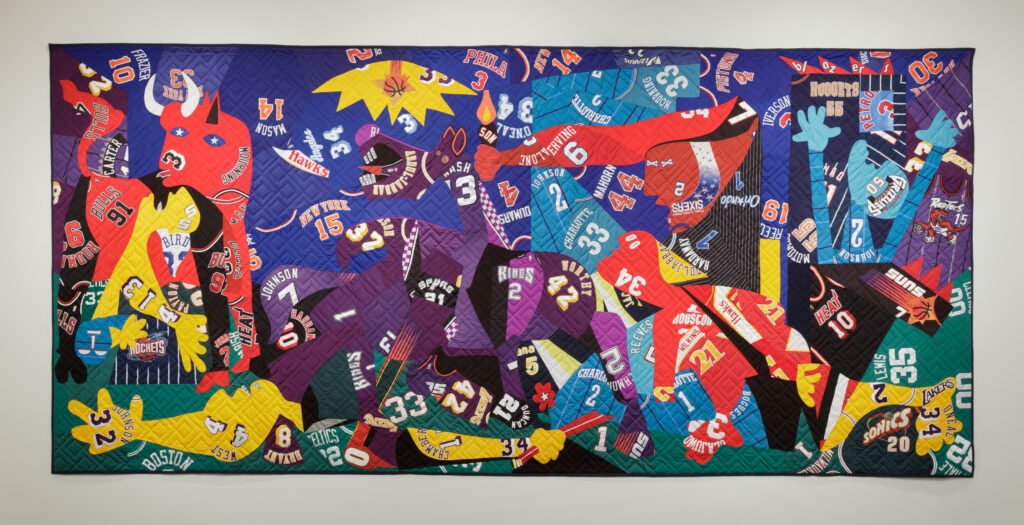
Guernica is a mixed media work by American artist Hank Willis Thomas, created in 2016. The artwork measures over ten feet tall by more than twenty-three feet wide, making it a monumental horizontal composition. Its longest side runs parallel to the ground. It is constructed entirely from sports jerseys—primarily NBA basketball uniforms—that have been cut apart and reassembled into a complex collage.
The work references Pablo Picasso’s 1937 painting Guernica in its composition and structure. Thomas recreates the fragmented, angular forms of Picasso’s anti-war masterpiece using the colorful fabrics of professional sports uniforms. The quilted texture of the jerseys remains visible throughout, with stitched seams, printed numbers, and team names forming the surface of the image.
Reading from left to right, recognizable forms emerge from the patchwork of fabric. On the left side, a bull-like figure takes shape in dark purples and blacks constructed from Chicago Bulls jerseys. Moving toward the center, a large horse figure dominates the upper portion of the composition with its head thrown back as though in distress. The horse’s body is constructed from purple jersey pieces, with visible team names and player numbers scattered across its form. To the right of the horse, human-like faces emerge in red, their expressions appearing distressed or anguished. Below these central figures, arms and limbs seem to be trampled beneath constructed from yellow and gold Lakers jerseys. Behind all these forms, a deep blue background made from Knicks and Hawks jerseys suggests sky.
The color palette is intensely saturated and varied. The purple horse and deep blue sky create a foundation against which the red faces and yellow-gold limbs stand out dramatically. Celtics green, 76ers red and blue, turquoise from the Hornets, black from the Spurs, and other team colors fill in the remaining spaces, creating a dense, vibrant surface where each jersey fragment carries both its original team identity and its new role in the larger image.
Team names, player numbers, and jersey text remain legible throughout—”JOHNSON 7,” “JOHNSON 2,” “KNICKS,” “CELTICS,” “LAKERS”—creating a secondary layer of information that pulses across the surface. The work transforms symbols of American sports culture into an image of chaos and suffering, though the bright colors and familiar logos lend an unsettling energy to the scene.
What if we saw ourselves as powerful?
Emma Amos was born in Atlanta in 1937 and trained as an artist in both the United States and England before moving to New York, where she became active in the downtown arts scene. At the invitation of artist and mentor Hale Woodruff, she joined Spiral in 1964, a collective of approximately fifteen prominent African American artists founded by Romare Bearden, Charles Alston, Norman Lewis, and Woodruff in response to the Civil Rights Movement. Amos was the youngest member of the group and its only woman, a position that sharpened her awareness of the intersecting barriers facing Black women in the art world. She later joined the feminist collectives Heresies and the Guerrilla Girls, and spent twenty-eight years as a professor at Rutgers University. Despite her decades of significant work, a major retrospective of her career did not take place until 2021, the year after her death.¹
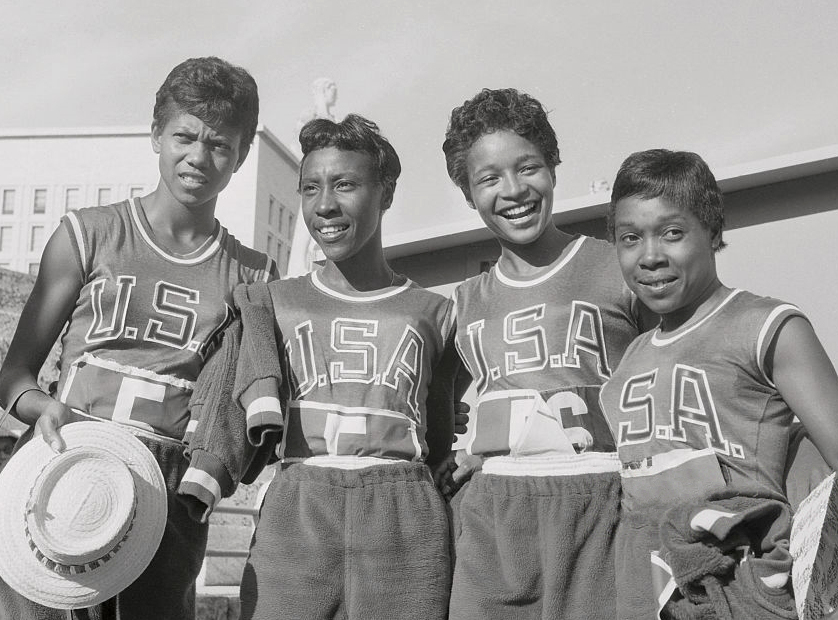
Members of the U.S. women’s 4×100-meter relay team — all students at Tennessee State University — after setting a world record at the 1960 Rome Olympics. Known as the Tigerbelles, the four women won gold in a sport that, until that year, had barred women from running distances longer than 200 meters.
Hurdlers I was painted in 1983, a decade after Title IX, the landmark federal legislation banning sex discrimination in federally funded education programs, had begun to transform opportunities for women in sport. Black women had long been at the forefront of women’s track and field even before these gains: the Tennessee State University Tigerbelles, under legendary coach Ed Temple, produced forty Black female Olympians and won twenty-three Olympic medals between 1952 and 1984, their dominance predating the legal protections that would later expand opportunities for women more broadly.² Yet Title IX’s benefits were not evenly distributed, and scholars have noted that the law’s singular focus on sex failed to address the specific barriers facing women of color.³
Painted at this charged historical moment, Hurdlers I celebrates the strength and determination of women athletes while embedding that celebration in the longer struggle for recognition and access that Black women in sport had long waged.
Footnotes
¹ “Emma Amos,” Smithsonian American Art Museum. https://americanart.si.edu/artist/emma-amos-88
² “HBCUs: A Legacy of Shaping African American Athletes,” National Museum of African American History and Culture. https://nmaahc.si.edu/explore/stories/hbcus-legacy-shaping-african-american-athletes
³ “Title IX Didn’t Guarantee Black Women an Equal Playing Field,” FiveThirtyEight, June 22, 2022. https://fivethirtyeight.com/features/title-ix-didnt-guarantee-black-women-an-equal-playing-field/
Emma Amos, Hurdlers I
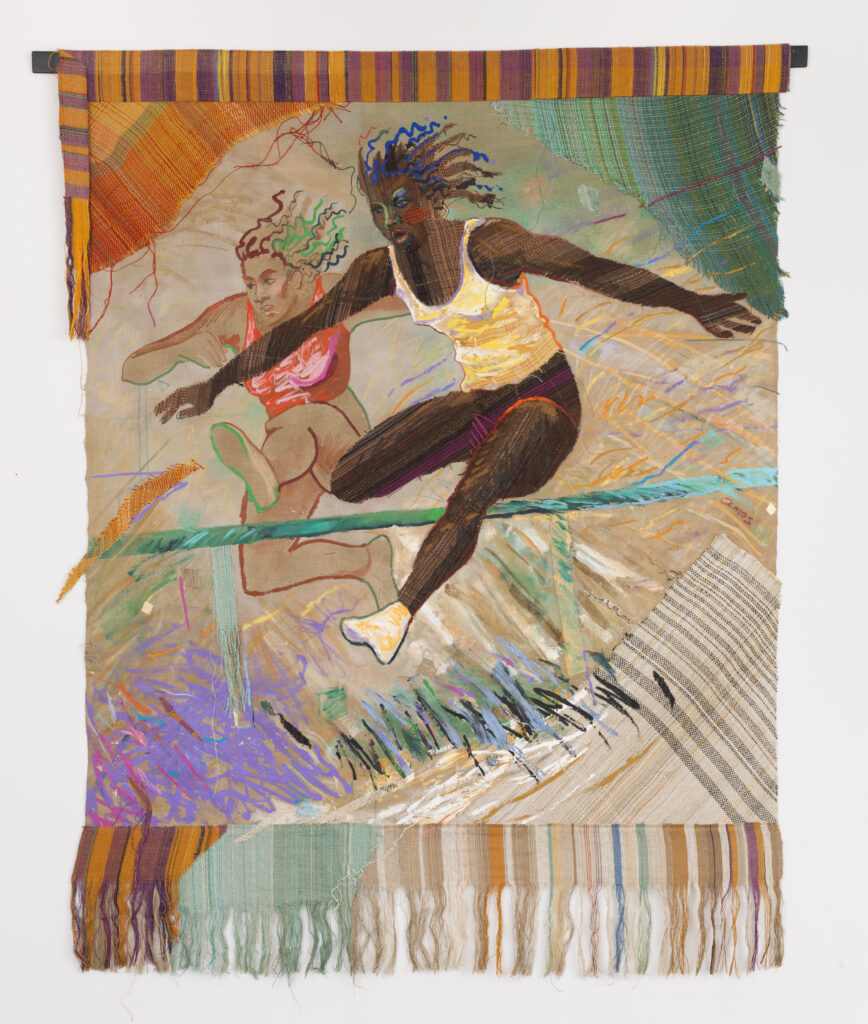
Hurdlers I is a mixed media work by American artist Emma Amos, created in 1983. The piece measures eight feet tall and just under six feet wide. It is vertical, with its shortest side running parallel to the ground, creating a commanding textile presence.
The work combines acrylic paint on canvas with hand-woven elements, creating a hybrid between painting and fiber art. Woven striped borders frame the composition at the top and bottom. The upper border features vertical stripes in purple, orange, and gold, while the lower border displays softer stripes in beige, green, and purple. Long fringe extends from the bottom edge; the loose threads hanging like the tassels of a traditional woven blanket. The edges of the work are irregular and raw, emphasizing its textile nature.
The composition itself integrates woven textiles throughout. In the upper left, woven orange fabric with diagonal striping creates a warm, textured area, while in the upper right, woven green fabric with diagonal lines fills the corner. The surface has a distinctive texture and pattern of actual woven material throughout much of the work.
The composition depicts two figures mid-leap over a hurdle. In the foreground, a Black woman athlete dominates the scene, her body captured in the dynamic motion of clearing the barrier. Her body is constructed entirely with woven textiles in varying shades of brown—from deep chocolate to lighter tans—with accents of magenta and purple woven throughout. The fabric creates the form and volume of her limbs and torso, the color variations suggesting muscle definition and the play of light across her skin. She wears a cream-colored uniform, and her arms are extended on either side for balance as she soars over a green horizontal bar; the hurdle. Her hair is rendered in energetic blue and brown strokes that suggest movement and lift. One foot, in a white athletic shoe, extends behind her as she clears the obstacle.
Behind her and to the left, a second figure with lighter skin and reddish hair rendered in loose, sketch-like strokes with green accents also leaps, wearing a red outfit. This figure appears smaller and less defined, creating a sense of depth and suggesting either distance or a ghosted second moment in time.
The background is composed of layered geometric areas in warm and cool tones with beige, purple, lavender, and turquoise sections, some woven and some painted. A section of woven textile with a grid pattern in neutral tones is integrated into the lower right corner. From this woven area, energetic brushstrokes in bright purple, blue, and black sweep across the foreground beneath the hurdle, creating a sense of speed and motion that echoes the athletes’ movement.
What if we honored different kinds of excellence?
Jean Shin was born in Seoul, South Korea and moved to the United States at the age of six, growing up in Bethesda, Maryland. Her parents, who had been professors in Seoul, took on various jobs after immigrating, eventually owning a supermarket and liquor store. That experience of quiet, unglamorous labor close to home would prove formative. Shin went on to study at Pratt Institute in Brooklyn and later worked as a curatorial assistant at the Whitney Museum, before establishing a practice built around the transformation of cast-off, everyday objects — prescription pill bottles, old lottery tickets, discarded sweaters — into large-scale sculptures and installations. For each project, she typically gathers her materials through community donations, a process that embeds the lives and histories of ordinary people into the work itself.¹
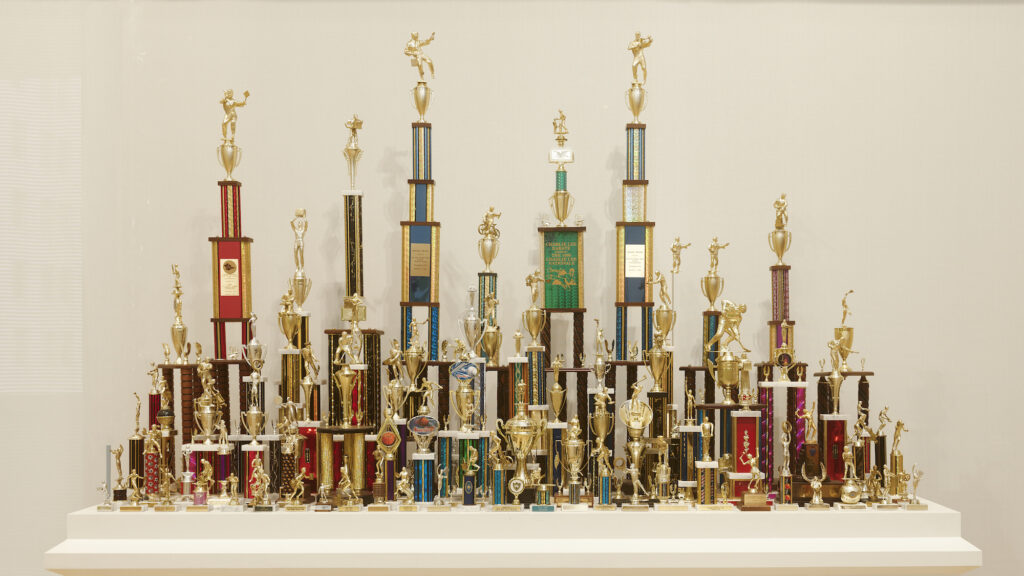
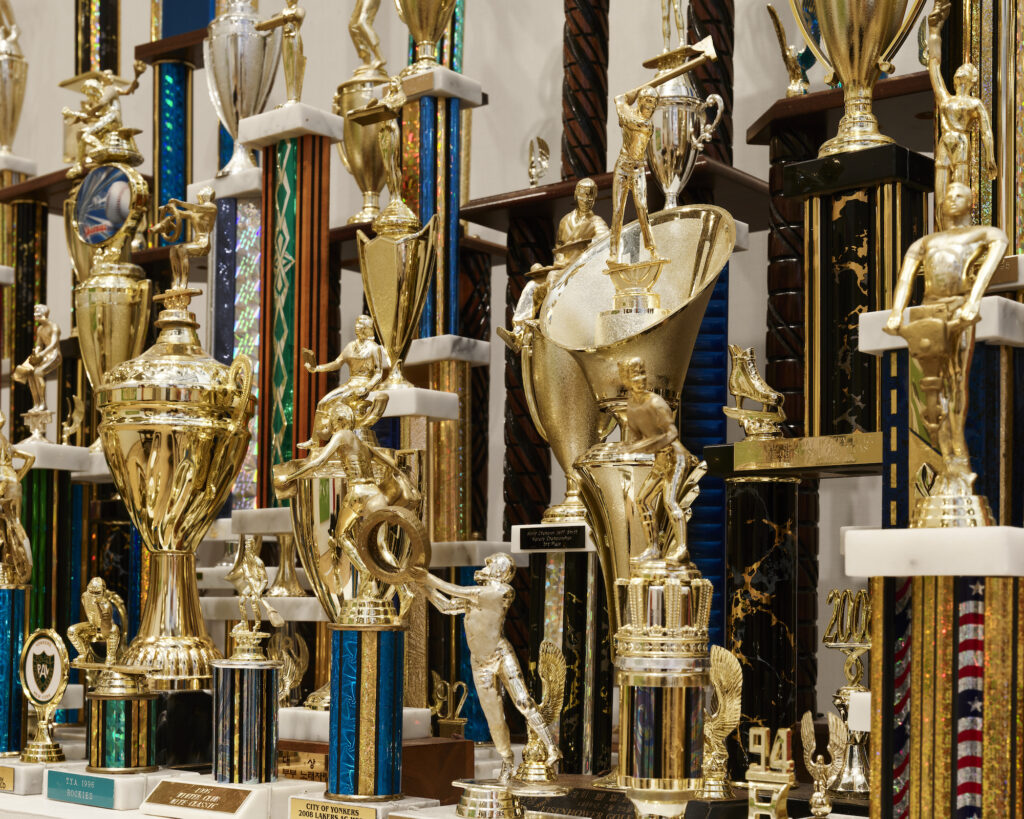
Everyday Monuments I began when Shin put out a call for donated sports trophies to residents of the Washington, D.C. area, eventually collecting nearly two thousand. She then altered each figure, replacing athletic poses with the gestures of everyday work: a bowler becomes someone pushing a stroller, a basketball player raises a hammer, a soccer player carries a typewriter. The gold-plated figures that result are arranged in a sprawling installation that, in its original form, recalled an aerial view of the National Mall — a space defined by grand monuments to presidents, generals, and historical events.²
The contrast is intentional. Public monuments have historically celebrated those deemed worthy of permanent commemoration: heads of state, military leaders, athletes who achieve at the highest levels. The workers who sustain daily life, by contrast, including caregivers, service workers, janitors, and delivery workers, rarely receive such recognition. Shin’s intervention asks who we choose to honor, and whose labor we take for granted. As she has said of the work, the champions here are those who do ordinary, essential work but “aren’t getting trophies today.”³
Footnotes
¹ Jean Shin, artist biography, Wikipedia. https://en.wikipedia.org/wiki/Jean_Shin
² Jean Shin, Everyday Monuments, artist’s website. https://www.jeanshin.com/everyday-monuments
³ “Jean Shin, Turning Trash Into Artistic Treasure,” NPR, April 30, 2009. https://www.npr.org/2009/04/30/103674782/jean-shin-turning-trash-into-artistic-treasure
Jean Shin, Everyday Monuments I
Everyday Monuments I is an installation by Korean-American artist Jean Shin, originally created in 2009. The work consists of altered sports trophies, paint, and cast resin.
The installation centers on a large white platform positioned in the gallery space. Across this platform, hundreds of trophies stand together in a dense, crowded formation like a glittering forest of recognition. The trophies vary dramatically in height, from small six-inch awards to towering multi-tiered structures that reach several feet tall. They create an undulating landscape of peaks and valleys, with the tallest trophies rising like skyscrapers above the shorter ones.
Each trophy follows the familiar structure of mass-produced awards: a figured person atop a column, mounted on a base. But Shin has altered these trophies in a crucial way—instead of athletes frozen in victory poses, the figures depict everyday people performing ordinary tasks. One figure hoists a large tire overhead. Another holds a large pot. Others appear to be carrying tools and domestic objects, reaching forward, or engaged in mundane labor. The heroic athletic poses typically found on sports trophies have been replaced with the gestures of daily life. The figures are rendered in gold, silver, and chrome finishes that catch and reflect light, creating a shimmering, metallic surface across the entire installation.
The columns supporting these figures come in a variety of colors and finishes. Some are wrapped in bright holographic or reflective materials in red, blue, green, purple, and gold that create vertical bands of color throughout the composition. Others are simpler cylinders in black, white, or metallic finishes. Many columns are multi-tiered, stacking several segments with decorative elements between them. The bases are predominantly white, creating a uniform foundation that unifies the diverse collection.
The work transforms the language of athletic achievement into a monument to ordinary existence. By replacing athletes with everyday people, Shin elevates the mundane and routine, suggesting that daily life and labor are equally worthy of celebration and recognition.
What do we trade for glory?
Born in Cameroon and raised partly in the Central African Republic after fleeing civil war in Nigeria, Samuel Fosso began photographing himself as a teenager while running a portrait studio, using leftover film from wedding and passport shoots to stage elaborate images of himself in costume. Over time, this practice evolved into a broader exploration of identity and representation, earning him the nickname “the man of a thousand faces.”¹
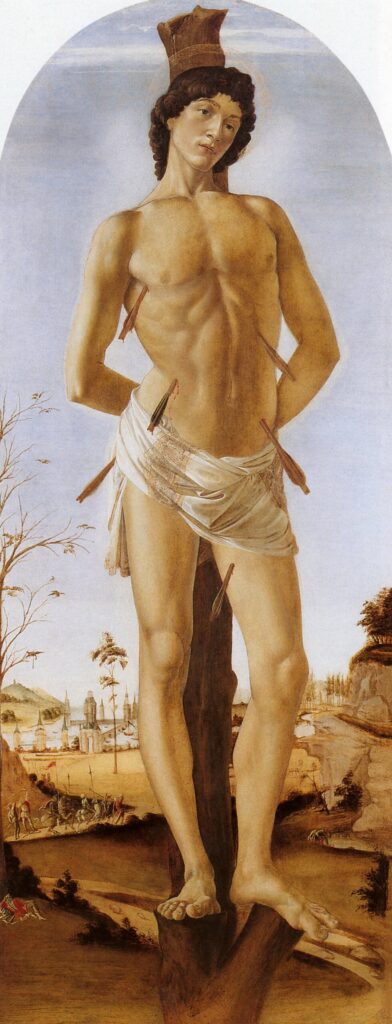
In Self-Portrait (Muhammad Ali), Fosso recreates a photograph taken by Carl Fischer for the April 1968 cover of Esquire magazine. In it, Ali is posed as Saint Sebastian — a Roman Christian martyr who, according to tradition, was tied to a post and shot with arrows as punishment for his faith. Though he survived, Sebastian was later beaten to death for continuing to practice Christianity. Over centuries, he became one of the most recognizable figures in Western art, depicted again and again as a muscular young man whose body endures suffering in defense of his beliefs.
Fischer’s use of this imagery was deliberate. In 1967, Muhammad Ali had refused induction into the U.S. Army, citing his Muslim faith and his opposition to the Vietnam War. Consequently, Ali was stripped of his boxing title and license, had his passport confiscated, and was convicted of draft evasion — a conviction later overturned by the Supreme Court in 1971.² The Esquire cover framed Ali as a modern martyr: a man being publicly punished for the courage of his convictions at a moment when the Vietnam War and the Civil Rights Movement were bitterly dividing the country.
His refusal also inspired other prominent athletes to speak out. On June 4, 1967, Jim Brown organized what became known as the Cleveland Summit, bringing together prominent figures including Bill Russell and Kareem Abdul-Jabbar at the Negro Industrial Economic Union in Cleveland to publicly defend Ali’s stance — an early and defining moment in the history of athlete activism.³ Self-Portrait (Muhammad Ali) is at once a tribute to Ali’s legacy and a reflection on the ways photographs construct identity, history, and meaning.
Footnotes
¹ “Samuel Fosso.” Artsy. https://www.artsy.net/artist/samuel-fosso
² “Muhammad Ali Refuses Army Induction.” History.com. https://www.history.com/this-day-in-history/april-28/muhammad-ali-refuses-army-induction
³ “Muhammad Ali.” Wikipedia. https://en.wikipedia.org/wiki/Muhammad_Ali
Samuel Fosso, Self-Portrait (Muhammad Ali)
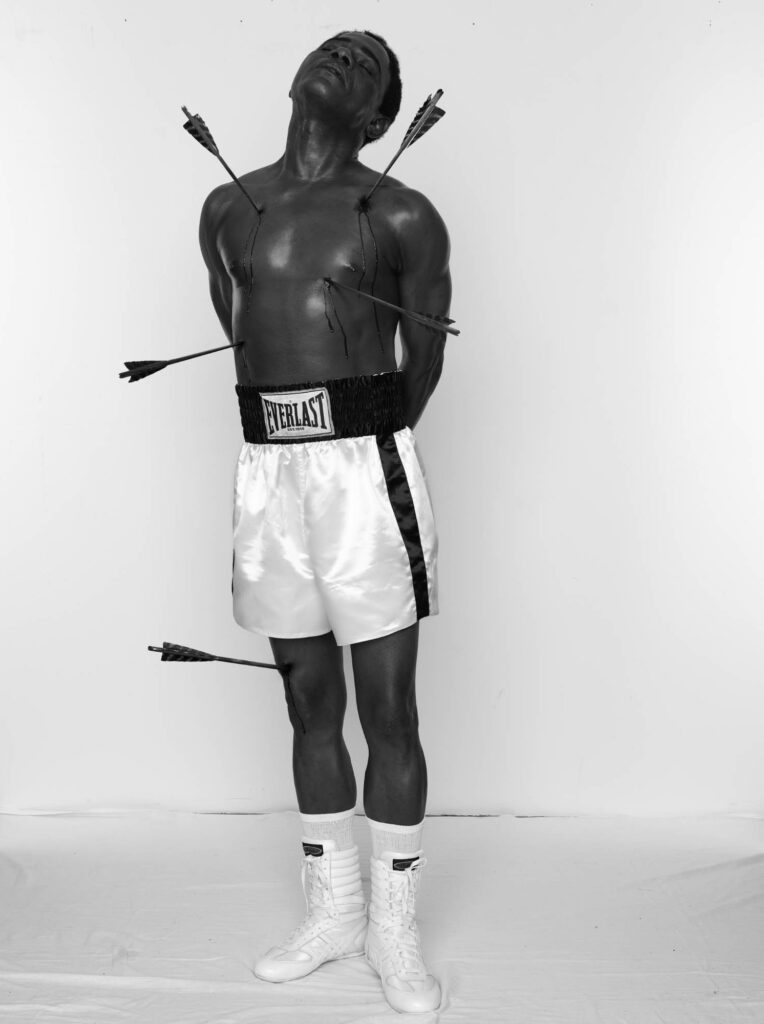
Self-Portrait (Muhammad Ali) is a gelatin silver print by Cameroonian artist Samuel Fosso, created in 2008 and printed in 2022. It is part of his series African Spirits. The photograph measures forty inches tall by thirty inches wide. Its shortest side runs parallel to the ground.
The photograph is rendered in black and white, with stark contrasts between light and shadow that emphasize the dramatic nature of the scene. The work recreates the famous 1968 Esquire magazine cover depicting Muhammad Ali as the martyred Saint Sebastian.
The composition presents a single figure—the artist himself, performing as Muhammad Ali—standing centrally against a plain white background. The figure’s body is positioned frontally, feet planted shoulder-width apart, but his head is tilted dramatically backward, face turned upward toward the sky. His eyes appear closed; his expression one of pain or perhaps transcendence.
The figure’s bare torso is oiled and gleaming, muscles defined by the play of light across dark skin. Five arrows pierce his body: two emerge from his upper chest near the shoulders, one from the center of his torso, one from his side, and one from his upper thigh. The arrows’ shafts are visible extending from the body, their feathered fletching dark against the skin.
He wears white satin boxing shorts that catch the light, creating bright highlights and soft folds. The waistband is black with “EVERLAST” printed in black letters—the iconic boxing brand. A vertical black stripe runs down the right side of the shorts. On his feet are white lace-up boxing boots that extend above the ankle, worn over white calf-length socks.
The overall effect is one of controlled drama. The figure stands in a pose that suggests both suffering and defiance, the athletic body simultaneously vulnerable and powerful. The stark black and white palette intensifies the emotional weight of the image, transforming a boxing champion into a symbol of resistance and martyrdom.
How do we reclaim a space?
Open Swim by Derek Fordjour is part of a body of work that examines the fraught relationship between Black Americans and bodies of water, one shaped by decades of deliberate exclusion from public swimming spaces. Born in Memphis, Tennessee to Ghanaian immigrant parents, Fordjour constructs his paintings through a labor-intensive collage process, building up layers of cardboard, foil, and newspaper before painting his figures on top. The textured, accumulated surfaces that emerge reflect the layered histories embedded in his subjects.
During the 1920s and 1930s, American cities undertook a massive pool-building campaign, constructing large, resort-style facilities that became central gathering spaces for communities across the country. Black Americans were largely excluded from these spaces, relegated in some cities to a single small indoor pool, or denied access altogether. In St. Louis, for example, Black residents made up over thirteen percent of the population in the late 1930s, yet accounted for only two percent of swimmers at the city’s municipal pools.¹ When cities began to allow men and women to swim together in the same pools, officials used the occasion to impose racial segregation, citing fears about Black men swimming alongside white women in such intimate public spaces. In some cities, white mobs violently attacked Black swimmers who attempted to integrate pools.²
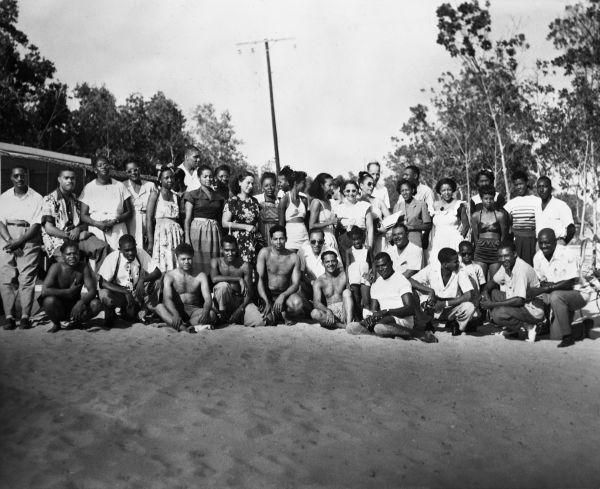
Miami’s own waterfront tells a parallel story. For decades, Black residents were barred from the city’s beaches entirely. In May 1945, a group of civil rights activists staged a wade-in at all-white Baker’s Haulover Beach, risking arrest to demand access. Less than three months later, county officials opened Virginia Key Beach as a designated “colored only” park — the only beach in Dade County where Black families could legally swim.³ Accessible only by boat until 1947, it quickly became a cherished community gathering place, used for picnics, religious services, and recreation. It remained the sole legal option for Black swimmers in the county throughout the 1950s.
When pools and beaches were finally desegregated following the Civil Rights Movement, many white communities responded by closing public facilities entirely and retreating to private swim clubs, spaces that remained effectively off-limits to Black Americans. The consequences of this history persist today. Black children in the United States are significantly less likely to know how to swim than their white peers, and drown at disproportionately higher rates, a disparity rooted not in biology but in generations of denied access.⁴
Open Swim enters this history as an act of reclamation, asserting the water as a space of joy, freedom, and belonging for Black swimmers, and insisting on their full presence in a space from which they were so long excluded.
Footnotes
¹ Jeff Wiltse, Contested Waters: A Social History of Swimming Pools in America, as cited in “Racial History of American Swimming Pools,” NPR, May 6, 2008. https://www.npr.org/2008/05/06/90213675/racial-history-of-american-swimming-pools
² “Public Swimming Pools Are Still Haunted by Segregation’s Legacy,” National Geographic, September 27, 2024. https://www.nationalgeographic.com/history/article/public-swimming-pools-still-haunted-by-segregation-legacy
³ “Water as a Divider: When Beaches Were Not For All,” Florida Humanities. https://floridahumanities.org/blog/water-as-a-divider-when-beaches-were-not-for-all/
⁴ “Black Swimmers Teach Others Amid History of Aquatic Segregation,” CBS News, August 13, 2025. https://www.cbsnews.com/news/black-swimmers-drown-segregation-swim-summer/
What does endurance look like?
In 2013, at the age of sixty-four, Diana Nyad became the first person to successfully complete the open-water swim from Cuba to Florida without a shark cage — approximately 103 miles through waters known for strong currents, jellyfish, and sharks. It was her fifth attempt, following decades of long-distance swimming that had already established her as one of the most celebrated endurance athletes in the world.¹
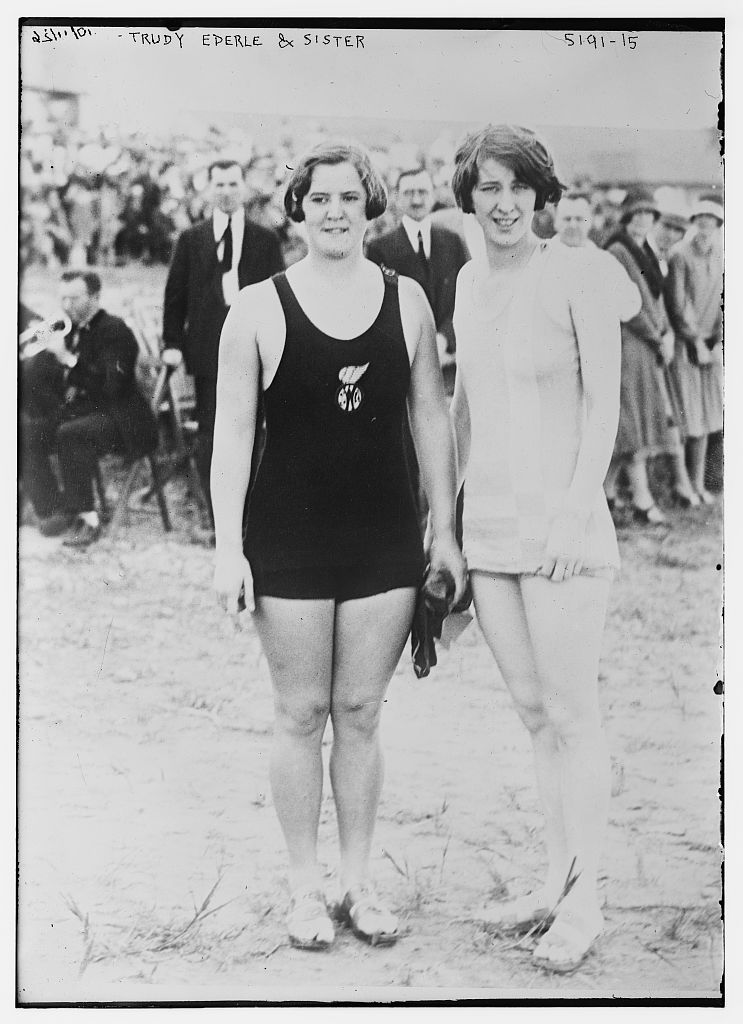
https://www.loc.gov/pictures/resource/ggbain.31219/
Gertrude “Trudy” Ederle and her sister, c. 1920s. In 1926, Ederle became the first woman to swim the English Channel, completing the crossing faster than any man before her — a feat that made her a global celebrity and a forerunner of the long-distance swimming tradition that Diana Nyad would later carry forward.
Catherine Opie’s portrait does not depict Nyad in action but focuses instead on the surface of her back and shoulders, photographed from behind against a dark background. Opie has described the figures in this portrait series as “coming out of black” — images meant to be looked at slowly and carefully.² The lighting isolates Nyad’s form so that the viewer’s attention moves across the surface of her skin, where areas of pale flesh, previously covered by a swimsuit, contrast with the darker, weathered tone of skin repeatedly exposed to the sun. Musculature, skin tone, and posture together suggest both the strength required for such an achievement and the vulnerability that accompanies physical aging.
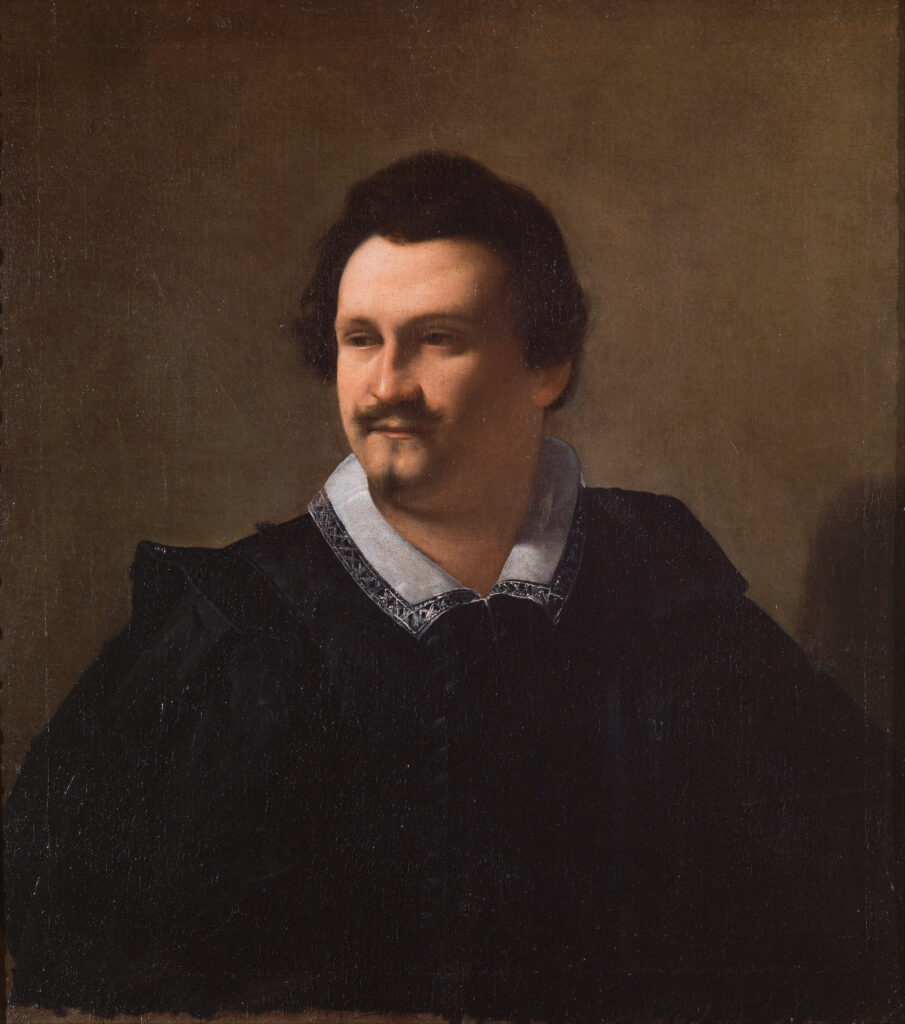
This visual approach is consistent with the Portraits and Landscapes series more broadly, in which controlled studio lighting and dark backgrounds evoke the tradition of Old Master painters such as Rembrandt and Caravaggio, where figures emerge from deep shadow into carefully directed light.³ Here, that language frames Nyad not as an untouchable hero, but as a person whose body carries visible evidence of time, labor, and dedication.
Footnotes
¹ “Diana Nyad, 64, Makes Record Swim from Cuba to Florida.” History.com, September 2, 2013. https://www.history.com/this-day-in-history/september-2/diana-nyad-64-makes-record-swim-from-cuba-to-florida
² “Catherine Opie: The Provocateur Who Photographed Elizabeth Taylor’s Home.” CNN Style. https://edition.cnn.com/style/article/photographer-catherine-opie-interview/index.html
³ “Catherine Opie: To Be Seen.” National Portrait Gallery Large Print Guide. https://www.npg.org.uk/assets/uploads/files/opie-large-print.pdf
At what point does a game belong to the world?
Global Baseball by Ben Sakoguchi draws on the format of vintage California orange crate labels — brightly colored, small-scale advertisements that were pasted onto wooden shipping boxes from the 1880s through the 1950s. The labels promoted an idealized vision of California as a land of sunshine and abundance, their cheerful imagery concealing the exploitative agricultural labor system that produced the fruit. Many of the workers who harvested those crops were migrant laborers, including Japanese immigrants who had come to the United States during the late nineteenth and early twentieth centuries. Sakoguchi’s parents were among them, running a grocery store that served the laborers who worked the fields of San Bernardino, California.¹
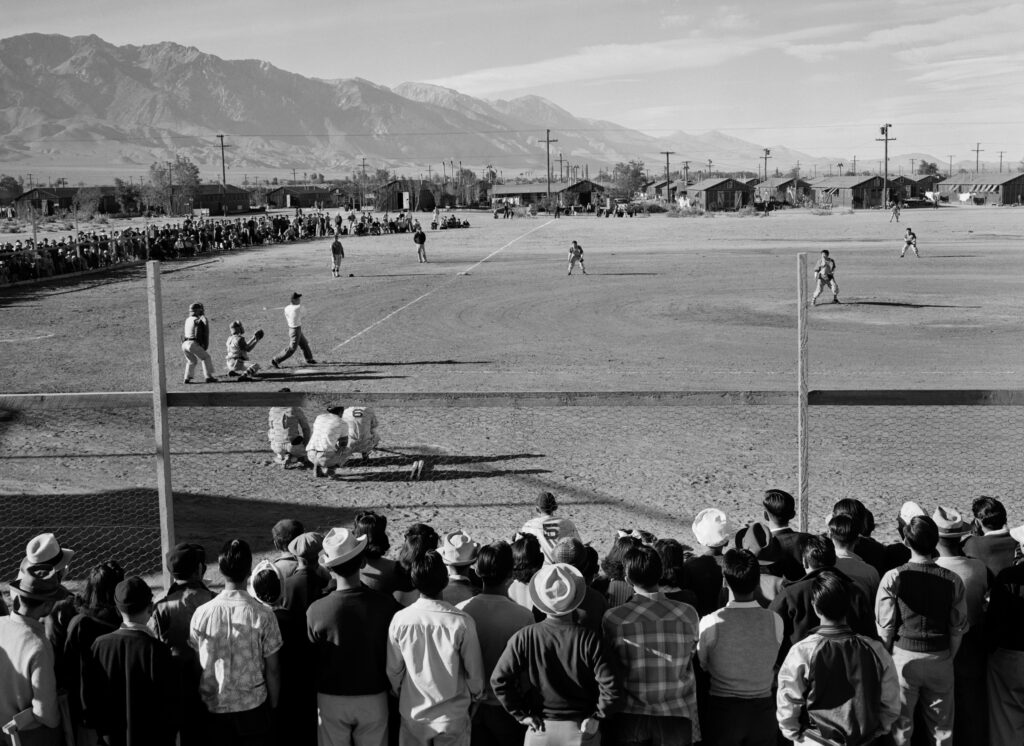
In February 1942, following the attack on Pearl Harbor, President Franklin D. Roosevelt signed Executive Order 9066, authorizing the forced removal of approximately 120,000 Japanese Americans from the West Coast into internment camps across the country’s interior.² Sakoguchi’s family was sent to the Poston War Relocation Center in Arizona, where they remained until 1946. Despite the loss of their property, livelihoods, and civil liberties, many internees refused to abandon the game they loved. Across the ten War Relocation Authority camps, internees built baseball diamonds, formed leagues, and filled the stands as fans. At Gila River alone, a thirty-two team league emerged from the desert ground up.² For many, the game offered a rare sense of normalcy and dignity within circumstances designed to strip both away.
Sakoguchi’s Global Baseball series reflects on this contradiction at the heart of America’s national pastime: a sport that has long symbolized democratic ideals while also reflecting the country’s histories of exclusion, labor exploitation, and racial injustice. Baseball’s global reach has also been shaped by migration and labor. As free agency transformed the economics of the sport in the 1970s, Major League Baseball teams increasingly turned to Latin America to recruit younger and less expensive talent, establishing academies in the Dominican Republic and Venezuela where players, some signed at just sixteen years old, often shouldered the financial responsibility of supporting their entire families or communities back home.³ Today, baseball is played by an estimated 65 million participants in 112 countries — a global reach that carries with it complex legacies of American influence, migration, and labor.⁴
Footnotes
¹ David Davis, “Through His Art, Ben Sakoguchi Used Baseball to Understand America,” VICE Sports, April 11, 2016. https://www.vice.com/en/article/nzxndx/through-his-art-ben-sakoguchi-used-baseball-to-understand-america
² Terumi Rafferty-Osaki, “Baseball in American Concentration Camps,” Densho, April 5, 2016. https://densho.org/catalyst/baseball-world-war-ii-concentration-camps-photo-essay-brief-history/
³ Andrew Mitchel, “The Dominican Republic and the United States: A Baseball History,” Origins, Ohio State University. https://origins.osu.edu/article/dominican-republic-and-united-states-baseball-history
⁴ Ben Sakoguchi, Global Baseball, artist’s website. https://www.sakoguchi.info/global-baseball
Whose labor makes the game possible?
https://www.loc.gov/item/2017798657
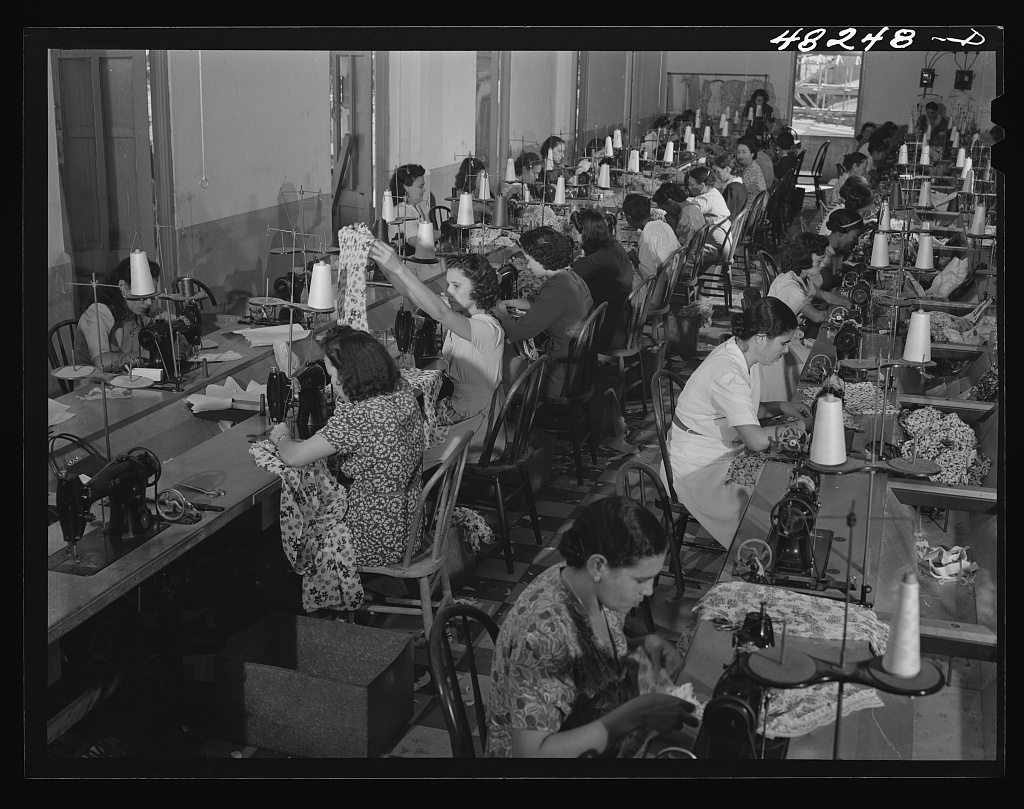
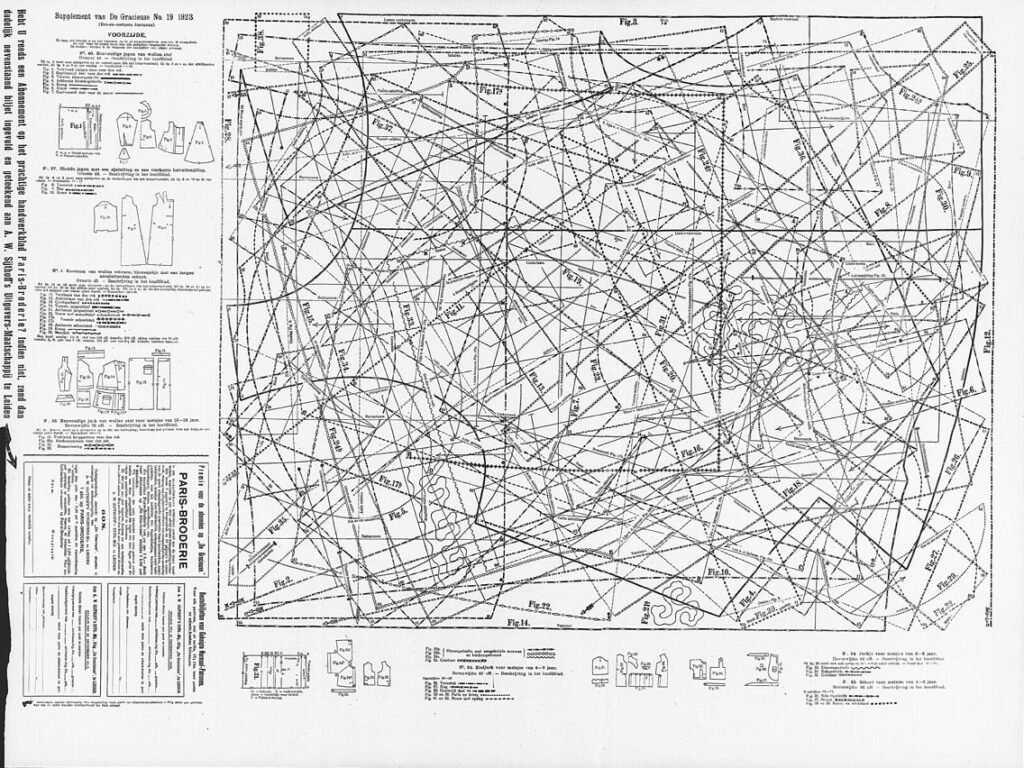
Ronny Quevedo was born in Guayaquil, Ecuador and moved to New York as a child, growing up in the Bronx.¹ Both of his parents’ professions are embedded in his practice. His father was a professional soccer player in Ecuador, and the lines of athletic fields — soccer pitches, basketball courts, gymnasiums — recur throughout Quevedo’s drawings and installations as abstract landscapes of movement, migration, and memory. His mother worked as a dressmaker and seamstress, and it is her labor that is most directly present in the materials of astro and all star. Wax paper is a standard tool of the garment trade, used to transfer patterns from one surface to another. By elevating it into a fine art material, Quevedo honors the working-class labor embedded in its history. As he has said of his material choices, he hopes viewers come away knowing that “this work is meant to represent a history of labor.”²
The titles of the two works carry their own layered meaning. In a 2022 interview with the Joan Mitchell Foundation, Quevedo spoke directly about the connections he draws between playing fields and the cosmos, describing the movement of bodies as being “like those of constellations,” and noting that alongside sports diagrams, he finds himself “thinking about constellations and stars.”² In this sense, astro — the Spanish word for star — connects athletic aspiration and the physical space of play to the night sky and to deeper questions of navigation, migration, and belonging. All star similarly operates across registers, evoking both the highest honor in professional sports and the everyday aspiration that drives players at every level of the game.
Footnotes
¹ Ronny Quevedo, artist biography, Alexander Gray Associates. https://www.alexandergray.com/artists/ronny-quevedo/
² Ronny Quevedo, interview, Joan Mitchell Foundation, July 11, 2022. https://www.joanmitchellfoundation.org/journal/in-the-studio-ronny-quevedo
Ronny Quevedo, astro and all star
astro and all star are two wax on paper works by Ecuadorian-American artist Ronny Quevedo, both created in 2021. Each piece measures just over fifteen inches tall by just over nineteen inches wide. Their longest sides run parallel to the ground, and they are meant to be displayed together as complementary works.
Both pieces draw from the visual language of sports—the marks, diagrams, and symbols used to map plays and track movement. The wax medium creates a textured, layered surface that gives the works a tactile, almost chalkboard-like quality, as though they’re recording movements or strategic plans.
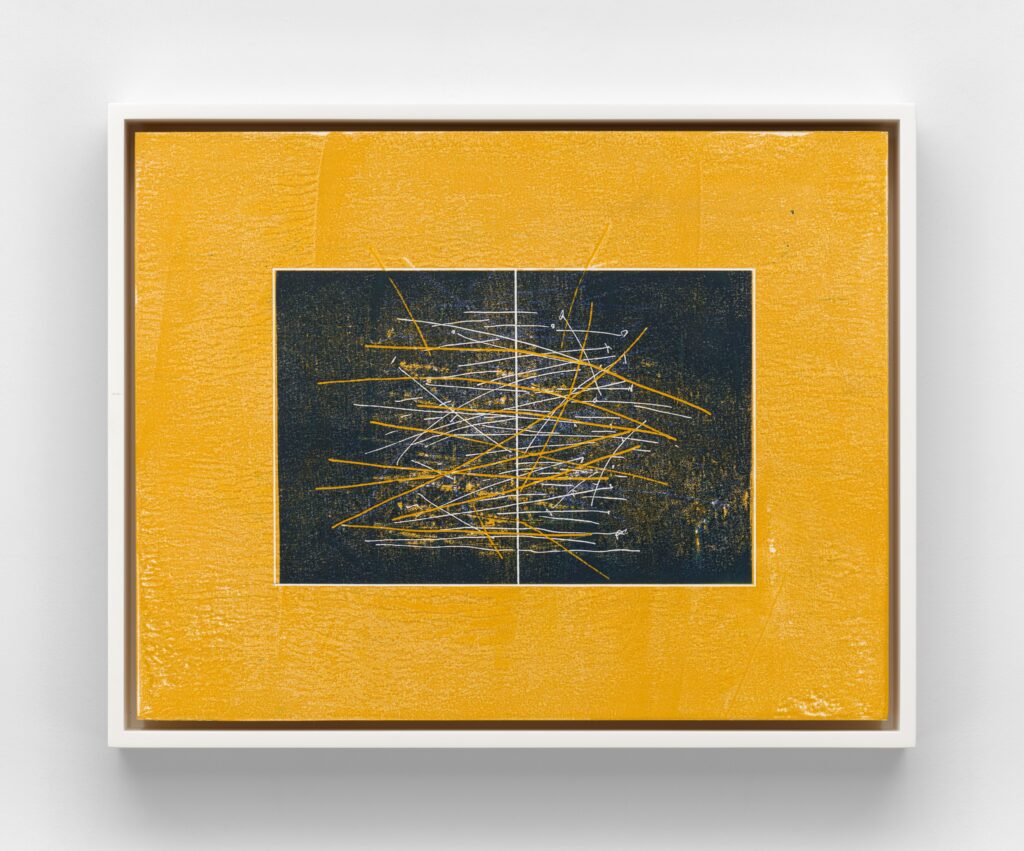
astro is framed by a vibrant golden-yellow border that surrounds a dark central field. The interior is a deep blue-black surface divided vertically down the center. Across this dark ground, white and yellow lines shoot in multiple directions, crossing and overlapping each other in a frenetic tangle. The lines vary in weight and intensity—some are bold and decisive, others more delicate. They create a sense of speed and trajectory, like paths traced through space or the arcing flight of a ball captured in multiple exposures. The energy is explosive and scattered, with lines radiating outward from various points.
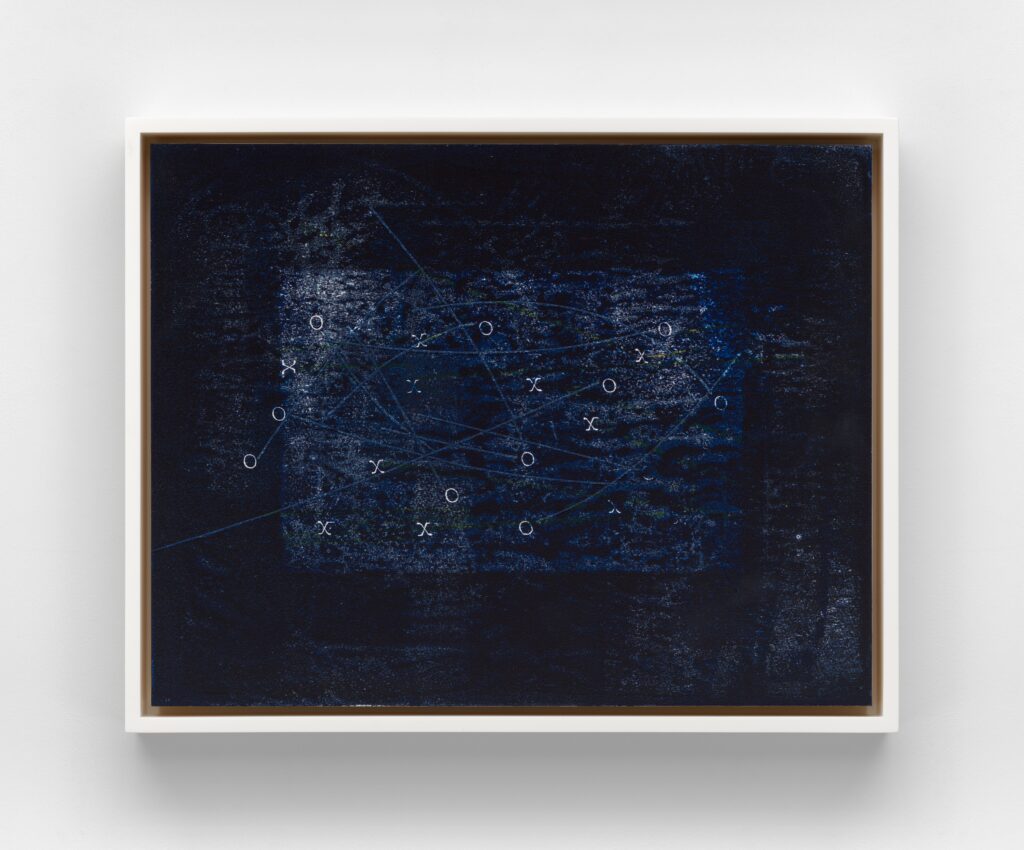
all star, in contrast, presents a quieter, more strategic composition. The work is dominated by a deep midnight blue surface with areas of texture and variation—some sections appear worn or brushed, creating subtle tonal shifts across the field. Scattered across this dark ground are white circles (O’s) and X’s, the familiar notation of game plays and tactical diagrams. Thin white lines connect these marks, creating a network of strategic relationships. The marks are distributed across the surface in a deliberate pattern, suggesting a planned formation or choreographed movement. Unlike the explosive energy of astro, this work feels more contemplative and analytical, as though mapping out possibilities rather than capturing action in motion.
Together, the two works create a dialogue between spontaneity and strategy, between the kinetic energy of play and the careful planning that underlies it. The golden warmth of astro contrasts with the cool, deep blue of all star, while both share a vocabulary drawn from athletic fields and courts.
How do our bodies keep the score?
Tabitha Soren spent nearly a decade and a half as a television journalist, most notably as a reporter and anchor for MTV News, before leaving that career in 1999 to become a fine art photographer.¹ In 2003, she was introduced to the Oakland Athletics’ newly drafted rookie class and committed herself to documenting their lives over the following fifteen years. The resulting body of work, Fantasy Life, follows them through the minor leagues and beyond, tracking not only their rise but their gradual release from the game: into coaching, coal mining, insurance sales, and in some cases homelessness. Only six percent of players drafted into professional baseball ever reach the major leagues.²
The elbow injuries embedded in Net Impact reflect the physical toll that minor league life extracts from pitchers. Bone spurs in the elbow develop from the repetitive stress of throwing overhand, as the extreme force of pitching — repeated thousands of times over a career — causes small fragments of bone to form at the joint. Related elbow surgeries have become increasingly common across professional baseball: by 2023, more than a third of all active major league pitchers had undergone reconstructive elbow surgery at some point in their careers, a twenty-nine percent rise since 2016.³ For minor leaguers, who earn far less than their major league counterparts and often play without the same access to medical support, the stakes of such injuries are even higher.
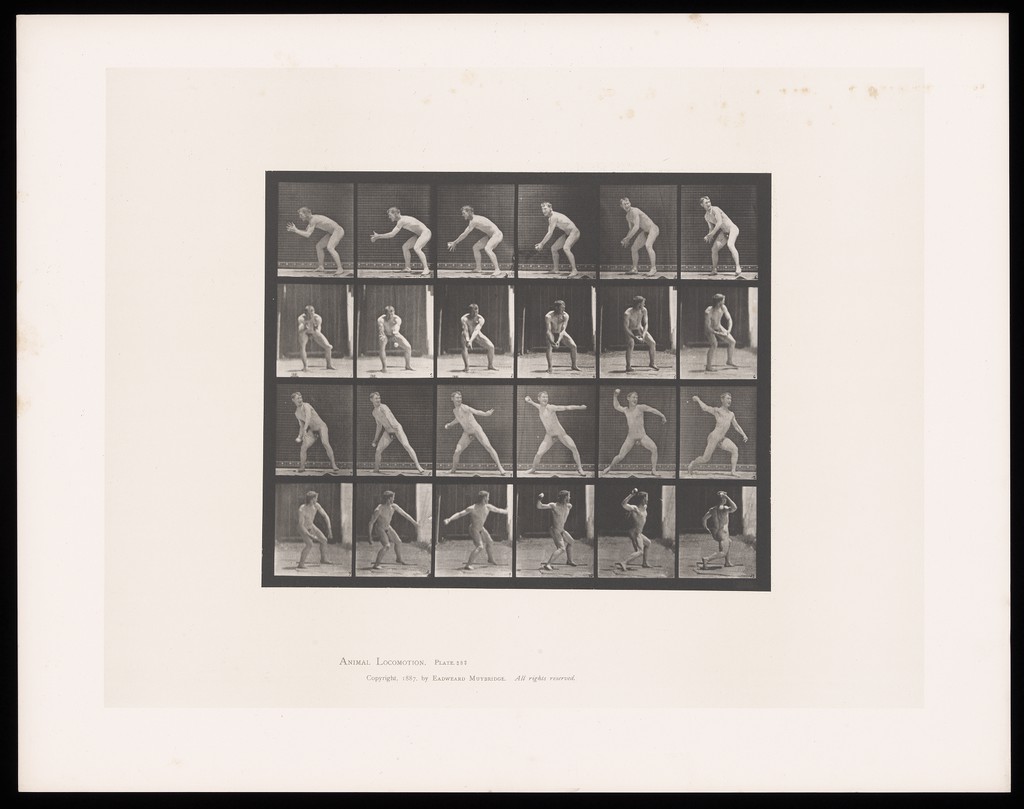
Soren chose tintypes — a photographic process developed in the mid-nineteenth century — because, as she has noted, baseball and photography came into the world only about a decade apart, making the format feel historically appropriate to the subject.⁴ The process requires long exposures and produces unique, unrepeatable images on thin sheets of metal, each one marked by the imperfections of its making. For Soren, that fragility felt right: a record of bodies pushing toward something that, for most, would remain just out of reach.
Footnotes
¹ Tabitha Soren, interview, The Photographic Journal. https://thephotographicjournal.com/interviews/tabitha-soren/
² Tabitha Soren, Fantasy Life, artist’s website. https://www.tabithasoren.com/work/fantasy-life
³ “What Doctors Wish Patients Knew About Tommy John Surgery,” American Medical Association, July 12, 2024. https://www.ama-assn.org/public-health/prevention-wellness/what-doctors-wish-patients-knew-about-tommy-john-surgery
⁴ Tabitha Soren, Fantasy Life, artist’s website. https://www.tabithasoren.com/work/fantasy-life
Tabitha Soren, Net Impact
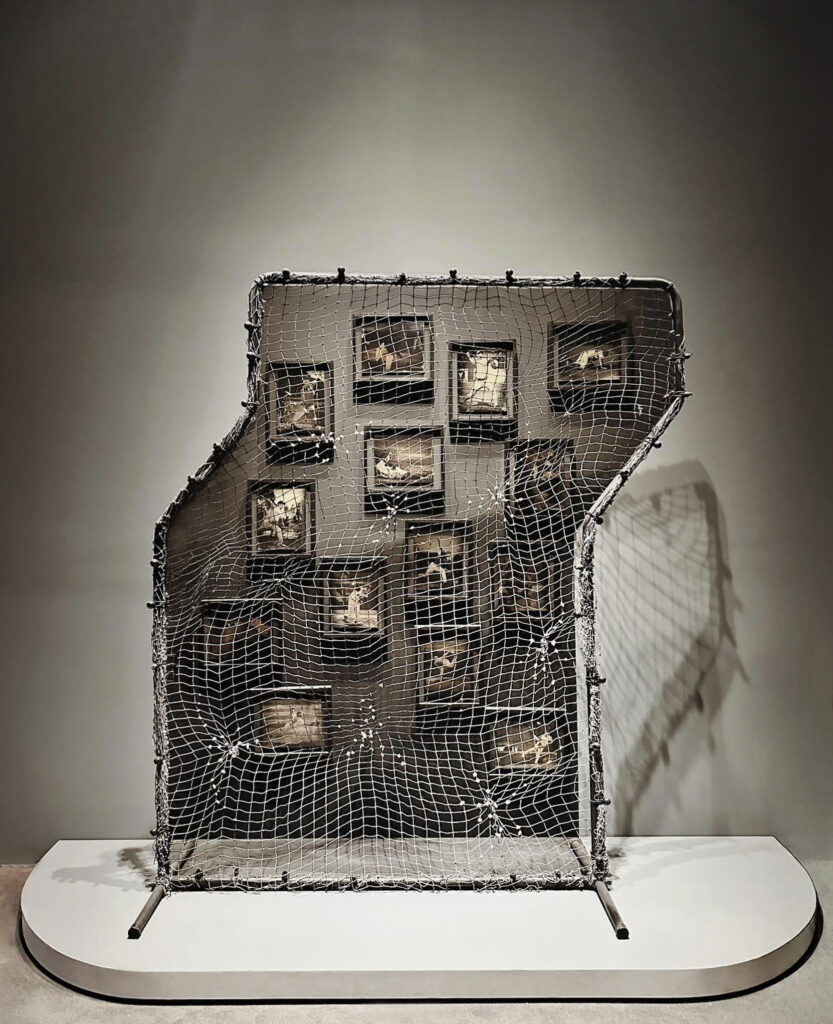
Net Impact is a mixed media work by American artist Tabitha Soren. Part of a series that began in 2003, the work measures seven feet tall by just over six feet wide by just over one foot deep.
The work is built on a pitcher’s safety screen—a steel armature frame, the kind used on baseball fields to protect pitchers during batting practice. This black metal frame provides the skeleton for the free-standing sculpture, giving it an industrial, utilitarian presence.
Stretched across this frame is UV-resistant nylon baseball netting, the same material used on practice fields and batting cages. The netting creates a grid pattern; its diamond-shaped openings slightly irregular and organic, sagging and pulling in places where tension varies. The netting functions like a screen revealing and obscuring what lies behind it.
Positioned behind the netting is a black backing board, cut to match the contours of the steel armature frame. Mounted on this board are fifteen unique tintypes arranged in a grid formation. Tintypes utilize a photographic process from the 1850s to create images on thin sheets of blackened metal, giving them a distinctive dark, silvery quality. Each tintype captures bodies in motion: baseball players mid-pitch, mid-swing, or in various athletic poses. The figures appear as ghostly presences viewed through the netting with their movements frozen in the historical photographic process. The tintypes vary in tone from deep black to warm sepia to cool gray. Their surfaces reflect light differently depending on the viewer’s angle.
Embedded throughout the netting are bone fragments—actual bone spurs that have been surgically removed from baseball players’ elbows. These small, ivory pieces of bone are attached to the netting at various points, secured with resin and cured glue. They appear like small nodules or growths on the net, catching light and creating a scattered pattern of pale marks across the dark composition. Some are clustered together while others are isolated. Their organic, irregular shapes contrast with the geometric pattern of the netting.
The work creates multiple layers of depth and transparency. The tintypes are partially visible through the netting’s openings, partially obscured by its threads. The bone fragments create additional points of visual interruption, small three-dimensional elements that cast shadows on the images behind them. The overall effect is of looking through a protective screen at historical images of athletic motion, while simultaneously encountering the physical evidence of the body’s breakdown from that same motion.

