Introduction

Hurvin Anderson: Passenger Opportunity is a new sixteen panel installation by the artist and his first solo exhibition with the Pérez Art Museum Miami. Anderson was born in Birmingham, England to Jamaican parents.
Anderson’s process explores various sources, including photographs from his travels, object studies, and personal experiences. This installation was inspired by the murals of renown Jamaican artist, Carl Abrahams, at the Norman Manley International Airport in Kingston, Jamaica. Created in 1985, these large, two-part murals, located in the departures lounge, depict various aspects of Jamaican history and culture from the colonial to the modern day. Anderson’s work for PAMM mimics the scale and structure of these murals—appearing nearly, if not identical in size.
Who are the Windrush generation?

Born in Britain to Jamaican parents who arrived with the Windrush generation, Hurvin Anderson channels his dual heritage into landscapes that blur the line between the real and the abstract, creating spaces that exist somewhere between memory and presence. The Windrush generation refers to Caribbean immigrants who came to the UK between 1948 and 1971, named after the HMT Empire Windrush ship.
These immigrants arrived when the 1948 British Nationality Act allowed colonial citizens to live and work in Britain. Though they came to help rebuild the country after World War II and filled important job shortages, they often faced discrimination. Still, they deeply influenced British life, especially through music and food. This wave of migration ended with the 1971 Immigration Act, which meant people from Commonwealth countries no longer had an automatic right to stay in Britain.
This change had lasting effects. The government failed to keep proper records of Commonwealth citizens already living in Britain, which led to the 2018 Windrush scandal. Many long-term residents were wrongly labeled as illegal immigrants. Some were detained, denied basic rights, threatened with deportation, and in at least 83 documented cases, wrongly deported. The scandal revealed serious problems in Britain’s immigration system and sparked important discussions about racism in British institutions.
Today, “Windrush” has become a symbol of broader conversations about immigration, race, and British identity. The UK now celebrates Windrush Day on June 22nd, marked by a national monument unveiled in 2022. It is within this continuing story that Anderson’s paintings explore what it means to belong to two cultures at once, capturing the complex experience of being both British and Caribbean.
Passenger Opportunity
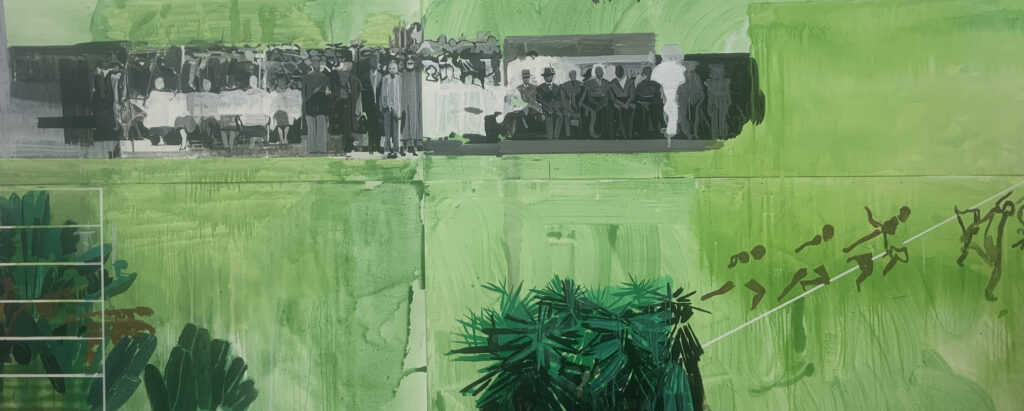
Passenger Opportunity is a sixteen-panel mural by the artist Hurvin Anderson completed in 2024. Overall, the artwork measures just over thirteen feet tall and thirty-two feet wide. It is in landscape format, meaning that its longest side runs parallel to the ground.
Upon entering the gallery, guests are greeted with the back of a raw wood panel wall. The wall is supported by a wooden frame with angled supports. This wall structure serves as a backdrop for displaying the mural. Guests can walk around from the back of the work, leading to an open room with concrete walls and two large benches in the middle back of the room. Once directly in front of the artwork, the entrance of the gallery is no longer visible.
The artwork is a large, colorful, multi-panel piece created with several thinned-out washes of oil paint. Its background is light blue and has a grid pattern, dividing it into several rectangular sections. Each section features a different scene or image, blending abstract elements with recognizable figures and landscapes.
The mural is divided in half. One side represents the movement of people as they have traveled between London and Jamaica. The top panels include a depiction of waves and a bright yellow sun, as well as a pink house. Below are images of people in everyday settings; such as walking, sitting, or interacting, painted in bright pinks, blues, and greens. The bottom row of the left side transitions into darker tones with black-and-white figures and abstract shapes showing passengers of the Windrush ship in 1948.
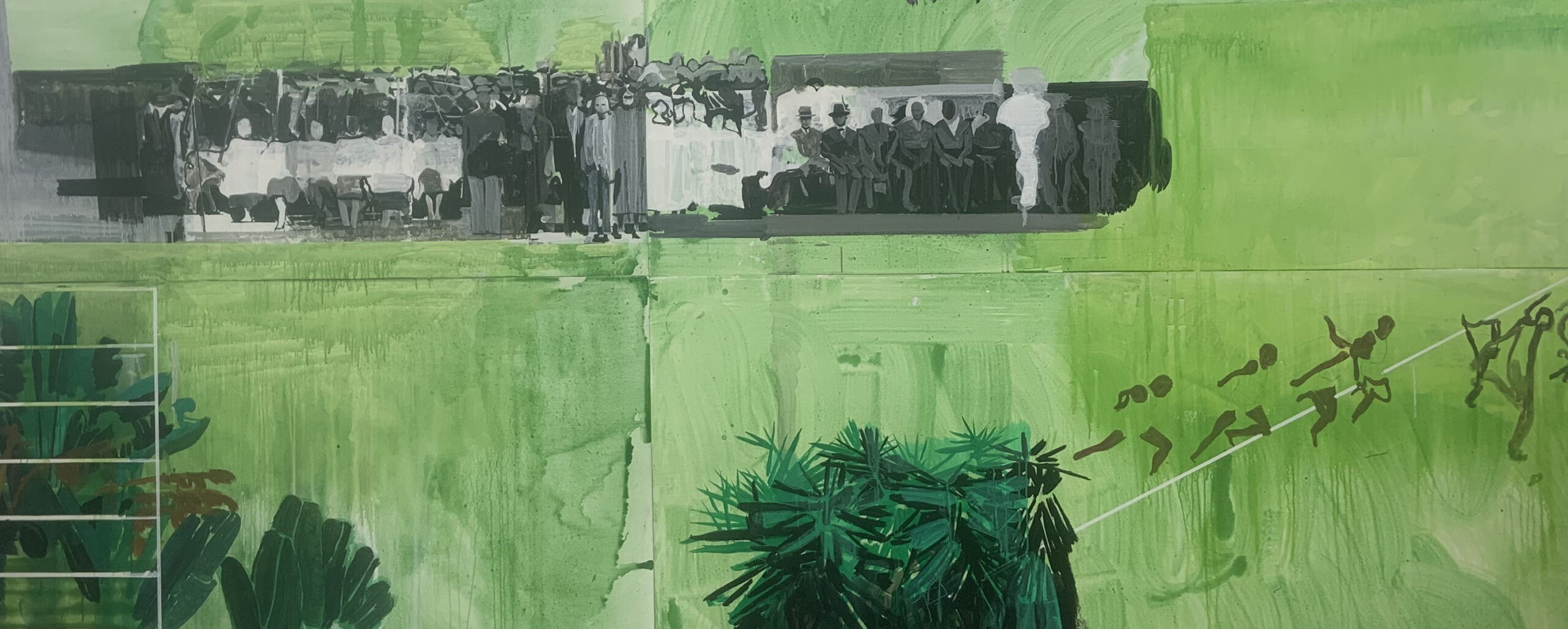
The other half of the wall is a full lush vibrant green paint, that helps to build a scene of an island setting. It shows an open natural landscape with palm trees, figures, and buildings dominated by shades of green. Some sections have abstract or sketchy shapes, while others include more defined scenes of people gathering or walking. Blue and yellow accents appear in the sky and water elements throughout this side. This half of the artwork also represents the movement of a people from their land, yet, from a different timeline for Jamaica, and its early historical connection to colonialism, slavery and the erasure of the Taino tribes (the indigenous people of the Carribean islands, such as Cuba, Jamaica, Haiti and Dominican Republic, Puerto Rico, and the Virgin Islands).
Feedback
We hope you enjoyed this Digital Exhibition Guide!
We appreciate you taking the time to submit feedback to us as we strive to make PAMM as engaging as possible. You may submit your feedback anonymously through this form.