Introduction
“Jedd Novatt (b. 1958, New York; lives in Paris) has created and continues to define a language of art making that is informed equally by the history of sculpture and the dynamism of the contemporary moment. Known for working in monumental scale, often outdoors, his works are also defined by their placement in the landscape and hence by their connection to nature and to place, often the site of something: a garden, campus, or public park. Pérez Art Museum Miami is home to two of his outdoor sculptures, Chaos Bizkaia (2012) and Chaos SAS (2013). Each is centered on stacks of open bronze and stainless-steel cubes in dynamic, seemingly unstable towers measuring 18 and 14 feet tall, respectively.
Jedd Novatt: Monotypes and More, on the other hand, comprises small-scale sculptures that inform Novatt’s two-dimensional works on paper and his relationship to drawing and printmaking. Displayed in the Mary M. and Sash A. Spencer Gallery, which has a window that overlooks Chaos SAS, this show captures the breadth of Novatt’s work in two and three dimensions, creating conversations between objects in and outside the museum.
Jedd Novatt: Monotypes and More is organized by Franklin Sirmans, Director, with Maritza Lacayo, Curatorial Assistant and Publications Coordinator. Lead individual support from an anonymous donor, and additional support from Burgess Modern + Contemporary, is gratefully acknowledged.”
-Maritza Lacayo – PAMM Curatorial Assistant and Publications Coordinator
The above text read by Curatorial Assistant and Publications Coordinator, Maritza Lacayo, forms the basis of this digital tour of Jedd Novatt: Monotypes and More. This tour focuses on the different ways Novatt explores similar themes and how, while being different, they are able to create a cohesion within themselves. By highlighting certain works, the tour is meant to offer an entry point into the work of Novatt. We hope this exhibition and tour generates curiosity and leads to a greater understanding of the work.
This app tour was developed and recorded by PAMM Teaching Artist, Armando Zamora with direction from Digital and Interpretative Content Coordinator, Darwin Rodriguez. PAMM Education would like to thank Maritza Lacayo and Franklin Sirmans for organizing this exhibition and for their help in developing this digital app tour.
Kármán Line I
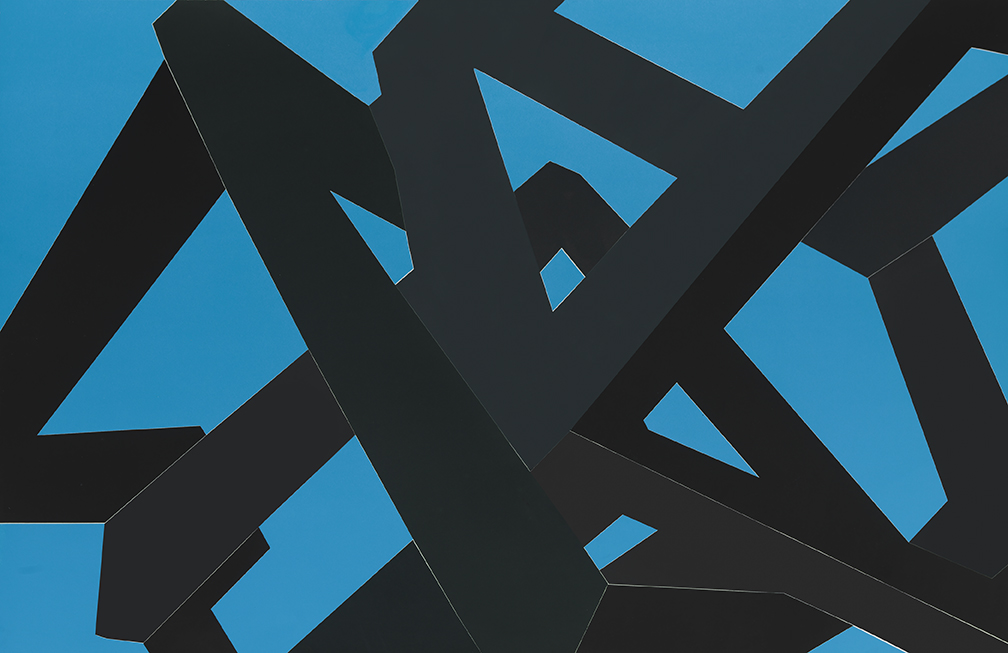
Upon entering the Mary M. and Sash A. Spencer Gallery, one encounters a large photograph of artist Jedd Novatt’s large scale installation, found outside in front of the museum. Turning left and near the end of the wall to our left, we will find Kármán Line I, a woodblock monotype on paper. It measures roughly four feet by six feet and is hung in a landscape orientation meaning its longest side runs parallel to the ground. The piece is primarily comprised of a foundation of solid light blue with intersecting lines made of shades of black and dark grey. The lines appear to move in every direction, with no clear sense of grounding. Many of the lines are bold and thick giving the impression of beams or pillars. While the intersection of these beams creates a sense of chaos, their stillness seems like a frozen moment of tranquility. While all different, many of the monotype pieces in this exhibition share a formalized approach. They all feature intersecting lines that are wide and of a different color than that of the background color, which like Kármán Line I is always a solid color. They also share a name in Kármán Line. The Kármán Line is the attempt to define the boundary between our atmosphere and outer space. These unique pieces with their shared visual approach provide us insight into how artist Jedd Novatt explores the idea of space, meticulously, and in different media.
Small Sculptures
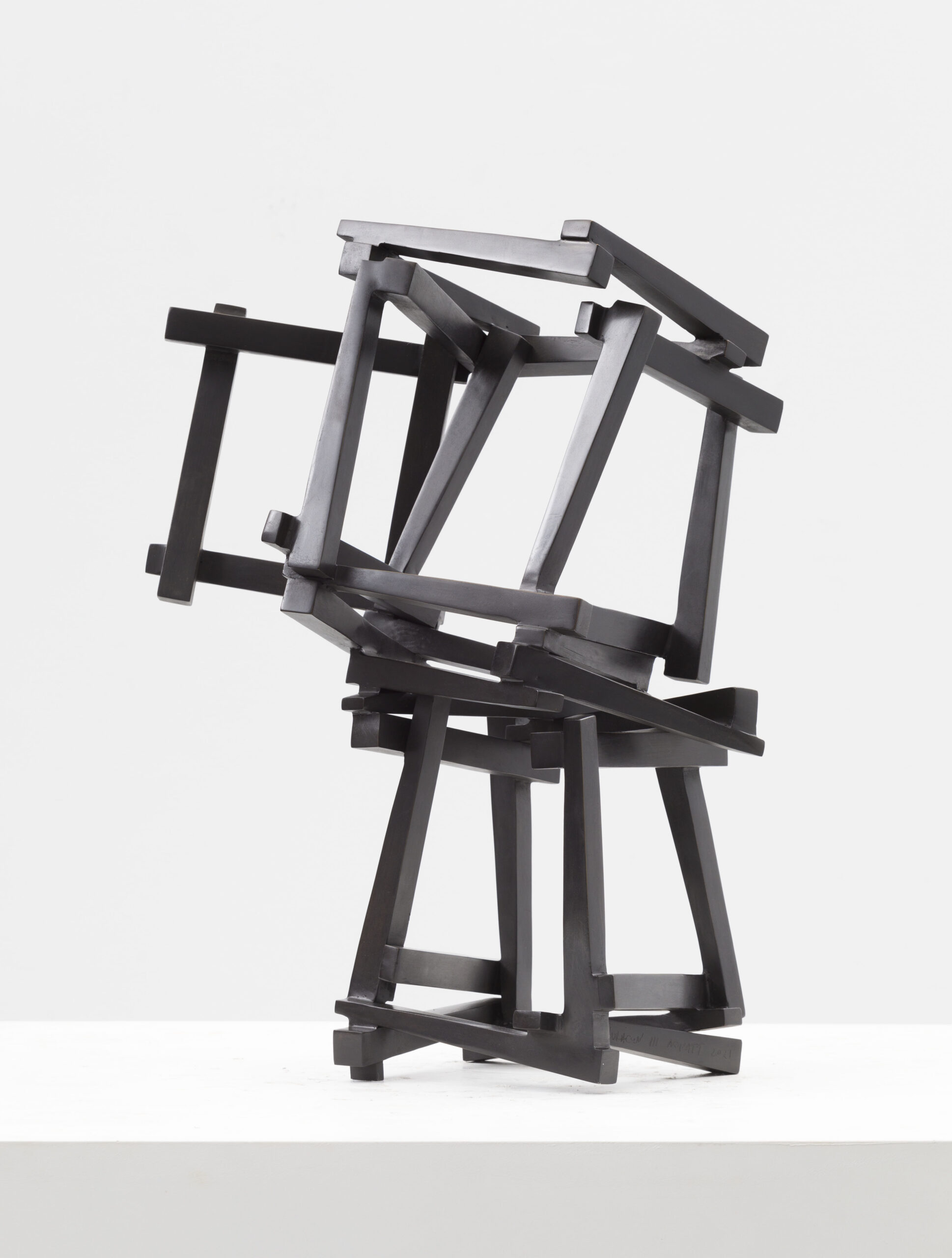
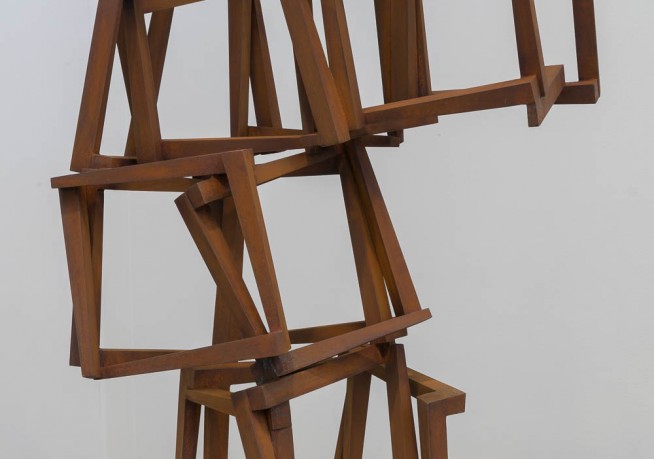
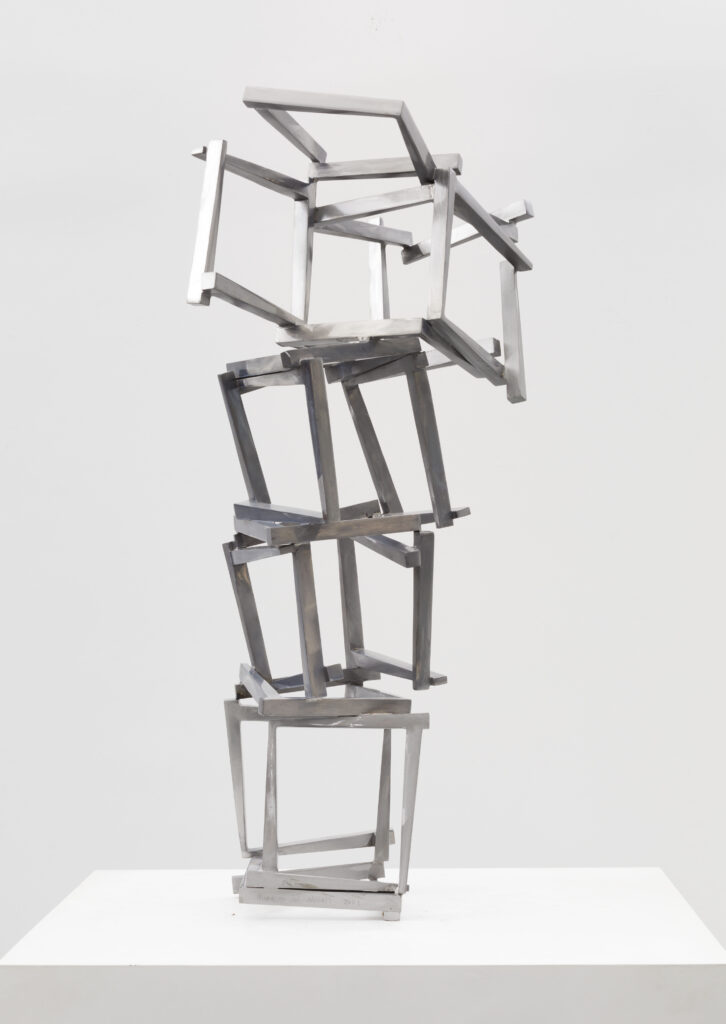
As one turns around and then faces the entirety of the gallery, we are surrounded by works of different sizes, materials, and media all by artist Jedd Novatt. In the center of the space there is a pedestal that is low to the floor. On it one can see a collection of four sculptures made of bronze, this is Novatt’s Huracán series. These sculptures vary in size ranging from eleven to nineteen inches tall, twenty-four to forty-five inches long, and nineteen to twenty-six inches wide. They are different shades of grey and silver with a metallic finish. While all different in their composition and color, much like the Kármán series of monotypes, they share a similar approach and demonstrate a cohesion among them. Like in the Kármán series, the sculptures in the Huracán series are composed of rectangular lines that look similar to steel beams used to construct buildings. They intersect to create a variety of geometrical shapes that resemble squares or cubes. However, the lines of these shapes often continue beyond where we normally expect them to end, creating irregular forms that protrude in many different directions. The cube-like shapes stack on top of each other and create the tension like they could fall over at any moment. Because they are hollow, it appears that the cubes are simply bars balancing on top of one another like a house of playing cards or matchsticks. While mostly vertical in their layout, many of the pieces in the Huracán series lean to one side at their peak. This slight tilt reinforces the sensation of an object that is at the verge of collapse.
Large Outdoor Sculptures
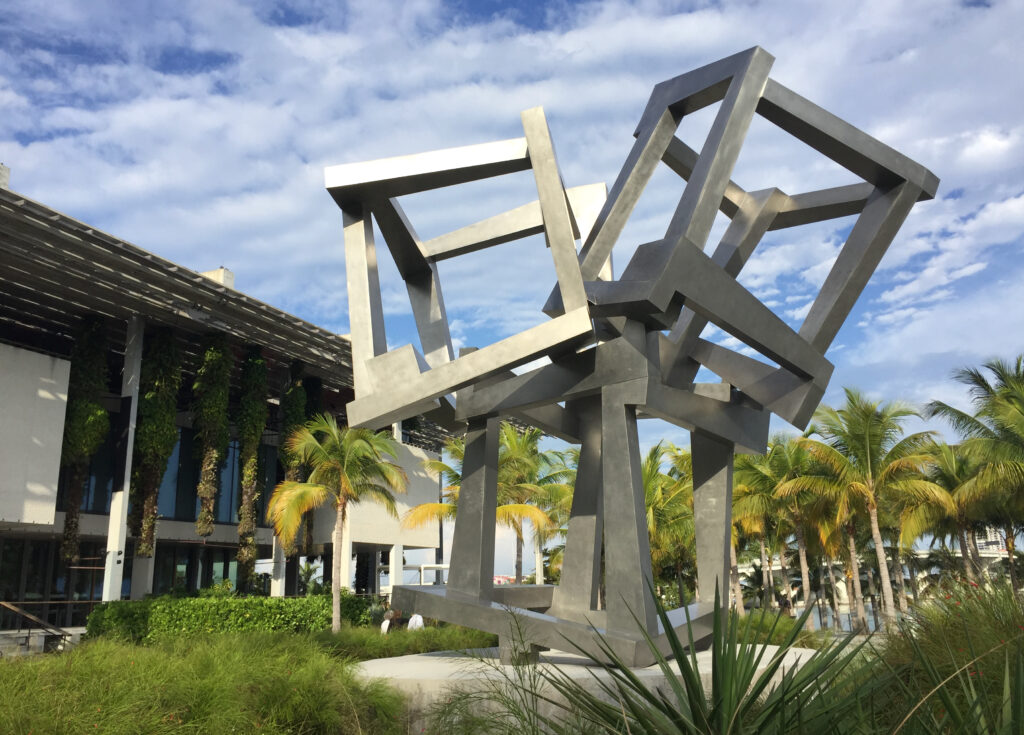
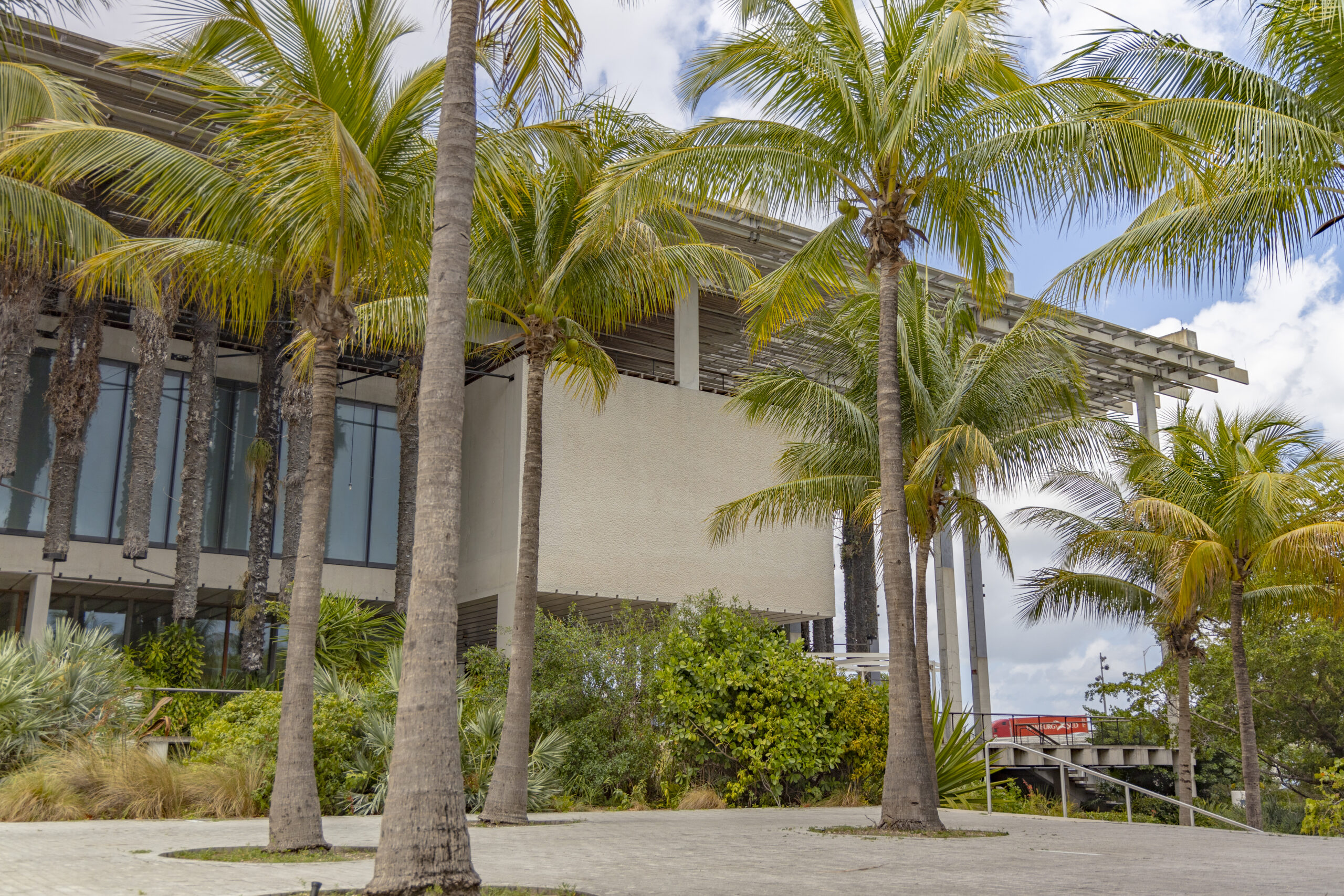
Past the pedestal of Huracán sculptures, toward the back of the Spencer gallery is a window. Beyond the window, outside on PAMM’s grounds, one finds a fourteen-foot-tall stainless-steel sculpture that shares many similarities with both the work from the Huracán and Kármán series. The sculpture is Chaos SAS by Jedd Novatt and is the same sculpture shown in the photograph at the entrance of the gallery. It sits among the park’s landscape and like the smaller pieces in the gallery, threatens to collapse within itself. Much like the Huracán sculptures, it is comprised of metal beams that intersect to create cube-like shapes that are stacked on top of one another. The cubes are irregular and flow into each other. Like the monotypes of the Kármán series, the bars of steel seem to go in every direction while maintaining a solid form. The hollowness of the sculpture along with the clear seams between its beams gives the impression of individual pieces in the process of being joined or falling apart, much like the smaller Huracán sculptures. The clear difference is the increase in scale. By increasing the scale of the object, the consequences seem to grow as well. One can imagine the weight of these beams and the strength required to maintain them suspended in their unstable state and the potentially catastrophic results the loss of that strength could result in. Chaos SAS was installed on the grounds of the PAMM while the PAMM was being constructed. It was shipped from Spain to Miami and then brought on site via truck. The relationship between Jedd Novatt and the museum continues as all the work seen in the gallery was made between 2019 and 2021 and has yet to be seen by the public, making its debut here at PAMM.
Feedback
We hope you enjoyed this Digital Exhibition Guide!
We appreciate you taking the time to submit feedback to us as we strive to make PAMM as engaging as possible. You may submit your feedback anonymously through this form or by emailing us directly at AppFeedback@pamm.org