- 1/24 1. Introduction
- 2/24 2. Jana Euler: Whitney
- 3/24 3. Gisela Colón: Ultra Spheroid (Gold Aqua)
- 4/24 4. Theresa Chromati: The bull is out and my foot is in my mouth (are we staying or leaving)
- 5/24 5. Wilfredo Lam: La Chevelure (The Mane)
- 6/24 6. Roberto Matta: Crucifixión
- 7/24 7. Eamon Ore-Giron: Infinite Regress LXXV
- 8/24 8. Guadalupe Maravilla: Silver Guadalupe Drawing
- 9/24 9. T. Elliot Mansa: The Victory of John Henry
- 10/24 10. Zilia Sánchez: Sin título
- 11/24 11. Hew Locke: For Those in Peril on the Sea
- 12/24 12. Leasho Johnson: The dissension of Anansi (#19)
- 13/24 13. Sam Gilliam: They Dance and Sail Away
- 14/24 14. Lorna Simpson: Night Light
- 15/24 15. Mark Bradford: Raidne
- 16/24 16. Gisela McDaniel: Speaking Seeds
- 17/24 17. Patrick Dean Hubbell: You Keep Our Spirit Safe Between All Within the Day to Night
- 18/24 18. Esteban Ramón Pérez: DNA (Bad Blood)
- 19/24 19. Frank Stella: Chodorow II and Protractor Variation
- 20/24 20. Robert Raushcenberg: Love Hotel [Anagrams (A Pun)]
- 21/24 21. Glenn Ligon: Notes for a Poem on the Third World (chapter one)
- 22/24 22. Rafael Ferrer: Red, White & Blue ARTFORHUM
- 23/24 23. Jamilah Sabur: I will wet you (pl.) with the new water
- 24/24 24. Feedback
Introduction
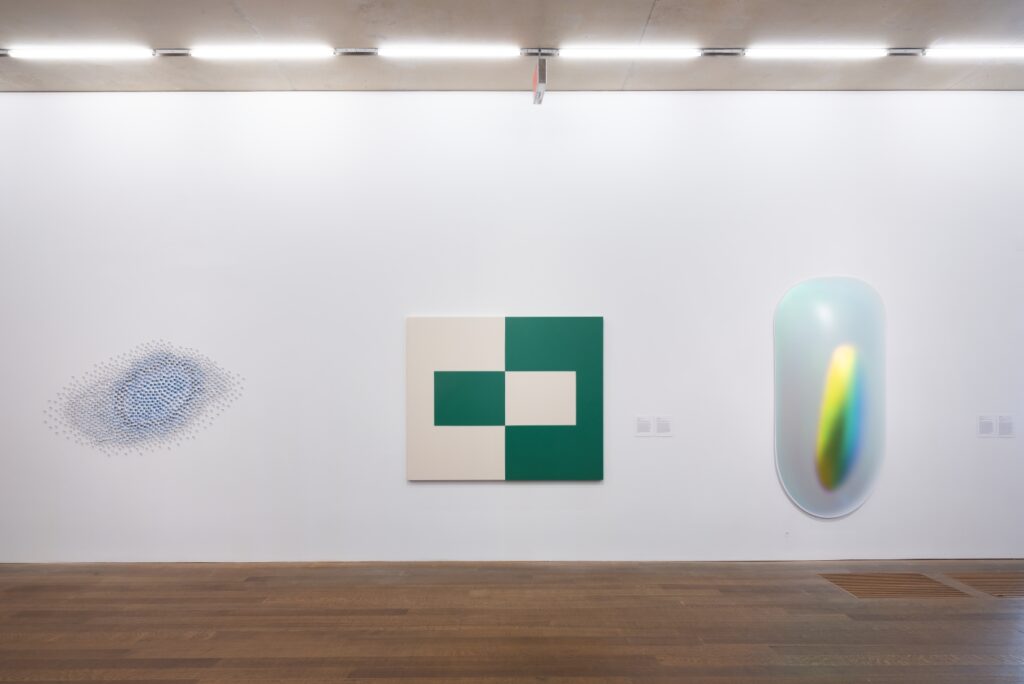
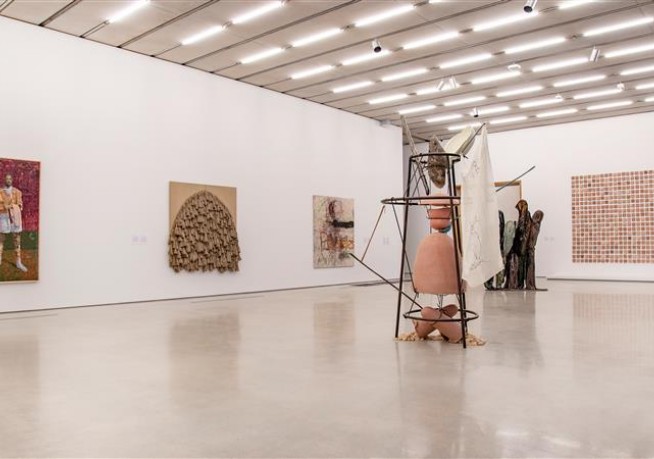
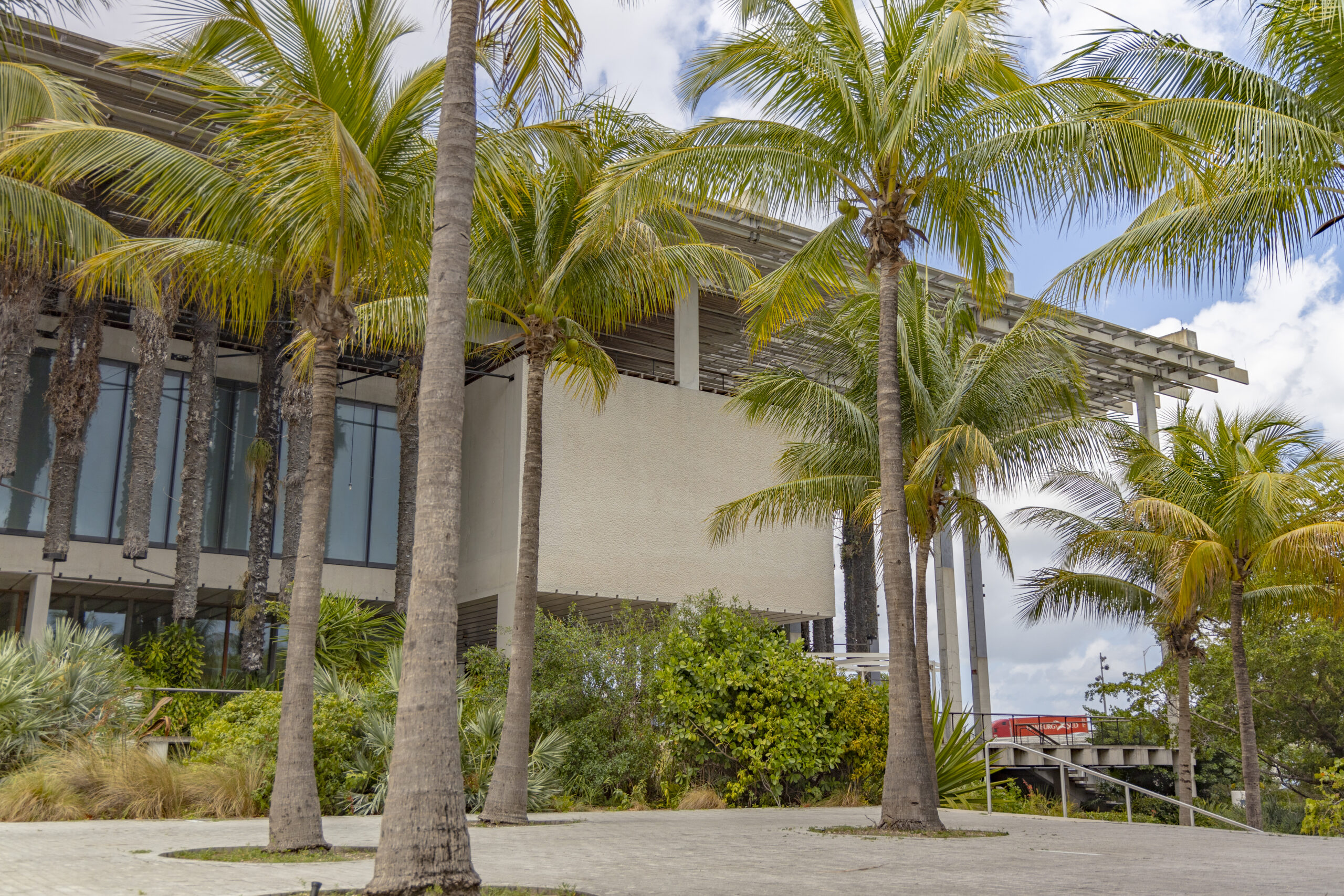
Welcome to the Pérez Art Museum Miami’s permanent collection. With nearly 3,000 works of art spread across eight galleries, this collection reflects Miami’s unique position at the crossroads of the Americas. Since the mid-1990s, PAMM has built a collection with a strong emphasis on art that relates to the US Latinx experience, the African diaspora, Latin America, and the Caribbean—spanning painting, sculpture, photography, video, installation, and more.
This digital exhibition guide highlights selected works from the collection, offering insights into the artists’ practices, the contexts in which they were created, and the stories they tell. Whether you’re visiting in person or from home, we invite you to explore and make meaning from the vibrant artistic conversations happening across our galleries.
Jana Euler: Whitney
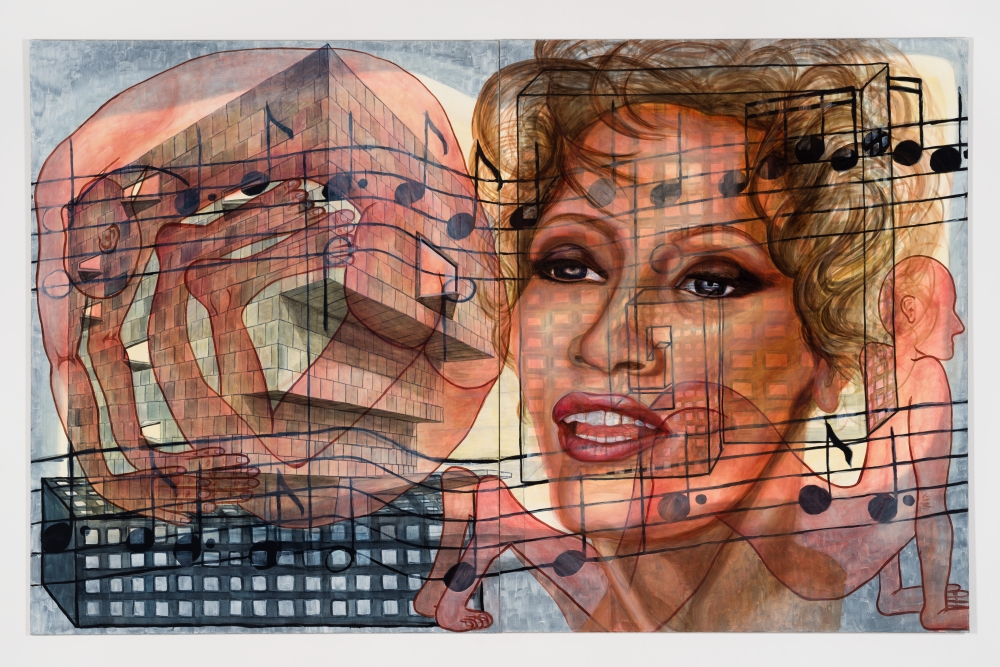
Whitney is an oil painting on canvas by Jana Euler. The artwork measures approximately six feet tall by ten feet wide by one inch deep. It is in landscape orientation, meaning that its longest side runs parallel to the ground.
This painting employs a layered, transparent approach that allows multiple visual elements to overlap and interact. The composition centers on a portrait of singer Whitney Houston. Her face sits on the right half of the painting, rendered in warm brown skin tones with her characteristic curly hair.
Overlapping and surrounding Houston’s portrait are distorted, faceless figures that create a ghostly, layered effect across the composition. At the left, a coiling human form bends backward in an extreme yoga pose. This figure contorts to emulate and embody the structure of the Whitney Museum of Art. The museum’s geometric facade is rendered in blue-gray tones with its characteristic grid-like window pattern underneath. Mimicking a spiraling snail shell, this figure rests—as does the Museum—atop a pedestal-like building.
The composition on the right flips this arrangement: a nondescript spiral-shaped building encases Houston’s face, while pinned beneath it, a human form arches in a catlike stretch. These abstract forms are integrated into a complex network of linear elements. Musical staff lines with notes are scattered throughout the picture plane.
Theresa Chromati: The bull is out and my foot is in my mouth (are we staying or leaving)
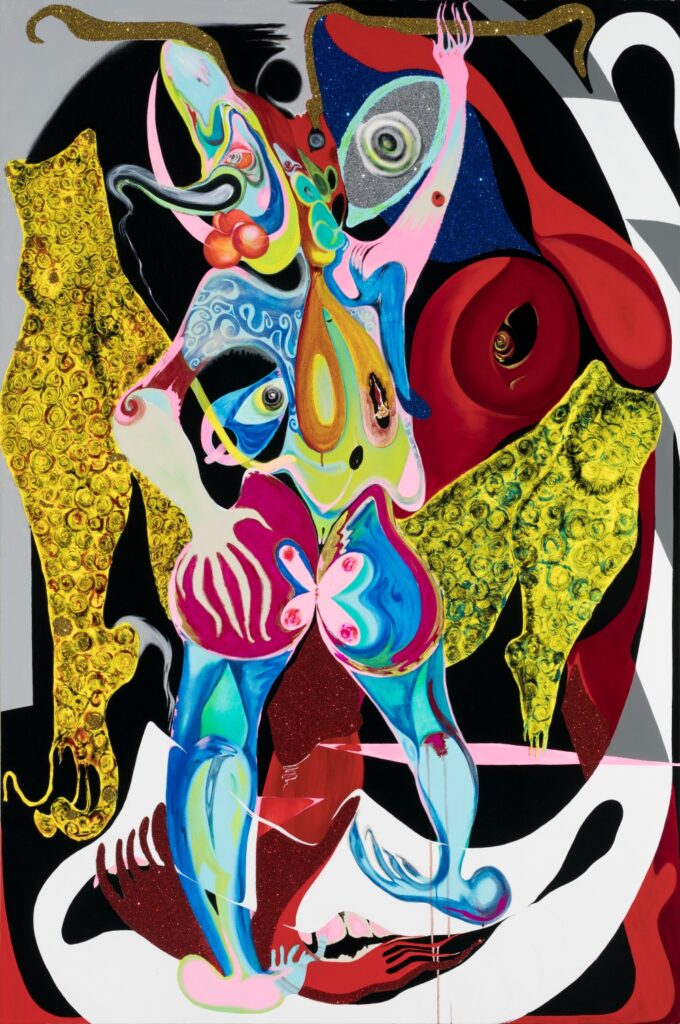
The bull is out and my foot is in my mouth (are we staying or leaving)? by Theresa Chromati is a mixed media art work on a six-foot by four-foot canvas. It is presented in portrait orientation, meaning that the shorter side runs parallel to the floor when on display in a gallery. Chromati uses acrylic paint, gouache, which is a type of paint similar to water color, and glitter.
The artwork is densely packed with variations of color. These colors create a circular composition of one, or possibly more, abstracted figures. The central figure has an arm on the viewer’s right outstretched towards the top center of the canvas as if rejoicing or dancing. Their fingers are thin and resemble the tentacles of a jellyfish. The arm is pink with light blue and grey on the forearm along with a small red dot at the elbow. At the base of the arm, it changes to dark blue. On the left, the arm is also blue at its base; however, it has swirling stripes of light blue and a portion painted in dark red, also at the elbow. It turns beige at the forearm and continues in this way toward the fingers, which are also thin and tentacle like. The figure has six fingers in its left hand and is touching their left buttock. The buttock is purple on the left, and a mixture of blue, light blue, and purple on the right. Between the left and right buttocks is a pink X shape with four red dots at each end. The figure’s left leg is blue, light blue, and green with pink at its base. The right leg is light blue, blue, and red with small drips of red extending from the knee going down towards the bottom of the canvas. The right foot has four toes and a distorted heel.
Going back towards the top of the canvas, the head of the figure is heavily abstracted and has an oblong shape, meaning it is longer than it is wider. The face is made of swirls of blue, light blue, light green, pink, and red. The nose is long and thin and extends outward like the noses of Harlequin or Pinocchio. The nose is grey, white, and black. Underneath the nose there are three red spheres, two on top of the third, that resemble puckered lips. The neck is brown, green, blue, and red. Extending upwards from the neck are two horn-like shapes made of gold glitter. The torso of the figure is made of bulbous shapes of various colors. Green, brown, dark and light blue, pink, yellow, and a spot of black. On the left extending from the torso there is an eye shape made of yellow, black, light and dark blue, and white. The pose of the figure gives the impression of someone in the middle of dancing or celebrating.
Jutting out from either side of the figure are two legs that are bent at the knee and appear to belong to another figure that is hidden behind the central, bulbous figure, but are painted in such a way that they could also belong to the same multi-colored figure described. The legs are two different shades of yellow. Both legs are painted with a repeating pattern of small circles that echo the circular shape of colors behind the figure. The brush strokes that create these small circles are thick and appear to lift off the canvas, creating both a sense of movement and a layer of undulating texture.
Behind the central figure there is an almost complete spiral made of white, grey, red, and black tones that encircles the figure. The circular shape is thicker on the bottom and thinner on the sides. The spiral hooks in an upside-down letter “U” shape on the right side of the canvas, and is met with a strip of pink on the right lower third of the canvas. On the right of the figure, in between its head and outstretched arm, there is a shape made of blue and silver glitter, and turquoise paint that resembles an eye. Underneath this eye, there is a red orifice that leads to a shape that resembles a leg and two feet. They are painted with red glitter, projecting behind and in between the legs of the central figure. The swirling background of colors along with the abstracted figure give the overall impression of a lively and psychedelic scene.
Wilfredo Lam: La Chevelure (The Mane)
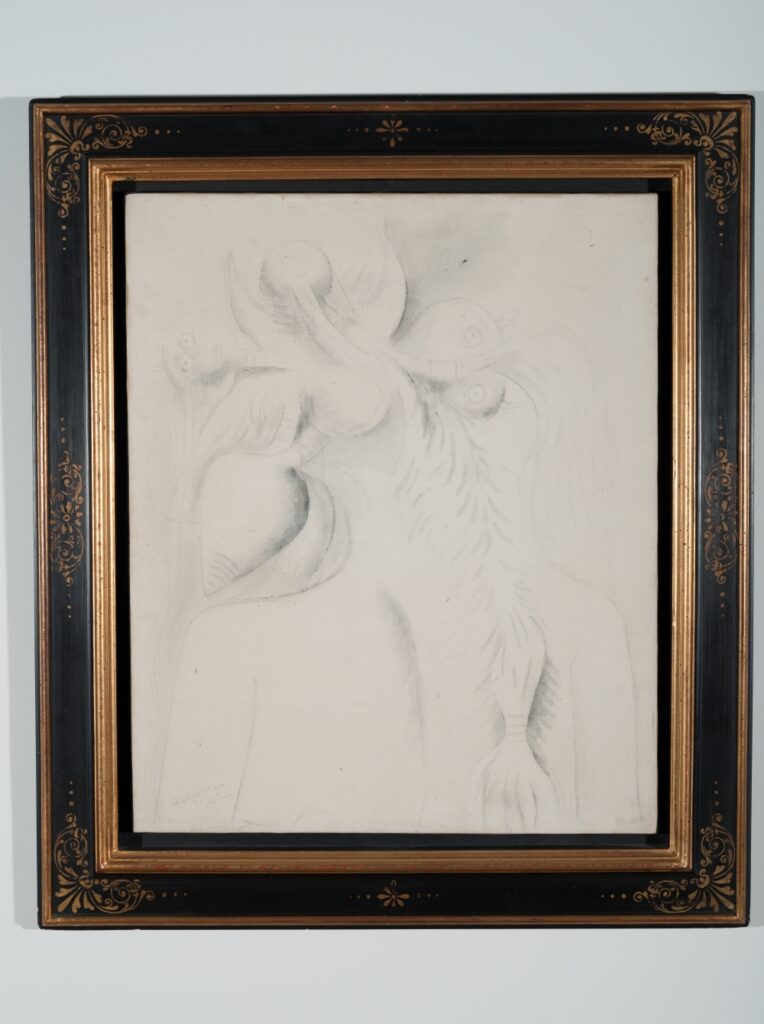
La Chevelure by Wilfredo Lam is a painting from 1945. It is made of oil paint and charcoal on canvas. It measures twenty-eight and three-quarters of an inch by twenty-three and five-eighths of an inch. It is hung in portrait orientation, meaning its shortest side runs parallel to the ground.
The painting depicts the back and shoulders of a figure and an abstracted mane.
The entirety of the canvas is painted in white oil paint. On top of this white paint the figure is drawn with charcoal. The application of the charcoal is light and appears as subtle pencil-like marks. The figure has their back turned toward us. Their left shoulder blade is visible while the one on the right is obscured by hair that is tied into a large braid that reaches the lower extreme of the canvas. The braids appear to fade into white and only subtle traces of it are visible as they reach toward where the figure’s head would be. Where the head would be there is instead an abstract collection of shapes that join together at the center. The shapes resemble spades, hearts, and circles, connected by cylindrical tubes. Several of these shapes have smaller shapes within them that resemble facial features like eyes, nostrils, and lips.
Roberto Matta: Crucifixión
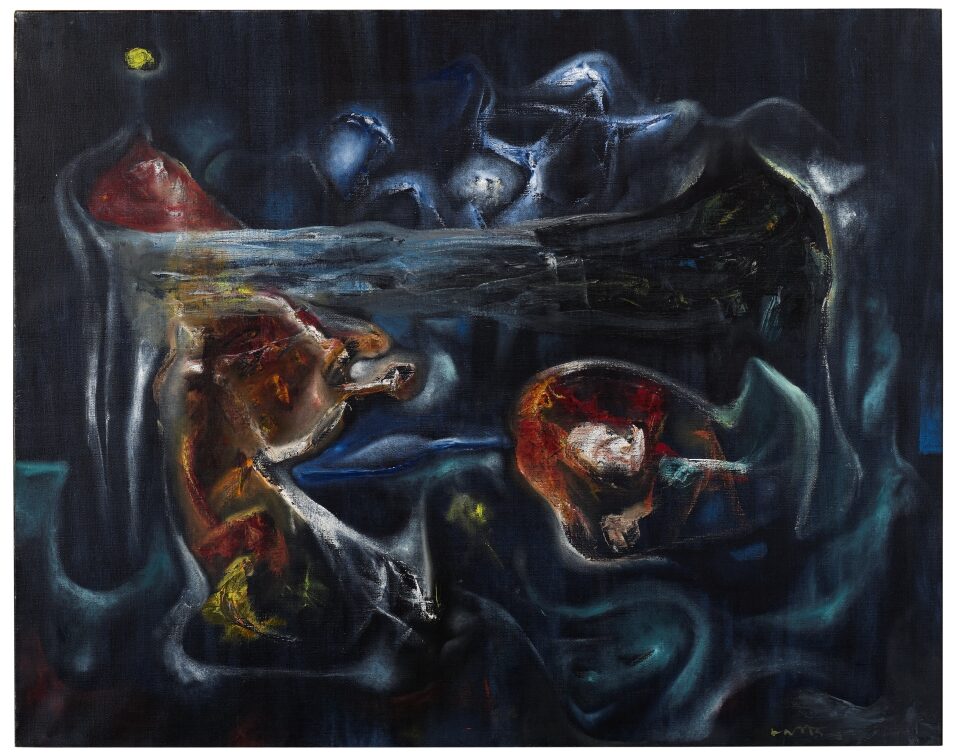
Crucifixión by Roberto Matta is a painting from 1938. It is made of oil paint on canvas and measures roughly two feet tall by three feet wide. It is hung in landscape orientation, meaning its longest side runs parallel to the ground.
This painting is an example of an abstraction, which is a style of painting that focuses on the gestural movement of shapes and colors rather than depicting scenes or figures.
The painting is formed with a foundation of dark colored paint that serves as the backdrop for the rest of the abstract shapes that seem to hover above it. This foundation is primarily black but has tones of red, blue, and green throughout that slightly change the tonality of the black color.
Above this foundation is a long streak of paint that is grey/green in color. It weaves itself around the painting and because of the gradient of shadows on it, gives the impression of a large fabric moving within the canvas.
At three points in the painting: the top left, directly underneath it in the bottom left, and toward the middle right, there are irregular shapes that are red, brown, yellow, and white in color. At the top right above one of the red shapes, there is a yellow circle. All of the shapes vary in their tonality, giving the feeling of movement and variation in light.
Eamon Ore-Giron: Infinite Regress LXXV
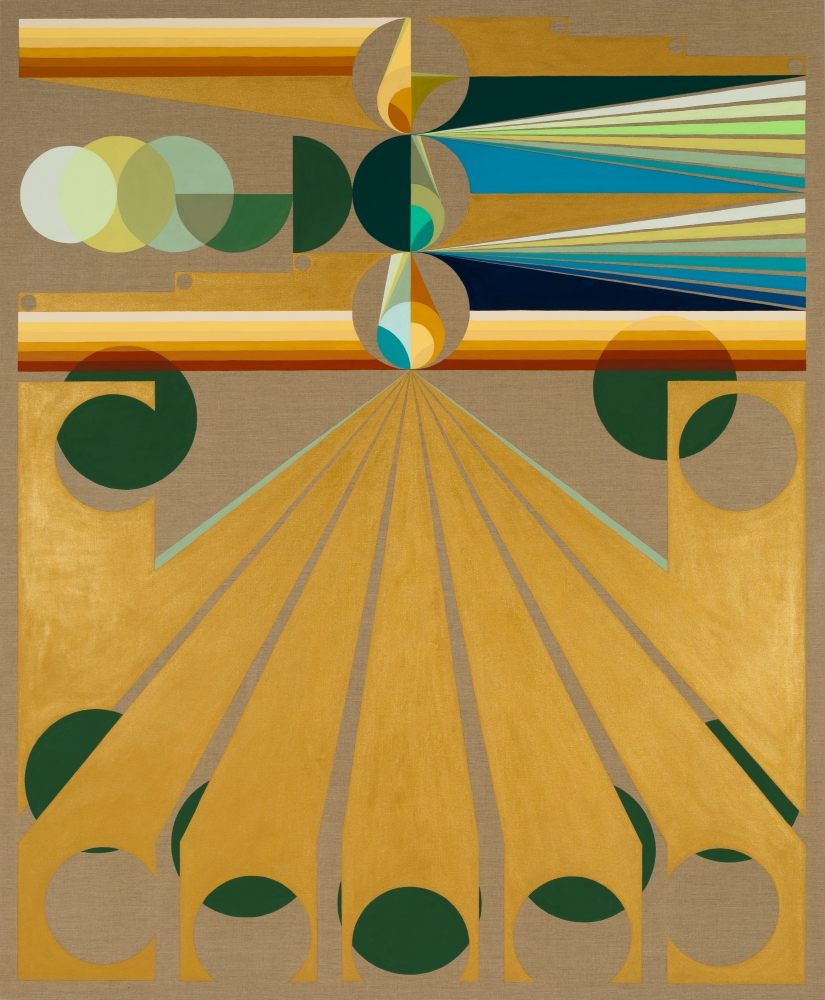
Infinite Regress LXXV by Eamon Ore-Giron is a painting from 1973. It is made of flashe on linen. It measures eight and a half feet tall by seven feet wide. It is hung in portrait orientation, meaning its shortest side runs parallel to the ground.
This artwork is an example of abstraction, a style of painting that focuses on the gestural movement of shapes and colors rather than depicting scenes or figures. The painting features a dense array of intersecting lines, rectangles, triangles, and circles over a brown linen background.
Starting from the bottom of the canvas and moving up, there is a large and irregular shape that resembles a pyramid and is painted golden yellow. At its base it has five circular cut outs that expose the linen underneath. The pyramid-like shape is made of long triangles that converge at the peak. Underneath each triangle there are five green circles that are partially obscured by the golden structure. On either side of the peak of the pyramid, there are dark green circles that rest behind bent rectangular shapes that complete the structure of the pyramid.
Touching the peak of the pyramid is a column of vertically stacked circles with abstract shapes painted inside them ranging in colors including blues, yellows, oranges, greens, greys, and browns.
Behind the column of circles there are two rectangular sections of paint that mirror one another and are placed on top of each other with a third section in between. The two mirrored sections are formed by a gradient that is a dark red at its base and transitions between shades of oranges and yellows before becoming white at the top. To the right, there is a section of long triangles painted in various shades of blue, yellow, and white. The third section between these mirrored sections contains a row of circles and half-circles to the left that are painted white, yellow, teal, and green. To the right, a triangle that is light blue on the top half, and golden yellow on the bottom.
Guadalupe Maravilla: Silver Guadalupe Drawing
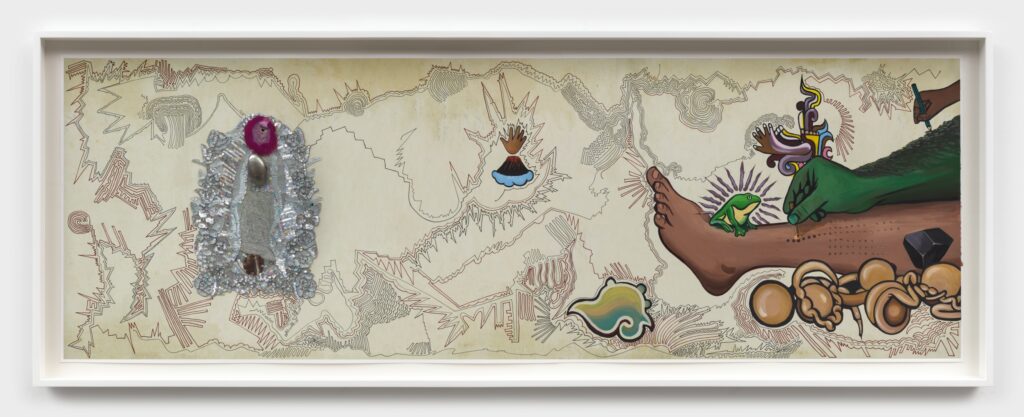
Silver Guadalupe Drawing by Guadalupe Marvilla is a mixed media print made of ink and paint made in 2022. It measures roughly two and a half feet tall by seven and a half feet wide and is hung in landscape orientation, meaning its longest side runs parallel to the floor.
The print depicts a Virgin of Guadalupe figure, a central image in Mexican Catholic devotion, with symbols of Indigenous healing.
The print stretches horizontally like a panorama. A figure made of shiny materials like beads is placed on the left-hand side, alluding to this Virgin figure. To the right of the composition, two arms come into the frame stretching toward the left. A brown hand holds a pencil, hovering above, appearing to draw the green arm beneath it. The green arm, in turn, holds a brown marking tool and punctures the skin of a brown leg below in two neat rows of dots—a pattern referencing ancient Indigenous healing practices. A green frog, a symbol of healing and transformation in Mesoamerican traditions, perches on the foot. Around these limbs, there are abstract shapes made of various colors. In the center of the composition, a small volcano rises with a hand hovering above it.
The background is a solid foundation of off-white Markedwith dark black and red ink. These organic lines flow across the composition like roots or veins.
T. Elliot Mansa: The Victory of John Henry
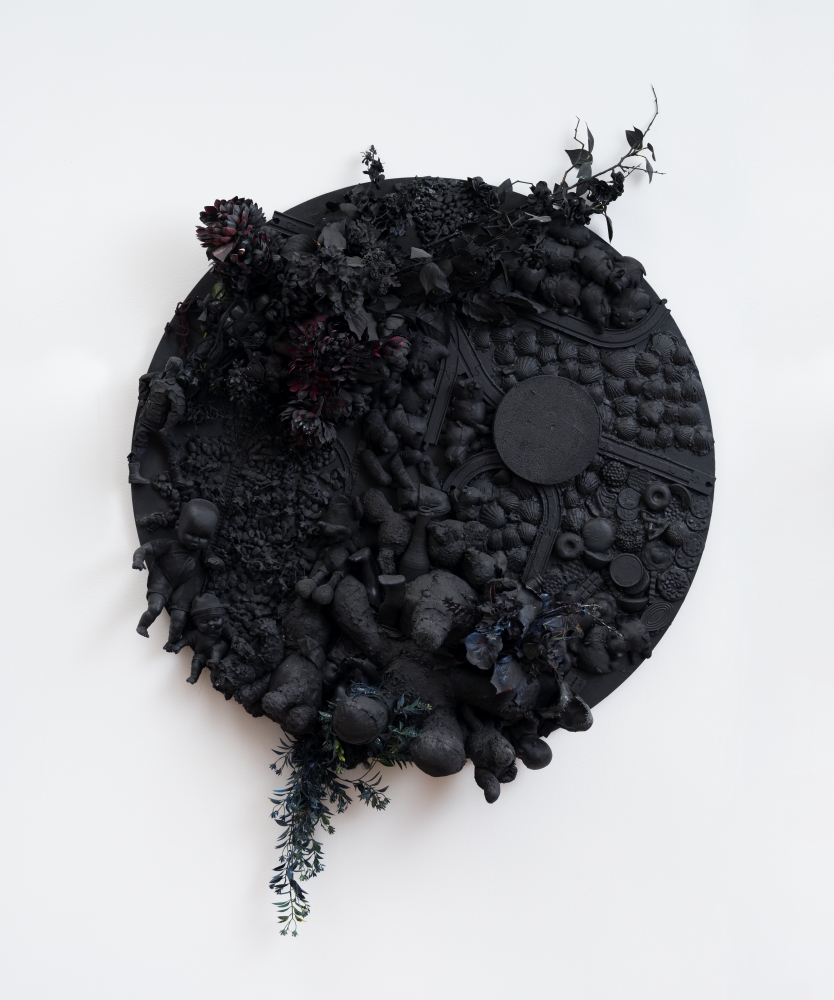
The Victory of John Henry is an artwork made in 2020 by American artist T. Elliot Mansa, who is based in Miami. It is a sculptural assemblage which is displayed as a wall hanging. Its base is a round panel of wood measuring roughly three feet in diameter. Several objects have been glued on this wooden panel, mainly children’s toys, which protrude outwards towards the viewer. The work is painted all over uniformly in black acrylic paint.
From afar, the work gives the impression of being made of charcoal because of its varied rock-like surface and uniform charred black color. The surface of the panel is very crowded with objects that have been glued to its surface, on top of one another, creating a very topographical texture. Upon closer inspection, it becomes possible to make out the different components which make up this prominent texture. It is mainly an assemblage of children’s toys such as plastic toy soldiers, stuffed animals, a baby doll, wooden toy train tracks, and figurines. There are also elements within the assemblage which refer to the natural world such as plastic flowers and foliage, seashells, and a taxidermized alligator head. The objects cluster more densely on the left side of the circular panel, while the curved lines of the toy train tracks and the arrangement of figures create a sense of radiating movement outward from the center, with small ornamental elements extending upward at the top and foliage cascading downward at the bottom. All painted over in a layer of matte black.
Zilia Sánchez: Sin título
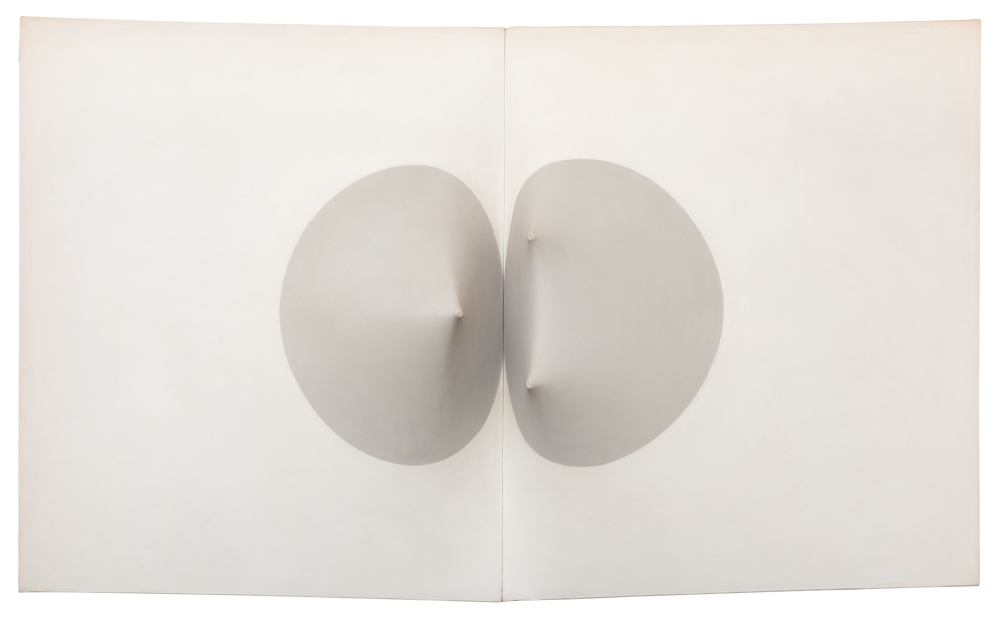
Sin Titulo (Untitled), Topología erótica, by artist Zilia Sanchez, is an acrylic painting on canvas made in 1971. It measures roughly six feet tall, and eight feet wide, and is hung in landscape orientation, meaning its longest side runs parallel to the floor.
This painting is an example of an abstraction, which is a style of painting that focuses on the gestural movement of shapes and colors rather than depicting scenes or figures.
Sin Titulo extends away from the wall, into three-dimensional space, in a way that blurs the line between sculpture and painting. The piece consists of two equally sized rectangular canvases, placed together side by side. Both left and right halves are identically mirrored, with a center seam in the middle, dividing both halves. Sin Titulo contains a pale grey background color that extends to the four corners and edges of the large three-dimensional painting. Layered on top of this grey rectangle is a slightly elongated, large white circle. Very similar to two capital letter “D”s placed back-to-back, this large, bright curved shape contrasts with the straight lines of the canvas and its grey background. The white circle almost reaches the four edges of the canvas, centered at around more than five feet tall and seven feet wide, in comparison to the larger, rectangular backing, leaving a narrow grey ridge around the periphery of the paintings. Centered in the white oval rests a smaller circle, around two feet in diameter, that projects outward into space. The edge of this three-dimensional shape, pushing from underneath the canvas, accentuates the smaller circle compared to the rest of the painting. Inside this jutting section, appears the indentation of a horizontal rod. This rod pushes up from underneath the canvas, creating a raised outline of itself in the center of this artwork.
Hew Locke: For Those in Peril on the Sea
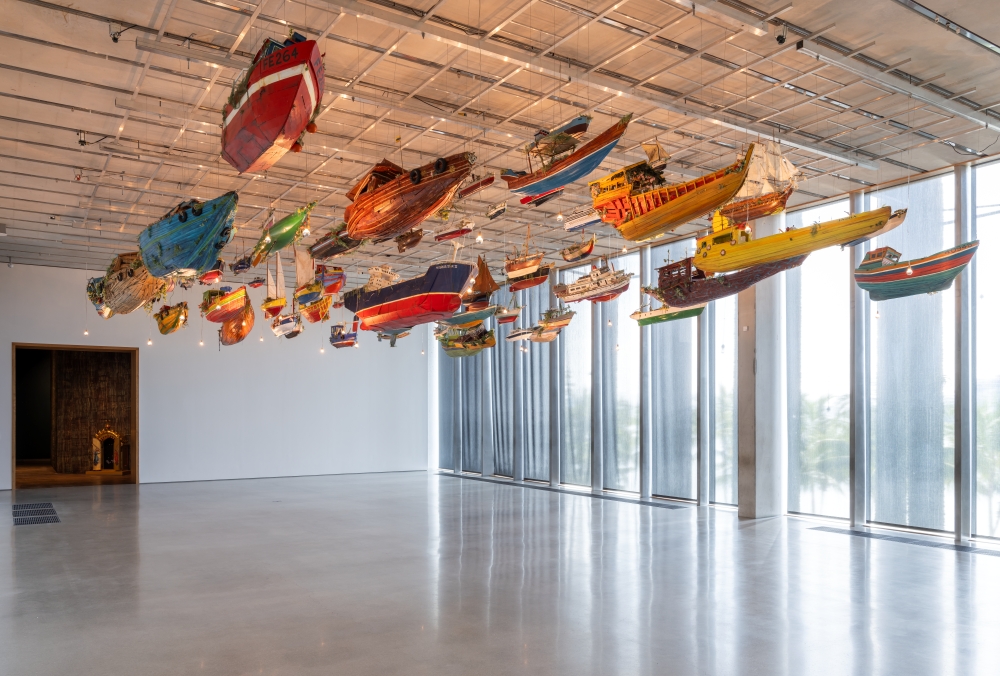
For Those in Peril on the Sea is a sculptural installation by the artist Hew Locke from 2011. It consists of approximately seventy boats made with mixed media. Its overall dimensions vary according to the size of the space it is installed.
This piece takes its title from the final line of the hymn Eternal Father, Strong to Save (often called The Royal Navy Hymn). It incorporates customized models of boats from around the world together with boats made from scratch. The boats all hang with wires from the ceiling, far above the viewer’s heads. They all face the same direction—as if the boats were all traveling together to an unknown destination. They vary in size from small children’s toys; to more substantial models with the largest of handmade boats measuring two feet across. Overall, they include many designs used around the world throughout different eras, and each boat has been treated by the artist to varying degrees.
Among the many models, a Galleon appears to lead the march of boats with its closer position to the front row. Galleons were multi-decked sailing ships that were used by European countries from the 16th to 18th centuries. This model contains four sets of white sails with a mahogany-colored hull (or bottom) typical to these colonial ships. In contrast, there are also more modern boats, such as a white cruise ship or smaller, more personal motor-powered yachts. The largest of the boats is a black cargo ship. Scattered in between are various types of fishing boats, ranging from the most rudimentary human-powered vessels to more modern multi-decked ships. Many of them are hand-painted with bright, saturated colors including combinations of aquamarine, cherry red, neon yellow, orange, and grassy green. No crews are visible on the boats. They almost seem to be in a state of abandonment. The artist has glued plastic vines, ferns, and small flowers to the vessels that appear to be growing from their insides.
Leasho Johnson: The dissension of Anansi (#19)
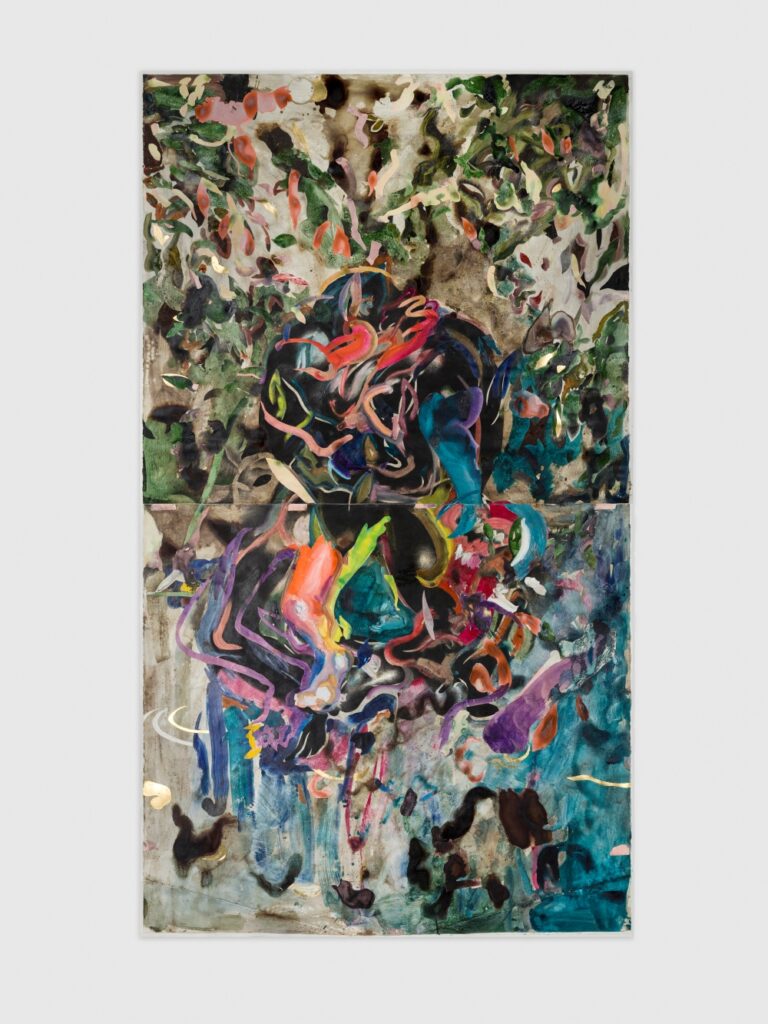
The dissension of Anansi (#19), is a painting by Jamaican born artist Leasho Johnson made in 2022. It is made with charcoal, watercolor, acrylic, oil stick, oil, coffee, logwood dye, gold foil, and gesso on paper mounted on canvas. It measures seven feet tall by just over four feet wide and two inches deep. It is in vertical orientation, meaning that its shortest side runs parallel to the ground.
The work comprises two distinct panels arranged vertically, one above the other, each presenting a dense, gestural composition of layered abstract forms.
In the upper panel, dark silhouetted figures emerge from a background of energetic green brushwork suggesting foliage or vegetation. Curved organic shapes in coral pink, cream, and yellow weave through the darker forms, creating a sense of movement and tension. The lower panel bursts with more vivid color—vibrant purples, oranges, turquoises, and magentas intermingle with deep blacks and browns. Flowing, ribbon-like forms curl and twist across the surface, while loose brushstrokes and drips reveal the layered painting process beneath. Both panels share a common visual language of fluid, intertwining shapes that suggest bodies in motion, though the forms remain abstracted. The raw, expressive mark-making and rich material complexity create a dynamic visual rhythm that draws the eye continuously through the composition from top to bottom.
Gisela McDaniel: Speaking Seeds
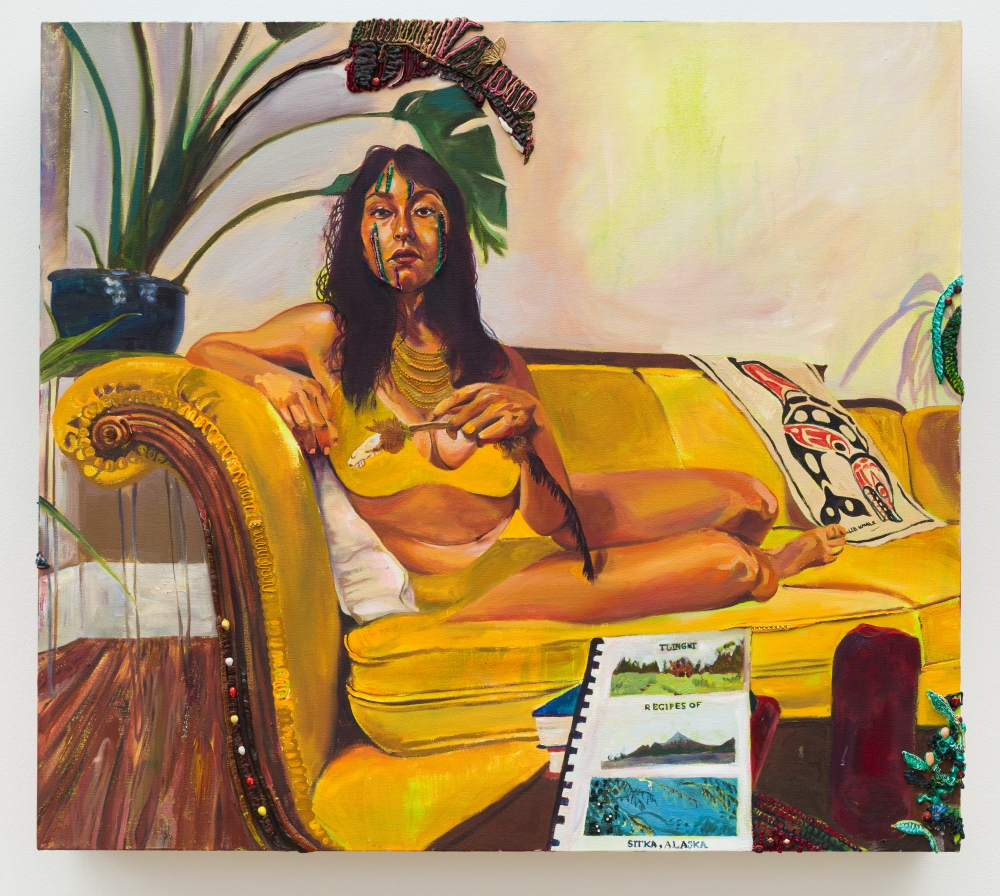
Gisela McDaniel’s Speaking Seeds is an oil painting on canvas. The artist also used found objects, corn, and seeds in the making this artwork. The canvas measures thirty-six inches tall by forty inches wide, and six inches deep. This is equal to three feet tall by around four and a half feet wide. It is presented in a landscape orientation, meaning the longer side runs parallel to the floor. There is also an accompanying twelve-minute audio clip that is part of this artwork.
Speaking Seeds shows a copper-skinned woman half sitting and half reclining on a mustard yellow couch. Her torso and face are turned toward outward, as she looks directly at the viewer. Her legs are locked together at the knee, and she is resting on the couch cushion. The top of one of her feet is seen painted behind her kneecap, indicating that her legs are bent back. Her left arm, on the viewer’s right, holds a limp plant stalk. The stem of this plant forms an arc that starts on her thigh and curves to the end in front of her right breast. Her right arm is bent at the shoulder, and leans on the couch’s curved, upholstered arm. She is wearing interior clothing, a bra and undergarment the same yellow as the couch. She is wearing multiple gold necklaces that cover the area above the cleavage of her breasts. Her hair is black and wavy and falls over her shoulders on either side of her layered gold necklaces, ending just above her yellow bra. Her face is decorated with strips of green seeds, that run up and down the length of her cheeks, and on her forehead and chin. To the left of the woman, on the viewer’s right, is a poster of Indigenous artwork, draped on the couch. The style of the poster looks like the artwork of many Pacific Northwest indigenous groups, with bold, rounded black and red shapes. The image on the poster could be that of a fish or whale.
The couch scene looks like it is in an interior room. Behind the couch is a white wall, that takes up the majority of the upper right quadrant of the painting. The white wall is painted with a good amount of yellow and pink shading, indicating a warm light source that illuminates the wall, as well as the seated woman. The upper left quadrant has a large house plant, behind and to the left of the woman’s head. The plant fans out from a central green stem into several thin branches. The branches unfurl into wide flat fronds, like a heliconia or palm tree behind and over the woman’s black hair. One of the palm fronds is also textured and covered in repeating lines of pink and green plant seeds. The house plant is in a blue ceramic bowl, elevated several feet off the floor on its own small table behind the visible arm of the yellow couch.
In the lower left quadrant, wood floorboards are visible as they meet the white baseboards of the walls. In the lower right quadrant, in the foreground, is a small coffee table in front of the yellow couch. On this brown wooden table are several books and a plant. The cover of the book mentions Sitka, Alaska. In the extreme bottom right of the painting, the plant is textured, with green leaves and yellow and red seeds placed on the canvas.
Patrick Dean Hubbell: You Keep Our Spirit Safe Between All Within the Day to Night
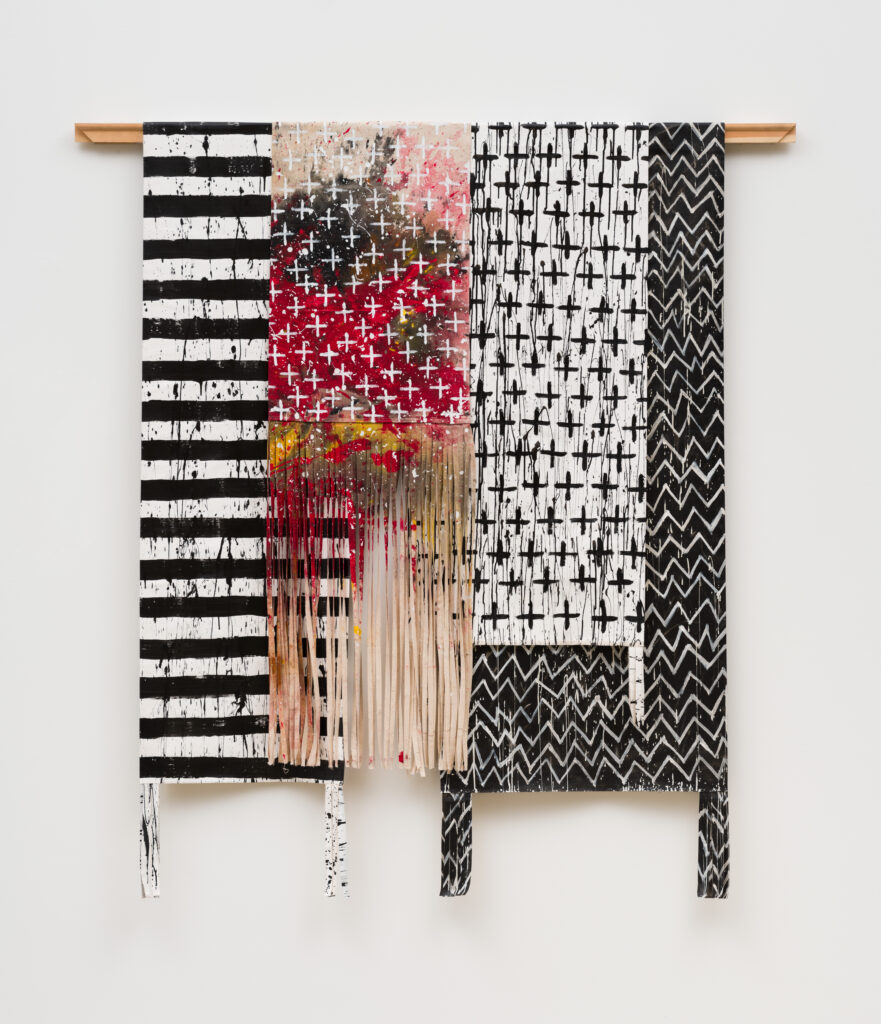
You Keep Our Spirit Safe Between All Within the Day to Night is an unstretched painting made with oil, acrylic, enamel, acrylic dispersion, sewing on canvas, and wooden stretcher bar. The work is in vertical orientation, meaning that its shortest side runs parallel to the ground. Overall, the work measures a little over six feet tall and is exactly six feet wide.
The painting resembles a woven tapestry, with multiple layers of canvas oveRo intricate and culturally rich artworks that delve into his Navajo heritage and identity. Drawing inspiration from his Navajo descent, Hubbell’s art weaves a tapestry of symbolism, patterns, and imagery rooted in Navajo culture, spirituality, and tradition. His artistic practice encompasses a diverse range of mediums, including painting, drawing, printmaking, and mixed media.
At the heart of Hubbell’s art is an exploration of identity, both personal and collective. His work grapples with the complex relationship between his contemporary identity as a Native American artist and the deep-rooted heritage and traditions of the Navajo people. Through his use of symbols and motifs, Hubbell navigates the intricate relationship between tradition and modernity.
Esteban Ramón Pérez: DNA (Bad Blood)
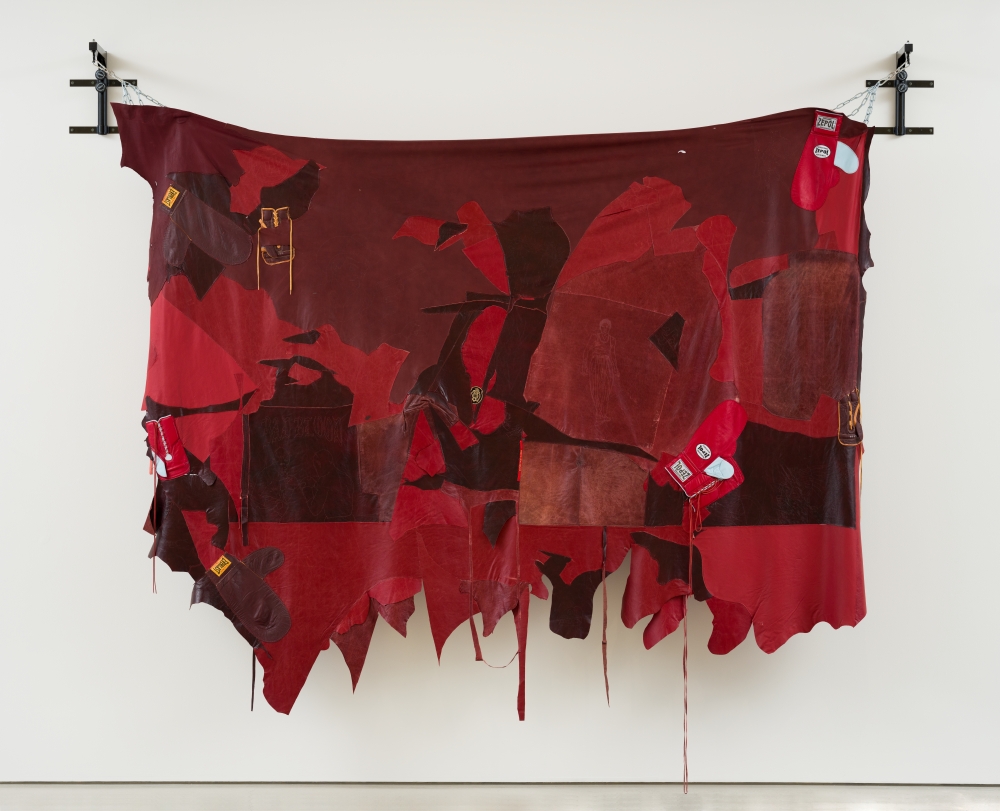
DNA (Bad Blood) is a textile work by Esteban Ramón Pérez, made in 2019. The work is twelve by twelve feet and hangs down one foot from the wall from thick silver chains that are used to mount punching bags.
The work is made primarily of leather and boxing gloves. The color palette is variations of red including: cranberry, crimson, burgundy and burnt umber. The textile is reminiscent of a quilt as it has differently sized and shaped pieces of fabric sewn together with a red thread. At first glance, the textile appears to be an example of an abstract composition, meaning it has no recognizable objects or figures rendered within it. Though upon close inspection, one can observe that there are various figurative drawings embossed throughout the piece.
At the top of the textile, there is a large piece of burgundy leather stretched across from the left to right corner. It sags in the center under the weight of the leather. At the bottom of the work, jagged pieces of leather fabric, glove laces and straps hang downward, resulting in an uneven and asymmetrical base.
As the work moves clockwise from the top left quadrant of the composition to the bottom left quadrant:
The top left quadrant has a bright cranberry red piece of fabric with triangular peaks reaching towards the left corner and a geometric design burnished into its top half. The design features three steps attached to a rectangular shape within a circle. Sewn into either side of the red piece is a burgundy, patent leather deconstructed Everlast branded boxing glove. The dorsal side of the glove is on the left and has a gold rectangular tag which reads “GOLDEN” in small, red text in capital letters and below it reads “EVERLAST”, in larger capital letters. The lettering is black and shaped into a horizontal hourglass. The palm of the glove is sewn to the right of the red piece. It has golden trim and gold lace enclosures which hang loosely down the surface of the textile. Below this is another large shape made of cranberry and crimson leather. It has jagged and random edges, as if it is a border on a map. The cranberry is on the top left side and the crimson is on the bottom left side. It has a thin strip extending down from the left edge of the canvas.
The top right corner of the textile has the dorsal side of a bright crimson red Zepol-branded boxing glove sewn in, facing down. It has a tag that reads “ZEPOL” in large, capital black lettering. Above it is written “Professional” in a smaller text, barely legible from a distance. The glove is sewn into a red square of leather, that then connects to a large rectangular shape of faded burnt umber leather. It reaches from the right edge of the canvas to the middle. Quilted on top of It and around it are smaller jagged pieces of red leather. The size and fading of the burnt umber leather make it seem as if it is a deconstructed punching bag. The bottom right side of the punching bag has the palm of another burgundy boxing glove sewn into the corner. It has a gold lining and laces that hang off the right side of the composition. The bottom left side of the punching bag has a thin figure embossed into the leather.
Scraps of cranberry leather hang off the right bottom side of the textile. There is another bright crimson Zepol-branded boxing glove splayed open. both the palm and dorsal side of the glove are visible and red laces droop from the right side of the glove, hanging just inches above the ground. A piece of burgundy leather sewn into its right side. There are two designs embossed into it. On the right, there is a circular graph. On the left, there is a Mesoamerican head in profile with a tongue sticking out of its mouth, facing towards the center of the composition. Below that, in the bottom right corner of the composition, is a large piece of bright red leather with four rounded peaks reaching towards the floor.
The bottom left corner of the textile has a large crimson area with downward facing pointed peaks that hang lower than the rounded peaks on the right side.
Frank Stella: Chodorow II and Protractor Variation
Chodorów II by artist Frank Stella is a felt, paper, and canvas collage on canvas made in 1971. It is hung on the wall, measures roughly nine feet by nine feet, and is around two inches thick.
This artwork is an example of geometric abstraction, which is a style of art that’s based on the use of geometric objects placed in an imagined setting, it does not depict a visual reality.
Although the measurements might imply that it is a square, it is not. The art piece is comprised of several segmented geometric shapes. One could describe the overall shape as looking like a beige cube tilted on one of its corners and has multi-color diagonal rectangular shapes coming out the top of it. Starting with the tilted beige cube-like shape, the left facing side has a purple square that almost completely covers the left facing side. This purple square that sits on top of the beige background is not centered, but is instead placed a little higher. Below the purple square, is a skinny purple rectangle parallel to the bottom of the cube. Moving on to the right-facing side of the beige cube, we see a skinny turquoise rectangle perpendicular to the bottom of the cube and placed right in the center. There is also a red rectangle placed right against the right edge of the cube that tapers off towards the right corner into a point. The top side of the cube is just a long red rectangle that extends past the limits of the cube on the right side and tapers off into a point. The length of this is almost double the length of the cube. Inside this rectangle, there are two much smaller and skinner purple rectangular segments, one on the left side and the other on the right and they both extend all the way until its respective edges. Sitting right on top of this long red rectangle is a slightly shorter dark green rectangle that appears to go through another shape- a smaller, beige, vertical rectangle. This larger rectangle has one straight edge on the left side and a tapered edge on the right. On top of that, there is a smaller horizontal dark green rectangle intersecting the larger rectangle it on the right side. Inside of this smaller rectangle there is an even smaller and skinnier turquoise rectangle right in the center.
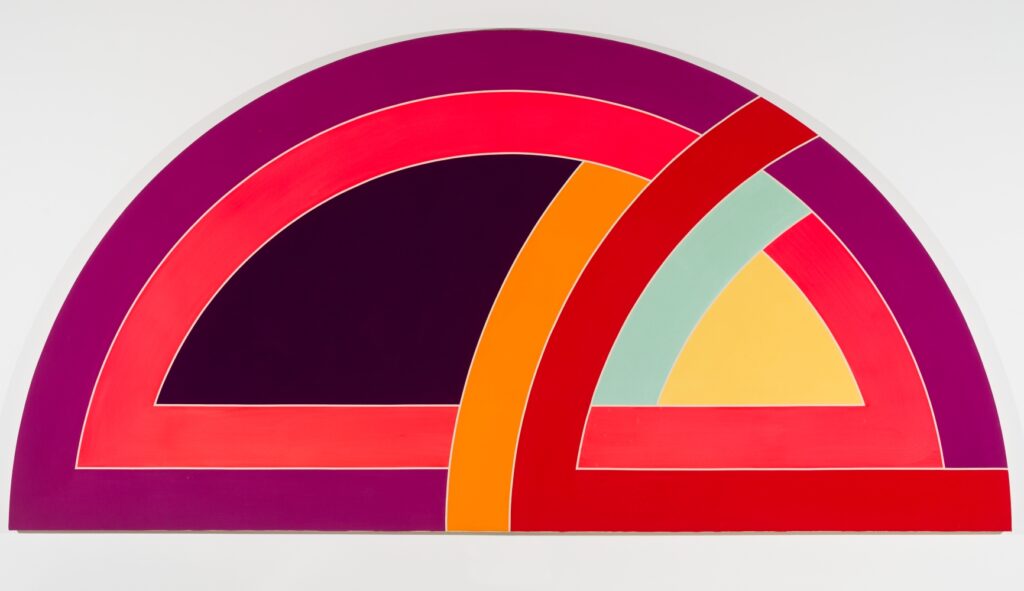
Protractor Variation I is a painting by contemporary artist, Frank Stella, made in 1969. This large painting is in the shape of a large semi-circle. The unconventional canvas measures sixteen feet across its entire width. By comparison, this painting is wider than the combined height of three average adults. The height of the arched canvas is eight feet, and the full length of the curved arch is twenty-five feet.
This painting is an example of Stella’s innovative experiments with shaped canvases. in this case, the shape of a semi-circle, and titled after the common mathematical tool, the protractor. As one stands in front of this large, colorful painting, one notices seven distinct shapes, some overlap and others are placed side by side. Most prominent is a purple band, at least a foot and a half thick that traces the entire arc, as well as the bottom center of the straight edge, which is parallel to the floor. Inside this purple border is a bright coral pink band that hugs the edges of the purple band, and the general curve of the arc and straight edge. From the center of the bottom edge is a yellow-ochre stripe that bends slightly to the right as it reaches the top of the painting but stops at the coral-pink stripe. Left of the yellow ochre is a fan-like shape, the color is a very deep purple, almost black; the color of eggplant. In the right side of the painting is a small yellow triangle nestled in between the peach-orange stripe to its right and a small, light blue curved stripe on its upper left next to a larger dark orange stripe. The Protractor series which he worked on from 1967–1971 was inspired by the circular-plan towns that Stella encountered during his travels in Western Asia, particularly the arches and decorative patterns he admired in Iranian art and architecture. He introduced the arcs and curves that can be created with a protractor, but also the straight edges as well. In his paintings the straight lines provide a framework or stabilizing structure for the curves.
Robert Raushcenberg: Love Hotel [Anagrams (A Pun)]
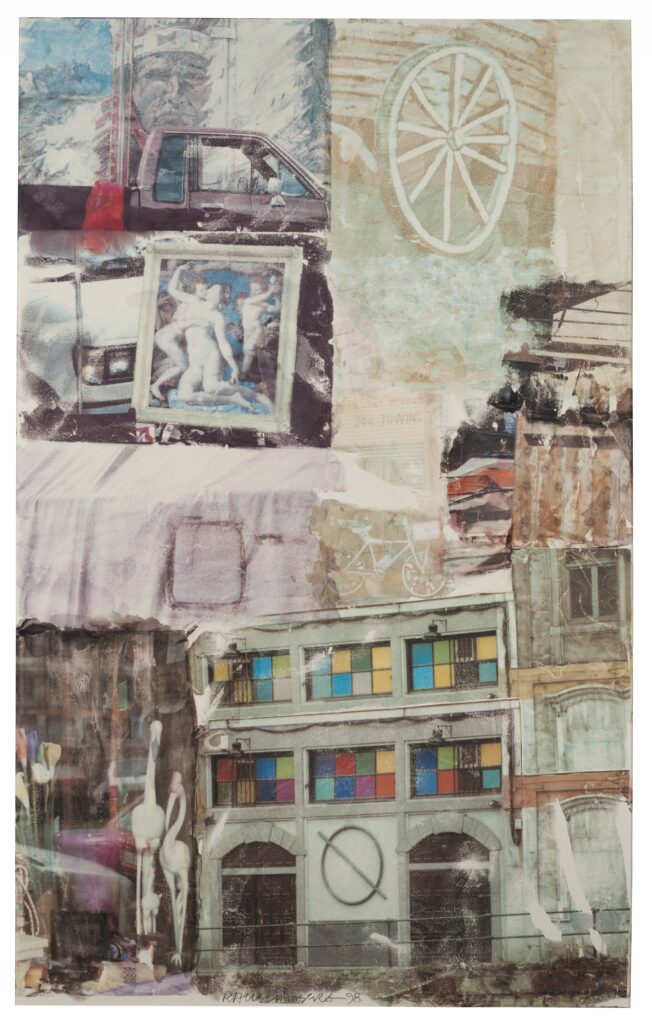
Robert Rauschenberg’s Love Hotel [Anagrams (A Pun)] is a dye transfer print on polylaminate. This print measures ninety-eight by sixty-two inches, or around eight feet tall by a little over five feet wide, in portrait orientation.
This large format print has a collaged composition. The larger image is made up of a collection of seemingly random images placed next to one another. Either due to the technique of the printing process or the image sources, the overall artwork looks weathered, and the colors are washed out and dull, as if exposed to too much light.
If one were to describe the images like the order of written words on a page, starting at the top left is the face of a Native American man wearing a traditional feathered headdress. His face is barely visible, giving it a ghost-like appearance as it floats above the maroon cab of a pick-up truck seen from the side. Moving to the right across the top of the print, the image abruptly changes to show a drawing of a wagon wheel. It is large, wooden, and circular, with eleven spokes. It rests on a green surface.
Moving down along the left-hand side of the print, beneath the maroon truck, is the headlight and fender of a white van. Moving toward the right, a large painting rests in front of the van. This painting obscures the hood and bumper of the white van, lending this painting a height of at least three feet. It has a gilded frame, and the canvas has several classically posed nude figures painted on its surface. Moving further to the right, past the center line of the print are patches of faded green, pink, and yellow, as well as some images of rust covered surfaces.
Reaching the middle left of the print is a large, pale white sheet covering an oblong object, abruptly followed by the outline of a bicycle.
Extending toward the bottom third of the print, starting on the left is the reflection of a storefront window, with flamingo ornaments and other goods on display, with cars parked on the street reflected in the large panel of glass. Moving to the right along the bottom of the print is a three-story building. It has two archways on either side of the ground floor, with a circular decoration on its façade between the two arches. The second and third story both display three wide rectangular windows, further divided into eight squares each. Along both of the upper floors, the grid-like windowpanes are filled with a rainbow of different colors, red, magenta, yellow, green, blue, and cyan. On the lower right corner of the print, is the image of another three-story building, however, not quite lining up with the building just described. The bottom two stories have decorative arches, and the top story carries a window with a fully black interior. Alongside the bottom of the print, in front of two side by side buildings, is a black railing along a raised sidewalk.
Overall, the crammed and crowded collage gives the impression of a convoluted and decayed cityscape.
Glenn Ligon: Notes for a Poem on the Third World (chapter one)
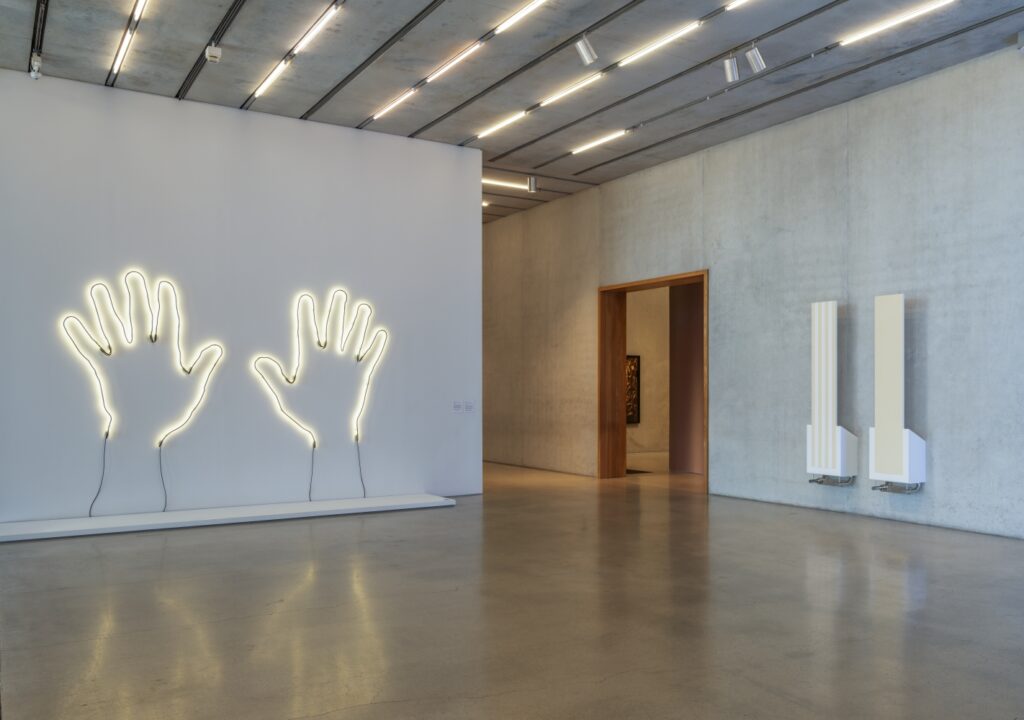
Notes for a Poem on the Third World (chapter one) is a large-scale neon light artwork created in 2018 by American artist Glenn Ligon. It is made with neon tubing and paint. It measures approximately nine tall by twelve and a half feet wide, with its longer dimension running horizontally. The piece depicts the outlines of two large hands placed side-by-side, with fingers spread.
Each hand is rendered in a simple, continuous contour line of neon light tubing. The tubing has been painted black on the front and left exposed at the back, so the light shines only onto the wall behind it. This technique produces a soft, yellowish halo that outlines the forms, emphasizing the glowing presence of the hands, and their luminous ephemeral quality. The glowing traces suggest a vague human presence. A kind of universal ghostly imprint without a body.
From the wrist area of each hand, electrical cords extend downward, continuing the contours of the arms before disappearing into an unseen power source below. These cords subtly highlight the work’s material reality, grounding its ethereal glow into a visible tangible form which is powered by electricity.
Rafael Ferrer: Red, White & Blue ARTFORHUM
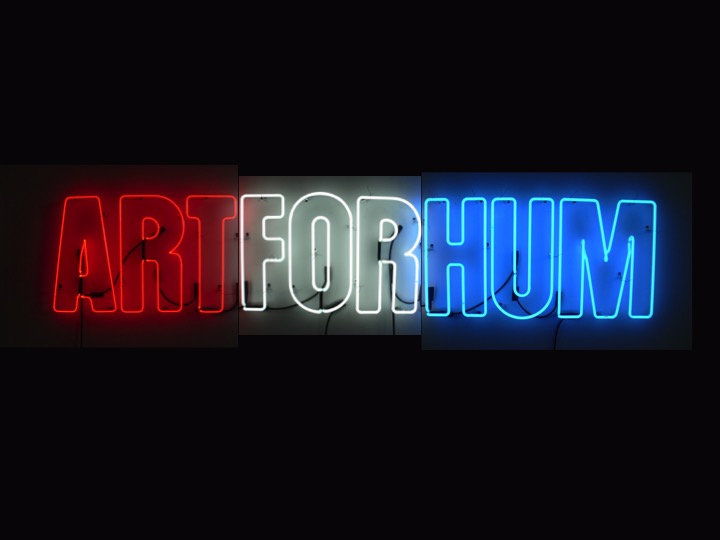
Red, White & Blue ARTFORHUM by artist Rafael Ferrer is a neon text sculpture made in 1973. It measures one and a half feet by nine feet and is hung in landscape orientation, meaning its longest side runs parallel to the floor.
The neon text reads “ARTFORHUM” in all capital letters which are evenly spaced from one another. The typeface used is a bold and condensed iteration of the Akzidenz-Grotesk font, used in Artforum Magazine. It is a sans serif outlined block lettering. The word is written in three separate colors from left to right: Red, White and Blue. The leftmost letters “A-R-T” are made of a rich red neon, the center letters “F-O-R” are made of a bright white neon and the rightmost letters “H-U-M” are made of a cerulean blue neon. The black electrical wires are visible through the letters, and drape down underneath each colored section to connect to their power source.
Artforum is an international monthly magazine specializing in contemporary art. The magazine’s founder, John P. Irwin, Jr named the magazine after the ancient Roman word forum hoping to capture the similarity of the Roman marketplace to the art world’s lively engagement with public debate and commercial exchange. The magazine features in-depth articles and reviews of contemporary art, as well as book reviews, columns on cinema and popular culture, personal essays, commissioned artworks and essays, and numerous full-page advertisements from prominent galleries around the world.
Jamilah Sabur: I will wet you (pl.) with the new water
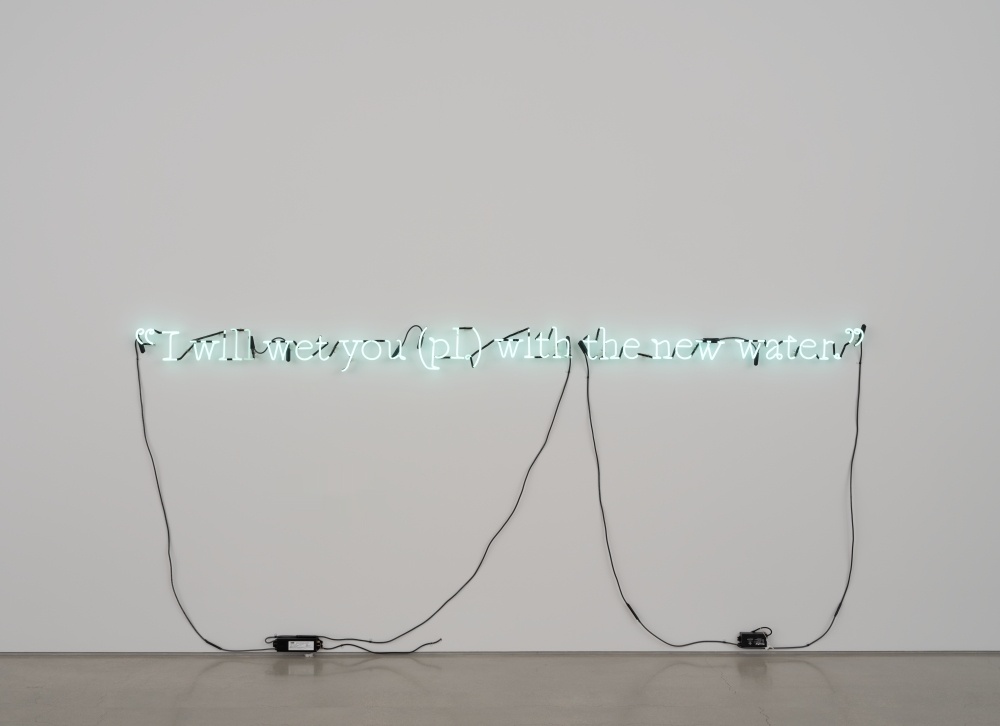
I will wet you (pl.) with the new water by Jamila Sabur is a neon artwork created in 2018. The bright glow of the turquoise color neon sign spells out, in quotation marks, “I will wet you, followed by the letters pl, a period in parenthesis and the phrase continues, with the new water”. In written American English, quotation marks usually refer to direct speech. The phrase is mounted on a large white wall. The length is about one hundred and forty-four inches, or twelve feet across. The neon lettering measures at most eight inches high, give or take several inches for the varying heights of each of the letters. The piece protrudes a little under an inch from the wall.
This work is based on the artist’s fascination with the Timucua people, a Native American tribe that stretched from north central Florida to southeastern Georgia; the last Timucua died in the 1700. The double quotation marks appear in the top left of the first word, in this case the letter ‘I.’ These quotation marks look like inverted commas. The entire phrase is written in a serif style font, meaning it has a decorative stroke, sometimes also called “feet” that finishes off the end of a letter’s stem. Neon lights consist of electrified glass/black tubes, which in this case are located behind the neon letters with two black, rectangular shape boxes. These small rectangular boxes are the electrical transformers needed to power the neon tubes. The artwork looks as if the artist stretched out her arm and wrote the phrase with her finger directly on the wall in bright turquoise light. You find similar neon signs around town that say common sayings like, “MIAMI,” “OPEN,” “DOLPHINS…” etc.
Feedback
We hope you enjoyed this Digital Exhibition Guide!
We appreciate you taking the time to submit feedback to us as we strive to make PAMM as engaging as possible. You may submit your feedback anonymously through this form.