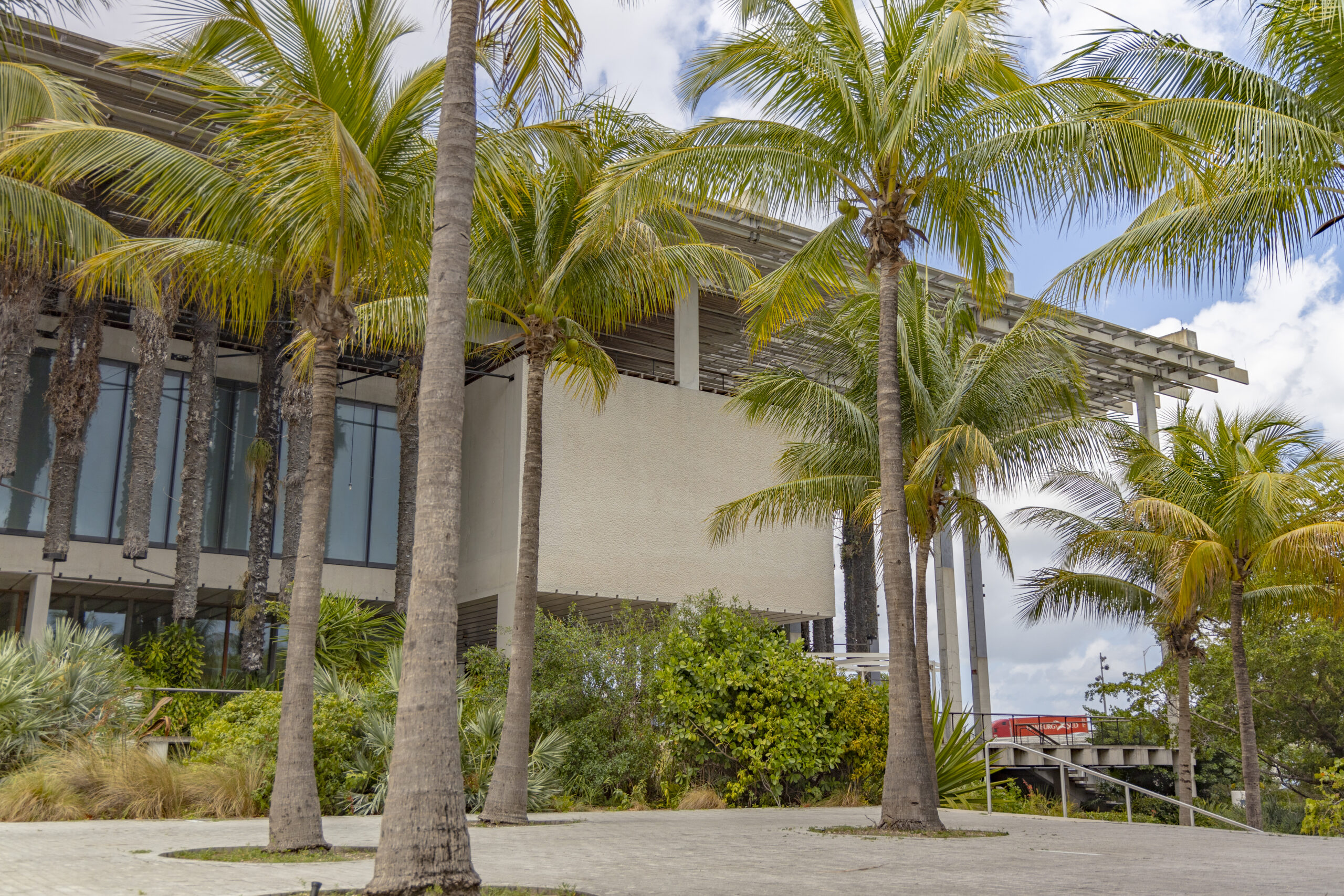
Introduction

The South American Dream is a painting installation by Brazilian artist, Marcela Cantuária. It is the artist’s first solo exhibition in the United States and presents all newly commissioned works.
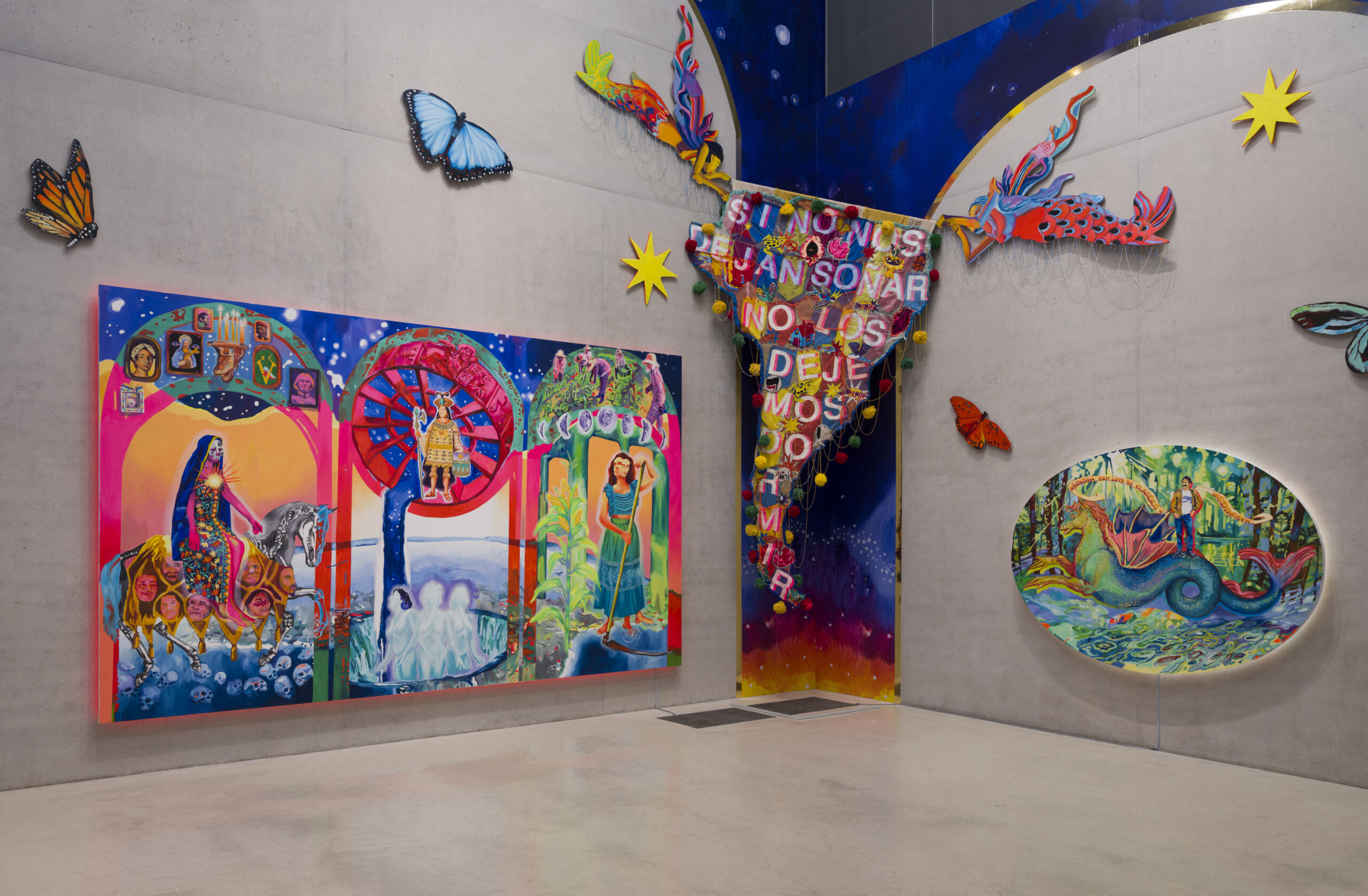
Set in PAMM’s double-height gallery, this painting installation envelops the visitor in a cathedral-like space. Included are three main paintings where the artist highlights important activists and environmentalists in South America, many of which were assassinated or murdered in relation to the cause they believed in. The figures range across different regions and times, with people such as Juana Azurduy de Padilla, a guerilla military leader who fought for Bolivian independence alongside her husband, or Túpac Amaru, the last leader of the Incan empire who fell to the Spanish in the colonial era—all the way to the present with Maria do Espírito Santo da Silva, a rural leader who was murdered in Brazil in 2011, and Dorothy Stang, among countless others. What they all share is that they believed in and fought tirelessly for the preservation of the environment, the rights and independence of their people.
Marcela Cantuária utilizes vibrant warm colors to mix representations of anonymous and critical public figures into landscapes of intensely colorful nature. She combines these representations with vivid symbols from Tarot and South American mythologies, empowering the work with potent imagery symbolizing protection, justice, and change. Therefore, she not only nurtures these radical South American histories but elevates the struggles and resilience of these historic figures to mythological status, equating their dreams and visions to the divine.
The South American Dream

Upon entering, the viewer is greeted by the largest of the three paintings on the opposite wall. The paintings are illuminated from behind and glow with a blue light. This large painting is between two oval shaped paintings on the adjacent walls. Sprinkled throughout the gallery, wooden cutouts of painted stars, butterflies, and figures occupy the space above these paintings. The figures have wings and wear robes with colorful strings of beads that dangle from their edges. On the gallery walls, a wallpaper designed by the artist resembles a starlit night sky. This cosmic wallpaper covers the entire wall except for a space that forms a high arch around each of the three paintings, cradling them as if they were in the shrine of a cathedral. In the corner, No los dejemos dormir (Let’s Not Let Them Sleep) is a textile in the shape of South America stretches nearly the entire height of the gallery at fourteen feet and half feet tall. Its face has a multicolored grid of patchwork with red, green, and yellow pom poms sewn onto its border. On the map, bold white capital letters spell out in Spanish: “If they don’t let us dream, let’s not let them sleep.”
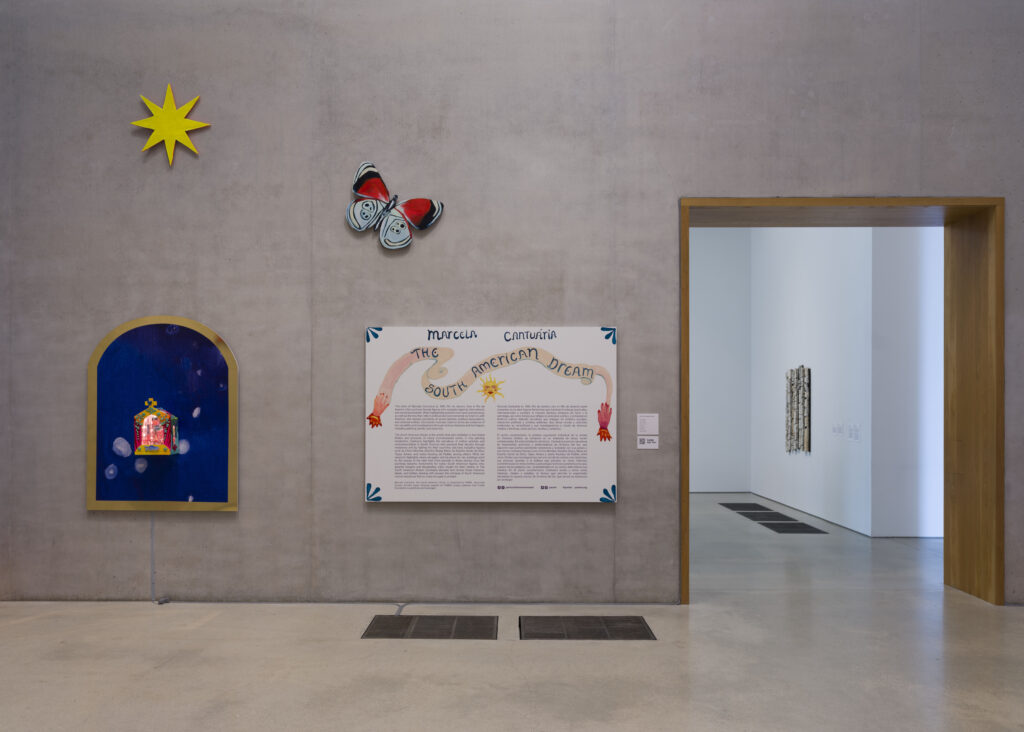
Next to the entrance of the gallery, A lua (The Moon) is a small altar box shaped like a little a house with a cross at the top of its roof. It is painted in bright golden yellows, oranges with aqua-colored floral details made and a ceramic fish on its front face. Inside, there are also ceramic elements. A full yellow amber moon rises from a tower of coral with sea creaturs at its base. The back is mirrored inside, revealing a woman’s figure with three faces on the opposite side of the moon.
O sonho sul Americano (The South American Dream)
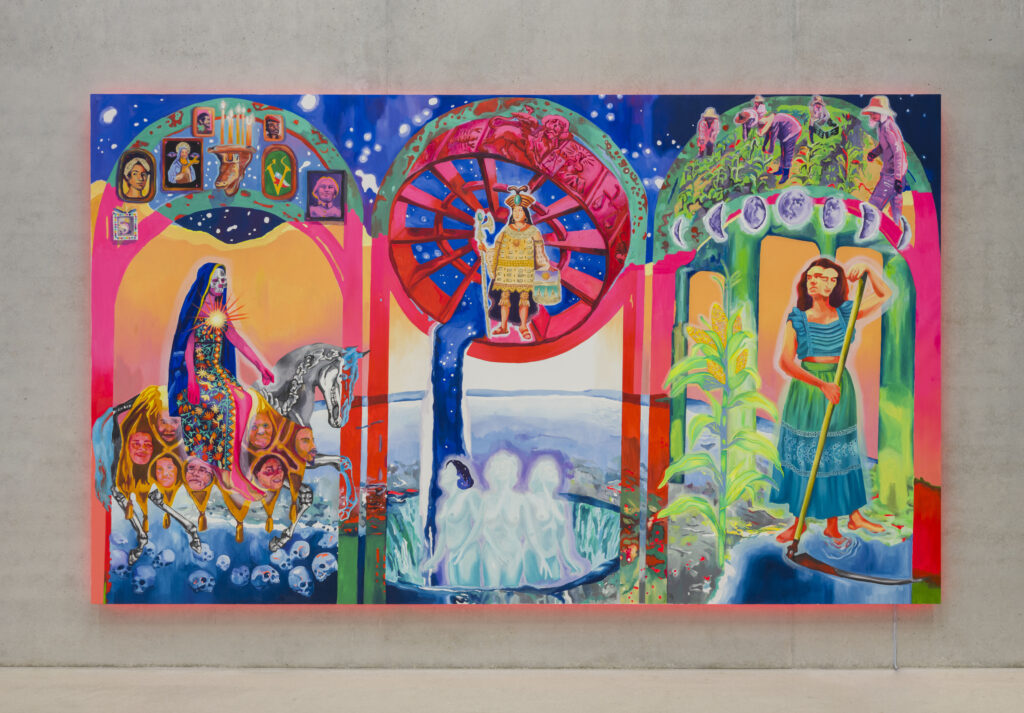
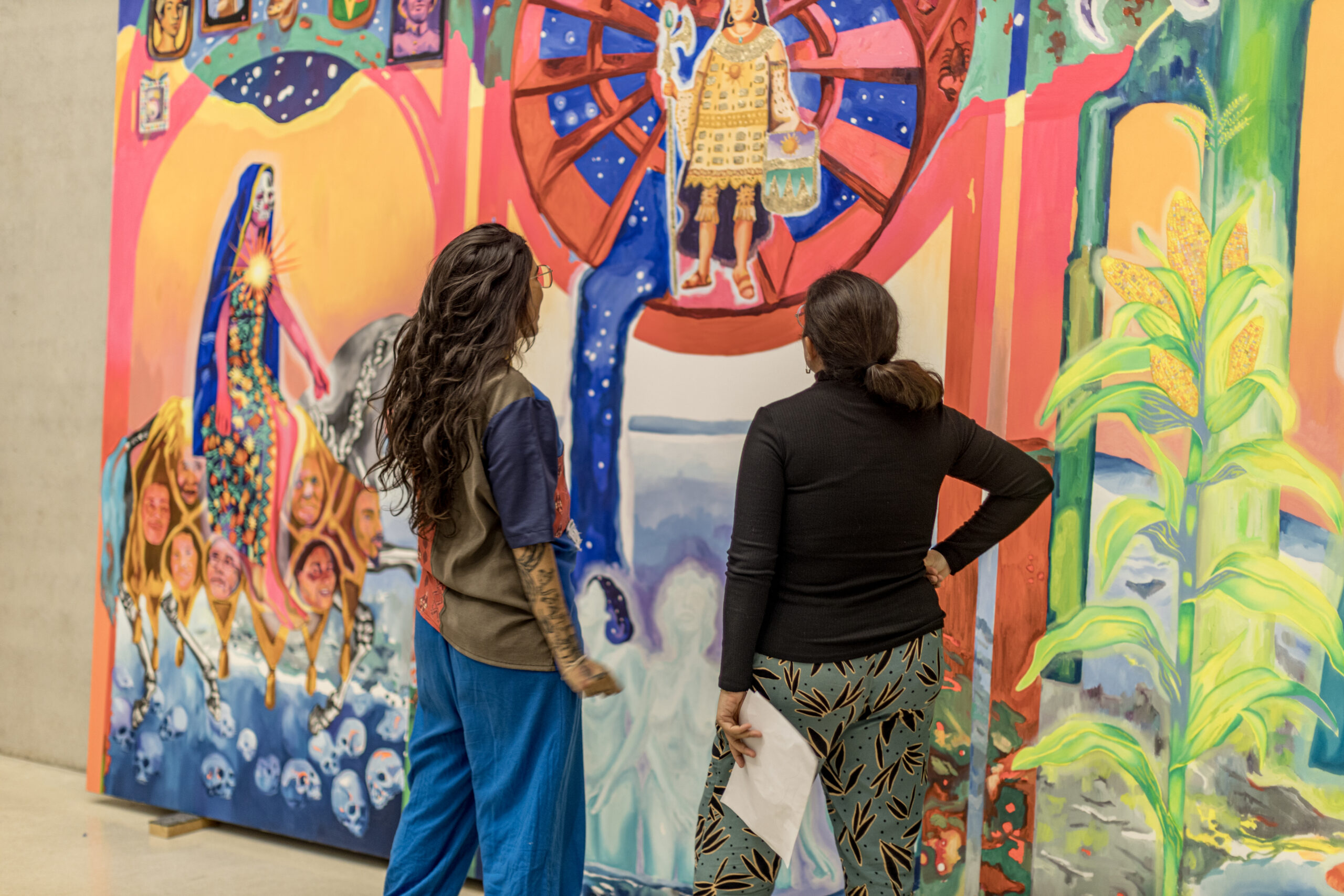
O sonho sul Americano (The South American Dream) is a large, central painting that is divided into three vertical sections by large hot pink archways that mimic the wallpaper on the gallery walls. Each section contains a figure at its center, ripe with colorful symbols and imagery.
On the left, the figure of a woman rides atop a ghostly horse whose skeleton is seen as if it were an X-ray image. The horse’s body is covered in a golden blanket decorated with eight faces. Like the knight on horseback featured on the Death card in the Rider-Waite tarot deck, there is a skull in lieu of the woman’s own face. In the archway above, framed portraits of historic figures surround the head of a deer with candles on its antlers.
At the top center section of the painting, the small figure of Túpac Amaru stands in a red round window pointing upwards to the sky, resembling the Wheel of Fortune cards in both the Rider-Waite and Marseilles tarot decks. The night sky pours through this window like a waterfall, flowing down onto three nude, pale, ghostly women who arise from a hole in water.
On the right, a woman with two faces and three feet dressed in a bright green and teal traditional skirt and blouse holds a scythe. One face looks downwards to the blade of the scythe by her feet. The other looks upwards towards the archway above, which contains images of the moon at multiple phases and scenes of farm workers harvesting above. Next to the woman, a bright green stalk of corn glows with light.
A temperança (The Temperance)
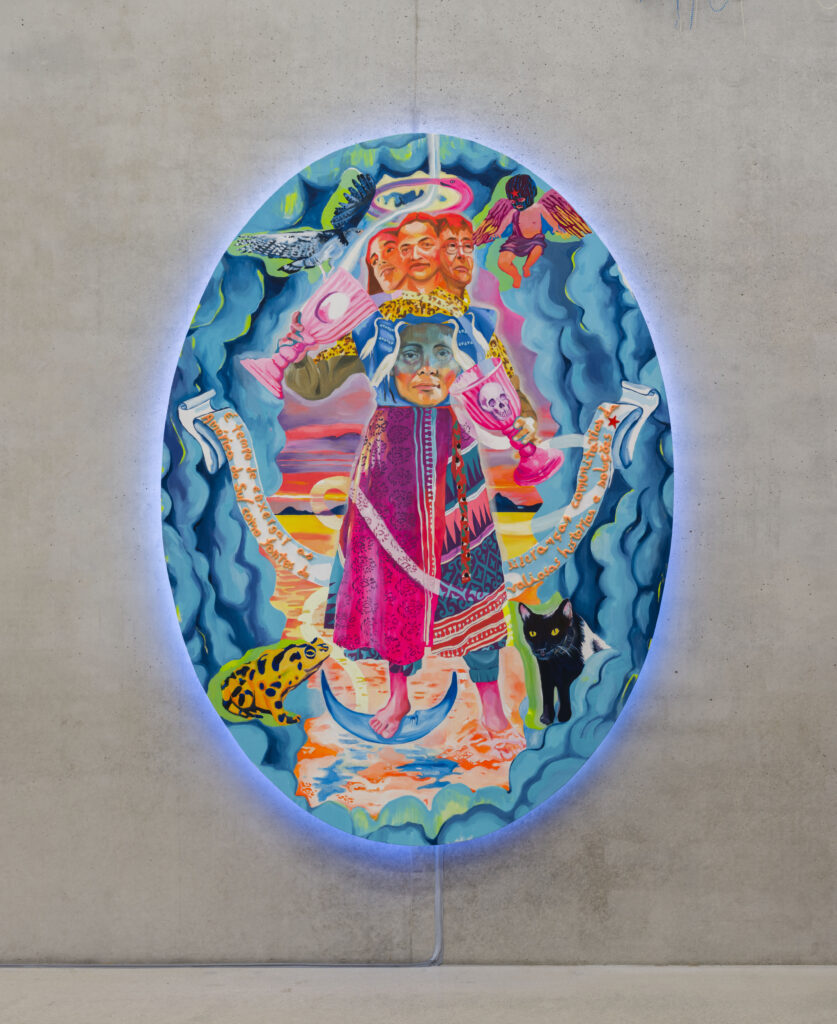
A temperança (The Temperance) is an oval painting on the left that depicts an androgynous figure with three faces. They wear a full-length tunic with animal print on the collar with decorative brocade and geometric patterns on their skirt as well as depictions of the guarana fruit, which is native to the Amazon. In the background, the figure is completely surrounded by a border of velvety blue-green clouds. At the center, a tropical landscape with rippling water is depicted in hot pinks, oranges and golden yellows. The figure hovers above the water with feet bare. Their right foot dips halfway into the water below while the other rests on a blue crescent moon reminiscent of the High Priestess and Temperance cards in the Rider-Waite tarot.
Like the figure depicted in The World tarot card, this floating person is accompanied by two animals at their feet. A yellow and black dart frog to the left and black cat to the right. To the left of their head is a hawk, and to the right a cherub wearing a black ski mask with a red star at its center. The figure holds two bright pink chalices, reminiscent of The Temperance character. A stream of light beams down from above their head, flows in and out of the chalice on their left and into the chalice on the right, where it flows outward again. The beam of light turns into a sash with words that read: “It is time to see community leaders in South America as sources of valuable stories and solutions.” The sash then flows behind the character before turning into a stream of light again that flows down through their left foot resting on the crescent moon.
Chico Mendes

Chico Mendes is an oval painting to the right that depicts a blue-green mythical creature. It has the scaled body of a serpent, the red tail of a fish, wings like a bat, head with a horse’s mane with the face of a dog, and two arms with webbed feet like a frog. It glides through a forest background depicted in shades of neon green, above a bright green body of rippling water. On its back stands the environmentalist, Chico Mendes. He is wearing blue jeans, a white t-shirt with an ochre-colored long sleeve layered on top and black shoes. He has short, ear-length black hair and a mustache. A banner begins at the creature’s head and stretches all the way across to its tail. Written in Portuguese are the words “environmentalism without class struggle is just gardening.”
Feedback
We hope you enjoyed this Digital Exhibition Guide!
We appreciate you taking the time to submit feedback to us as we strive to make PAMM as engaging as possible. You may submit your feedback anonymously through this form or by emailing us directly at AppFeedback@pamm.org
Related Content



Art Talk: Marcela Cantuária in Conversation with Jennifer Inacio

Marcela Cantuária: The South American Dream

