Diego Rivera Naturaleza muerta (Still-Life) 1908
© 2022 Banco de México Diego Rivera Frida Kahlo Museums Trust, Mexico, D.F. / Artists Rights Society (ARS), New York

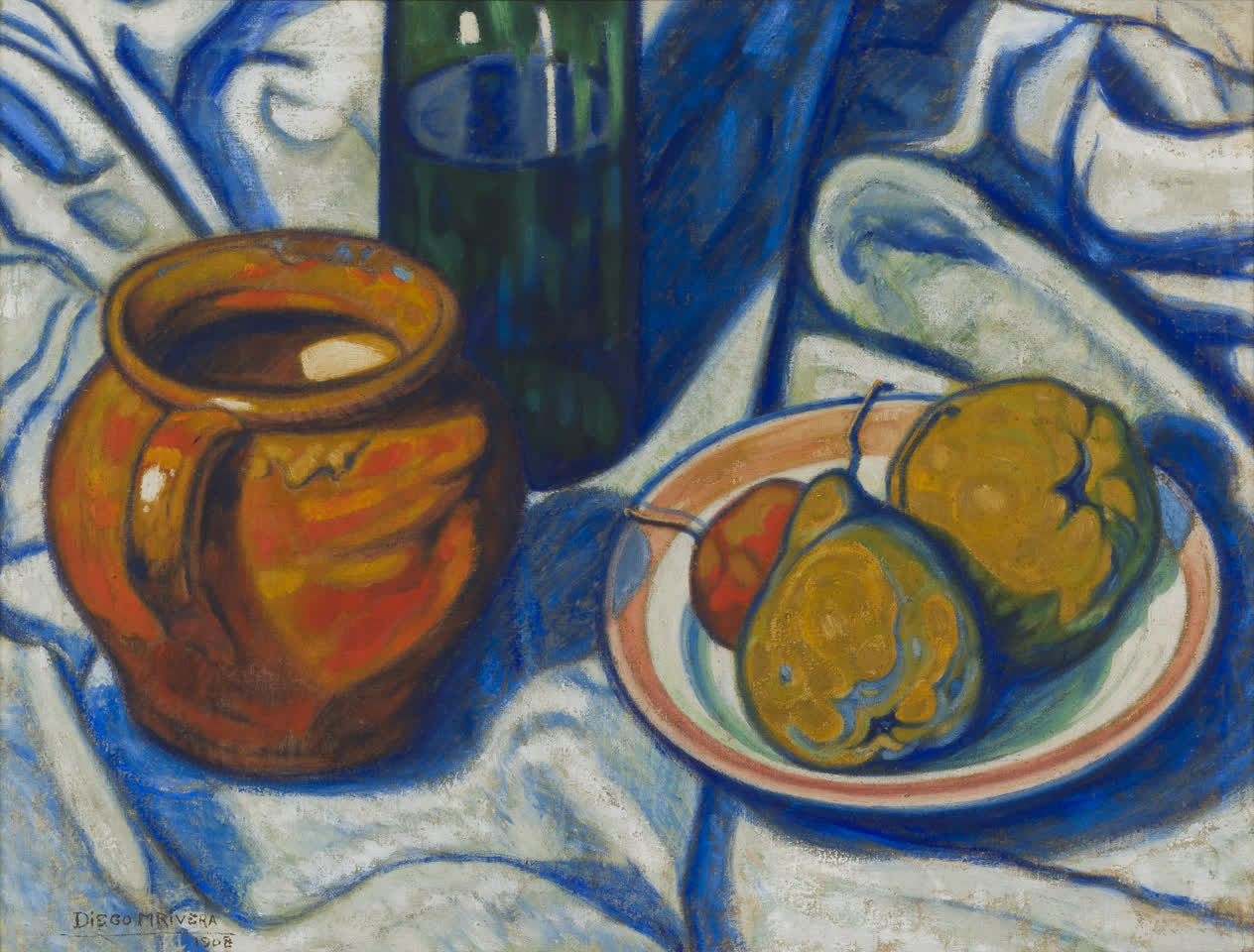
Naturaleza muerta is a classical still life painting depicting a jar, wine bottle, and group of pears atop white fabric. Executed during Diego Rivera’s time living in Spain, the voluminous dimensions achieved in the deep shadows that are cast on objects, as well as the arrangement of the pears, make a strong reference to the many still life paintings by Paul Cézanne, one of the artists Rivera credited for inspiring him to journey to Europe. Naturaleza muerta is an early Rivera painting that demonstrates his investigations and experiments with diverse European avant-garde influences prior to developing his signature style informed by indigenous practices and nationalist interests in Mexico.
Identification
Title
Naturaleza muerta (Still-Life)
Production Date
1908
Object Number
2012.90
Credit Line
Collection Pérez Art Museum Miami, gift of Jorge M. Pérez
Copyright
© 2022 Banco de México Diego Rivera Frida Kahlo Museums Trust, Mexico, D.F. / Artists Rights Society (ARS), New York
https://www.pamm.org/en/artwork/2012.90
Copy artwork link
Physical Qualities
Medium
Oil on canvas
Dimensions
17 5/8 x 15 inches
Visual Description
Naturaleza muerta by Diego Rivera is a painting from 1908. It is made of oil paint on canvas. It measures seventeen and five-eighths of an inch by fifteen inches and is hung in landscape orientation, meaning its longest side runs parallel to the ground. The painting depicts still life, a genre of art that uses simple objects to symbolize a transient moment or a deeper meaning.
The backdrop for the painting is a white cloth. It is painted with white, green, and yellow paint. The cloth is flowing and uneven. Its many contours and variations create shadows that are painted blue. Resting on the cloth is a small clay jug that is painted with orange, yellow, and red paint. Behind it there is a green bottle with liquid inside of it. To the right there is a small circular dish that is white with an orange stripe around its outer edge. Inside of the plate there are two pears painted in a yellowish orange and green with blue shadows. Behind the pears there is a red apple. In the bottom left corner, the artist’s name is painted brown along with the number “1908”.