Ebony G. Patterson . . . a wailing black horse . . . for those who bear/bare witness 2018
© Ebony G. Patterson. Courtesy the artist and Monique Meloche Gallery, Chicago

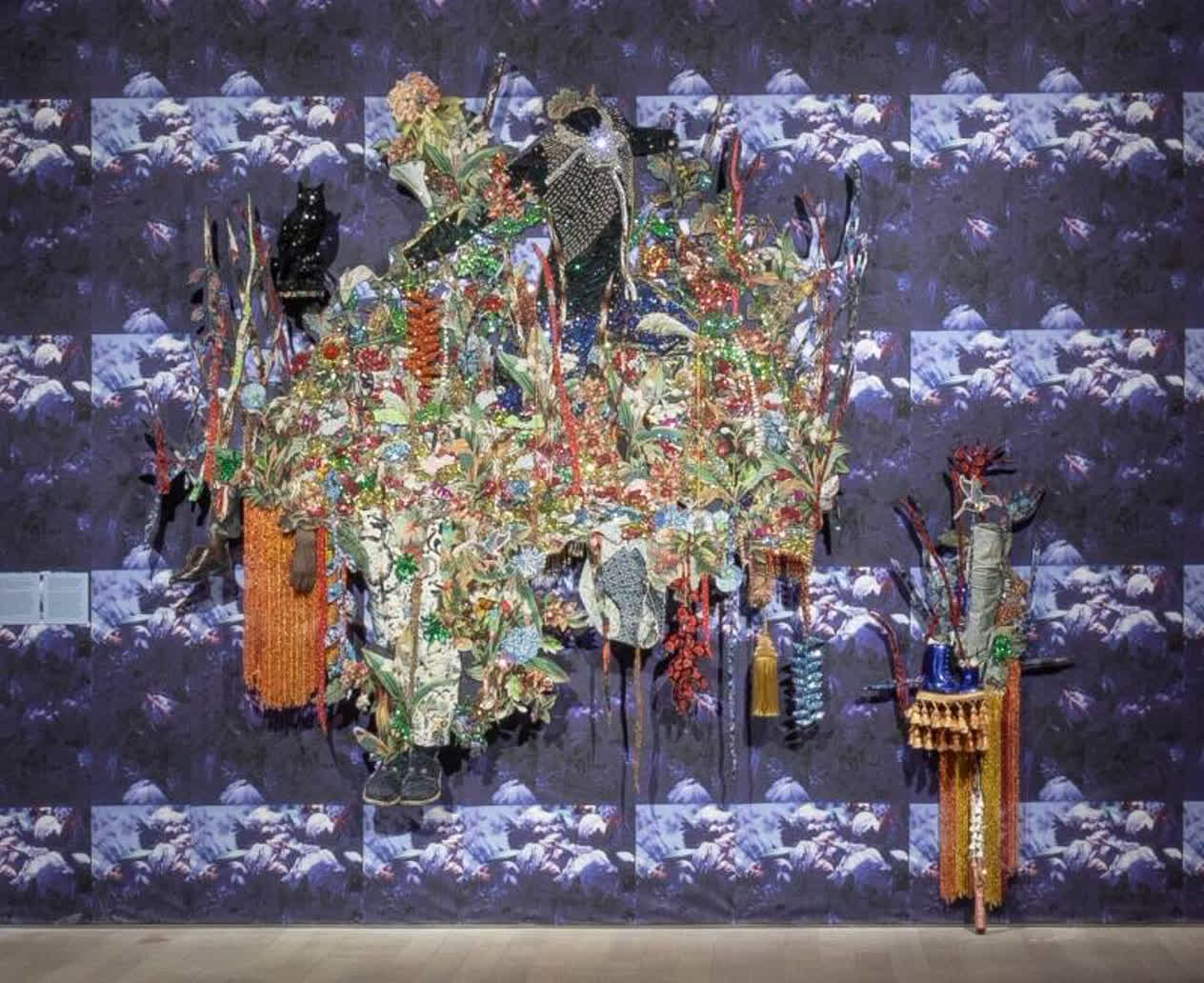
A large figure is depicted in this work kneeling at the top of the composition. Its arms are stretched back in a dramatic gesture that recalls that of surrender or emotional outcry. The piece’s tapestry structure is layered extensively with collaged fabrics, plastic jewels, lace, glitter, and beads. The dense complexity of the surface in this piece reveals the artist’s deep painterly sensibility; she uses the diverse juxtapositions of color and texture of these found materials as a painter uses paint. Among Patterson’s chosen objects is an owl, a traditional symbol of death, covered in black glitter. A toy gun is also included, as are two shiny rubber boots filled with seashells. Shells in many African diasporic religious traditions are believed to aid spirits in death on their journey back to Africa.
Identification
Title
. . . a wailing black horse . . . for those who bear/bare witness
Production Date
2018
Object Number
2019.001
Credit Line
Collection Pérez Art Museum Miami, museum purchase with funds provided by Jorge M. Pérez, the John S. and James L. Knight Foundation, and PAMM Ambassadors for Black Art
Copyright
© Ebony G. Patterson. Courtesy the artist and Monique Meloche Gallery, Chicago
https://www.pamm.org/en/artwork/2019.001
Copy artwork link
Physical Qualities
Medium
Hand-cut jacquard woven photo tapestry with glitter, appliqués, pins, embellishments, fabric, tassels, brooches, acrylic, glass pearls, beads, hand-cast and hand-embellished heliconias, shelf, and hand-embellished resin owl on artist-designed fabric wallpaper
Dimensions
115 x 144 inches
Visual Description
Ebony Patterson’s . . . a wailing black horse . . . for those who bear/bare witness is a mixed media collage with an irregularly shaped outline. Overall, it measures a little over nine and half feet from top to bottom, and stretches twelve feet from left to right, taking up an expansive space on the gallery wall. While not framed or rectangular like more traditional works of art, the general orientation is similar to a landscape painting, with the longer dimension running from side to side. This artwork projects a couple of inches from the gallery wall, which is covered in a patterned fabric wallpaper.
This large collage is made up of a variety of different media. It is mostly made up of glitter-embellished objects and artificial plants, long thin strips of fabric, tassels, acrylic paint, and strings of beads and glass pearls, all resting on a woven tapestry.
The long strips of fabric and embellished objects are arranged haphazardly on the surface of the tapestry, which acts as a background to the entire artwork. This background fabric is woven in what is called a jacquard loom, giving it a textured, raised profile. If one could imagine running their fingers along the surface of the tapestry, one would feel the soft, but slightly raised fibers that make up its floral designs. This fabric foundation of the artwork shows a dense garden, heavy with different leaf shapes woven in a variety of greens and browns, as well as several roses, carnations, and other flowers embedded within the greenery. Some of these leaves and flowers are layered with glitter, sharpening their appearance in contrast to the dull colors of the woven background. Around its edges, the garden fabric is hand cut, hugging the edges of the leaves and flower petals, giving the artwork its irregular shape.
Collaged on top of the garden fabric, are dozens of thin strips of different patterned fabric. No more than one to two inches wide, the strips stretch for two to three feet. Some are in animal print, like tiger stripe or leopard, while others are polka dot. They are arranged vertically, pointing straight up and down, across the surface of the tapestry, almost like licks of flame. The fabric strips extend above and below the jagged outline of the woven garden.
Starting in upper left, there is a small owl covered in black glitter, perched and staring off toward the viewer’s left. Moving counter-clockwise, in the lower left there is a curtain made up of a dozen or so strands of amber colored glass beads, hanging at least two feet downward past the edge of the artwork, as well as a severed hand with ashen brown skin, also dangling from the tapestry. In the lower right is a large golden tassel, nearly a foot in length. Next to it is a heliconia plant, often called a lobster claw, covered in sky-blue glitter. In the extreme lower right corner, is a part of the tapestry that is disconnected from the larger artwork. This small “island” off of the larger tapestry has the same background and fabric decorations, but protruding from its surface is a pair of sparkling blue workbooks, with gold tassel fringe attached around the edge of the boot’s soles. Behind this island, hundreds of yellow, copper, and amber colored beads and glass pearls hang more than two feet downward in dozens of neat vertical lines, nearly grazing the floor. Returning to the main tapestry, at the very top, what would be twelve o’clock on a clock face, woven as part of the tapestry is the image of a headless figure, kneeling over the collaged garden. This figure wears blue glittery pants and a similarly shimmering black shirt, embellished with pearls down its center line and across its chest, as well as an elaborate pearl broach at the collar. The kneeling figure’s arms are stretched outward, but similar to the absent head, their hands and feet are also not visible.
Behind the entire artwork is fabric wallpaper, mostly made up of hues of dark purple and deep indigo. It is a repeating image of foliage in a garden seen at night. The tops of the leaves and fronds of the ferns and shrubs look lit by moonlight. All round these lit areas, the dark colors envelop and surround the faintly visible plants.