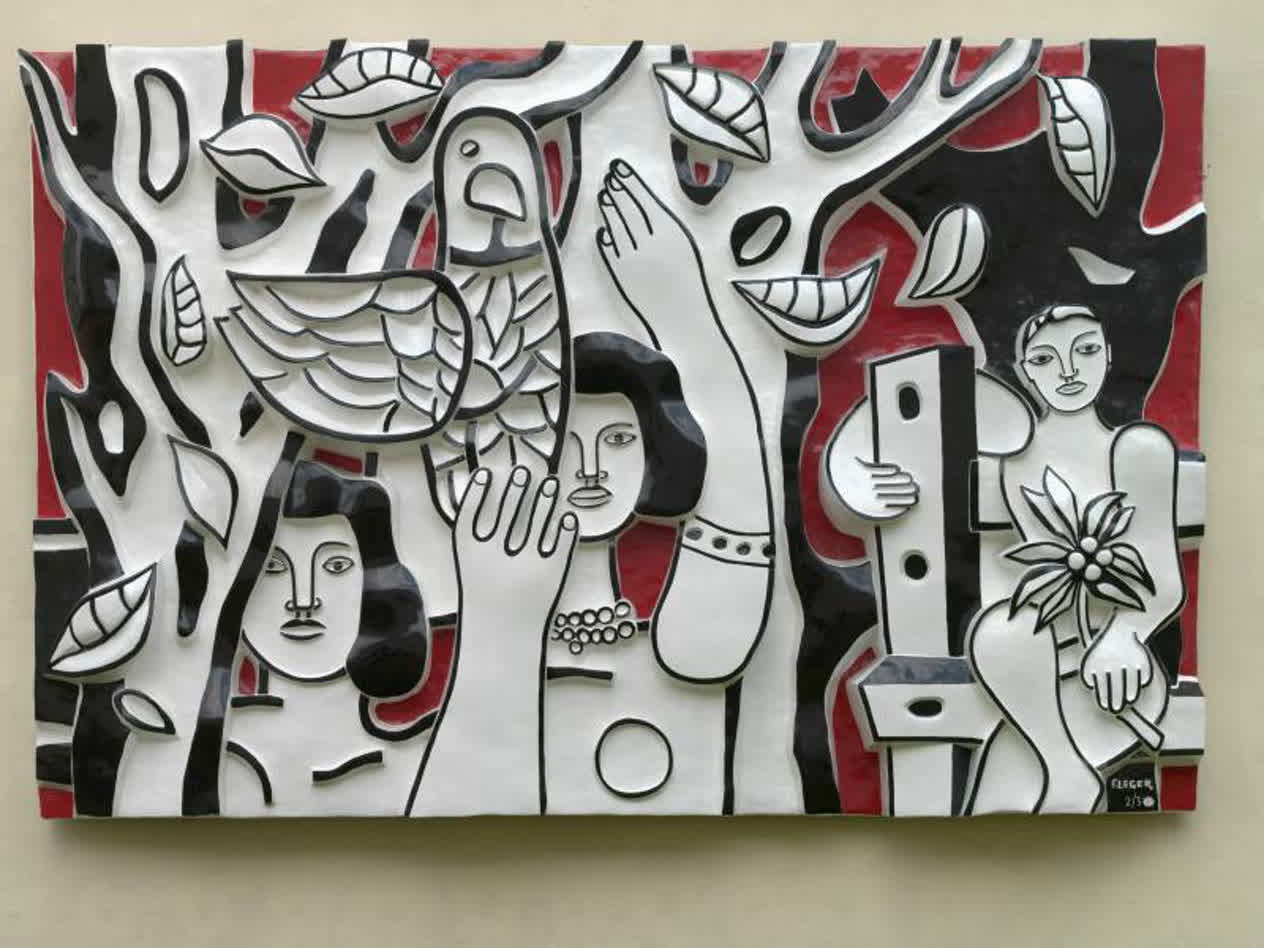
Fernand Léger Les Femmes au perroquet (Women and Parrot) 1951–52
© 2022 Artists Rights Society (ARS), New York / ADAGP, Paris

Léger is considered one of the great Modernist European artists of the 20th century. He initially associated himself with Pablo Picasso’s and Georges Braque’s Cubist movement, but in time was closely associated with Robert Delaunay, Francis Picabia and Alexander Calder.
From 1914 until the end of World War II, Léger’s work combined abstraction and representation, often depicting individual figures or groups of figures as machine-like assemblages of cylindrical and rectilinear forms. After World War II, Léger entered a period in which his work celebrated the working class and popular life through figural compositions that were less mechanical and more organic. As a result of the extensive rebuilding campaign that took place throughout Europe after the war, Léger, like many other European masters, was active in creating monumental public art works, of which Femmes au Perroquet is an example.
The composition shows an Edenic scene of women in nature. The two structural elements in the lower right, while suggesting a bench on which a figure is sitting, resemble the building girders found in other works by Léger, suggesting that the artist may be evoking a theme of building a new paradise.
Identification
Title
Les Femmes au perroquet (Women and Parrot)
Production Date
1951–52
Object Number
2006.34
Credit Line
Collection Pérez Art Museum Miami, gift of Jeffrey H. Loria in memory of Ruth and Walter J. Loria
Copyright
© 2022 Artists Rights Society (ARS), New York / ADAGP, Paris
https://www.pamm.org/en/artwork/2006.34
Copy artwork link
Physical Qualities
Medium
Painted bronze
Dimensions
134 1/4 x 189 inches
Visual Description
Femmes au Perroquet, or Women and Parrot, by Fernand Leger is a massive bronze relief sculpture that measures just over eleven feet tall sixteen feet wide and just shy of a foot and a half deep. The bronze relief shows a stylized scene of women in nature depicted in white, black, and crimson red. Their bodies appear cartoon-like and amorphous, seeming to defy any natural laws. At the center of the frame, a white hand and forearm drawn with a black outline reaches up from the bottom and holds a parrot-like bird. The bird’s feathered body is depicted with crisscrossing lines that resemble cracks on a dry salt flat, and has a single wing outstretched to the left. Behind this bird, we see half of the face of a woman peeking out from behind. She has short, chin-length black hair, wears a pearl necklace, and her abstract torso has a circle on the right side of her chest, as if to indicate a breast. She has her right arm outstretched above her towards the sky, resembling the wavy trees behind her. Behind this woman to the right, an unclothed woman sits with legs crossed on a bench that also resembles steel building girders. Her right arm almost looks as if it were drawn upside down as it is unnaturally wrapped around the steel girder to the left, while the other arm seems to hold a flower that is the size of her torso. Large, bean-shaped leaves sweep across the top of the composition, following a wavy tree trunk with squiggly lines down to the bottom left. Behind this tree trunk we see a woman with jaw-length black hair peering from behind with a blank expression. The background behind all the characters is a crimson red.