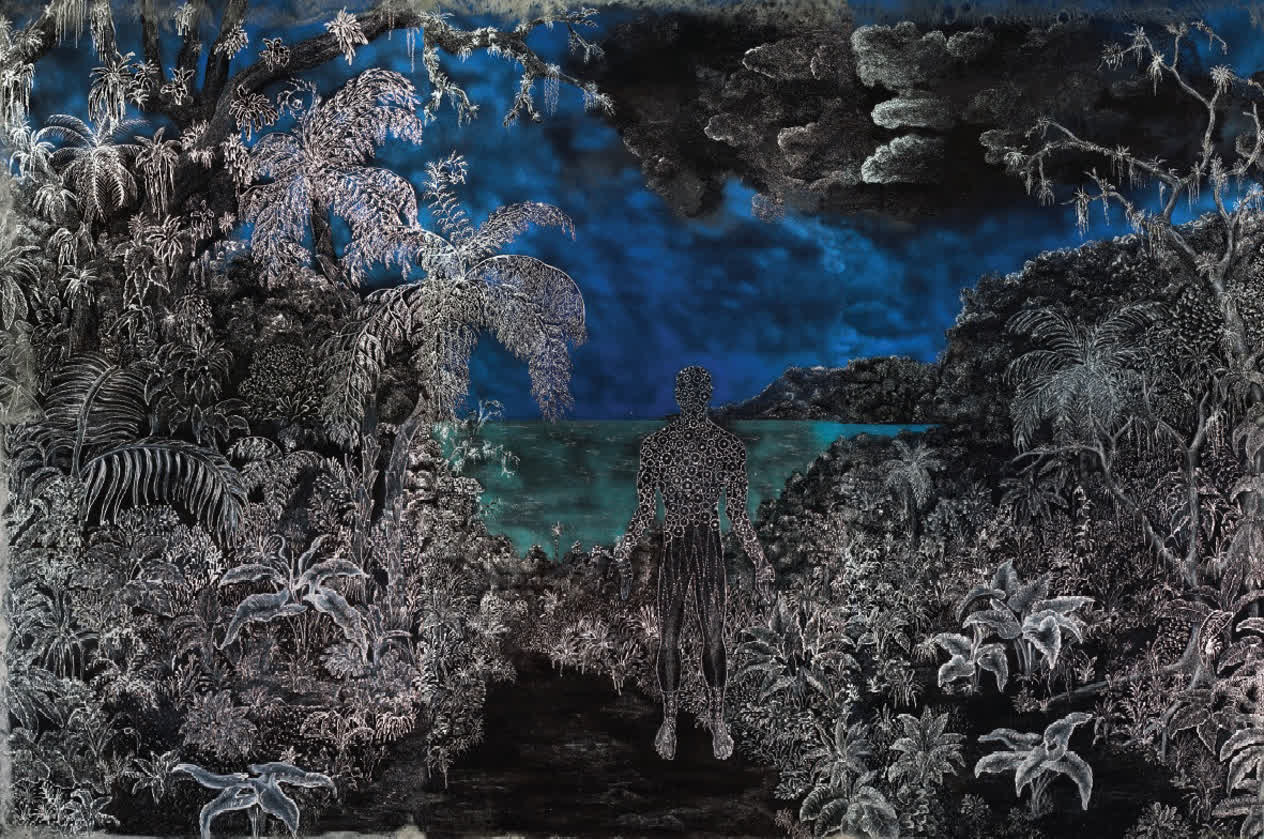
Edouard Duval-Carrié After Heade—Moonlit Landscape 2013
© Edouard Duval-Carrié

After Heade–Moonlit Landscape is the first work Edouard Duval-Carrié produced in the Imagined Landscapes series. The composition and details are based on an 1887 painting by Martin Johnson Heade (1819-1904), titled View from Fern-Tree Walk, Jamaica. This historical work was developed from sketches that the Pennsylvania-born artist produced on site during a trip to Jamaica in 1870. Inspired by the popular and lucrative travel literature of the German explorer Alexander von Humboldt (1769-1859) and the engravings of Frederick Catherwood (1799-1854), Heade made several trips to the Caribbean and Central and South America; the first was to Brazil in 1863, followed by trips to Nicaragua in 1866, and to Colombia, Panama, and Jamaica in 1869-70.
Heade’s painting presents a dense landscape in which each plant is rendered with a botanist’s attention to detail. It is devoid of any human subjects, placing the viewer in a position of mastery, in the role of explorer, as if discovering and bringing into view this landscape for the first time. Duval-Carrié has copied the composition of this painting and its various details in black and silver, and includes an enigmatic male figure, whose faceless body is covered with an unusual pattern.
Identification
Title
After Heade—Moonlit Landscape
Production Date
2013
Object Number
2014.120
Credit Line
Collection Pérez Art Museum Miami, museum purchase with funds provided by Jorge M. Pérez
Copyright
© Edouard Duval-Carrié
https://www.pamm.org/en/artwork/2014.120
Copy artwork link
Physical Qualities
Medium
Mixed media on aluminum
Dimensions
96 x 144 inches
Visual Description
After Heade–Moonlit Landscape by Edouard Duval-Carrié is an artwork made of mixed media on aluminum. Made in 2013, it measures ninety-six by one hundred and forty-four inches, which equals eight feet tall by twelve feet wide. It is displayed in landscape orientation, meaning that its longest side runs parallel to the floor. This artwork displays a human figure centered in the middle of a lush tropical landscape, painted mostly in blue, green, and black. Unlike a traditional painting on canvas, which has a pale cream background, this painting is dominated by black as the underlying hue. Every element of this composition, from the outline of the human figure, the leaves of the palm fronds and shrubs, even the clouds in the sky, are etched in glittery silver onto the black aluminum background.
Starting in the center, the human figure stands on a cleared path in what looks like a tropical jungle. The upper half of the human figure is covered in an intricate pattern of concentric circles and rosettes. This pattern fills their torso and arms. The figure‘s lower abdomen and legs feature a sparser covering of glittery silver, exposing more of the black base color. The figure bears no face and stands with his palms facing outward toward the viewer.
Behind the patterned figure is a horizon in the distance that divides the aquamarine teal of the sea from the cobalt blue of the sky. To the left of the figure, covering the leftmost quarter of the artwork, is a dense jungle of foliage, palm trees, and tropical vegetation. The jungle forms a thick column of silver glitter against the deep black of the base color. Again, these natural features look otherworldly and alien rendered in silver and black. On the righthand side of the artwork, the jungle rises diagonally, starting behind the figure, and rising gradually to the upper right corner of the large artwork. This allows for the right side of the artwork to showcase a landmass resting on the horizon in the distance to the right of the figure’s shoulder and neck.