Mark Dion Herbarium Perrine (Marine Algae) 2006
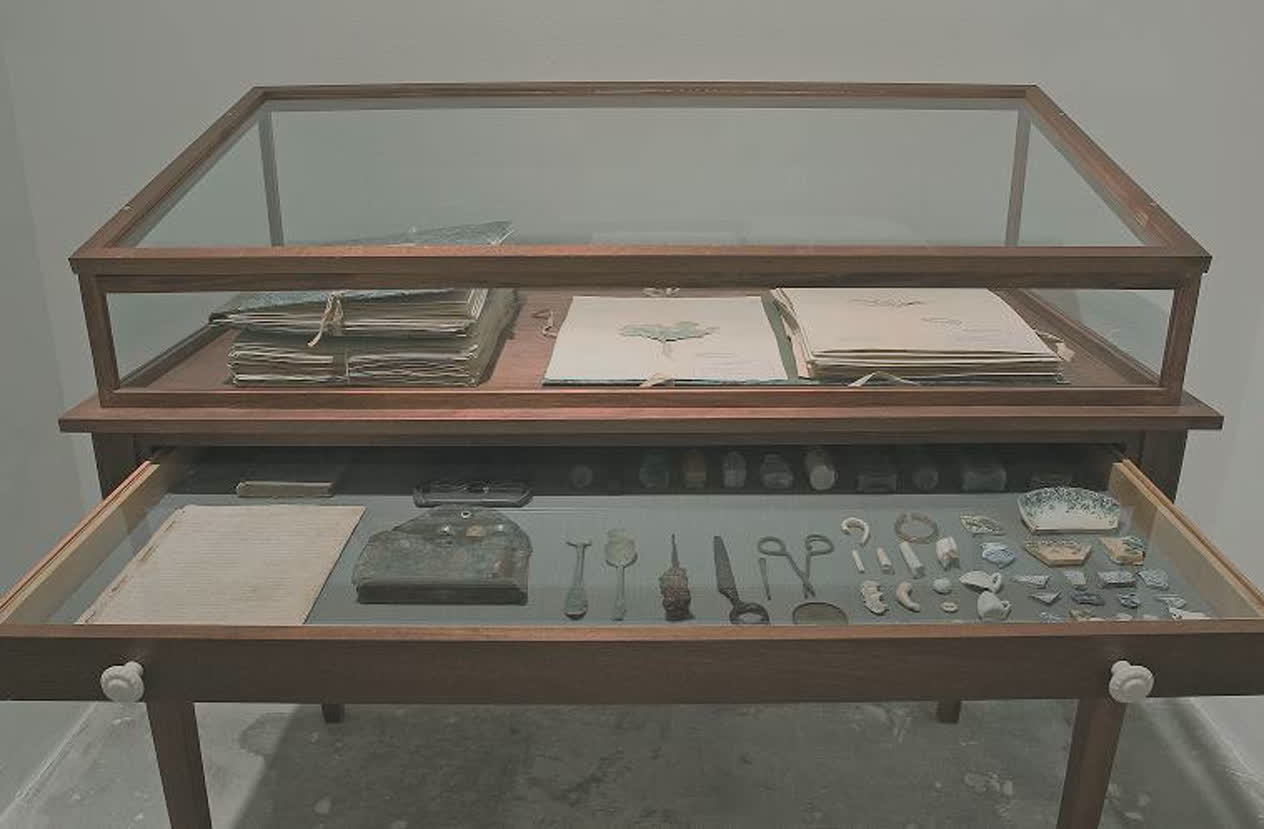
© Mark Dion. Courtesy the artist and Tanya Bonakdar Gallery, New York / Los Angeles

Mark Dion’s research-intensive work weaves together art, science, ecology, history, and archeology in order to question the relationship between humans and the environment. Herbarium Perrine (Marine Algae) explores the incursions of settlers into the Everglades in the 18th and 19th centuries and the related desire prevalent during that time to explore, classify, and tame the landscape.
Contained in this cabinet is an herbarium—a portfolio of preserved and categorized plants—of pressed seaweed specimens, purportedly gathered and compiled by the botanist and early Florida settler Dr. Henry Perrine. Perrine was part of a legion of amateur explorers who ventured into remote areas to systematically document the region’s life forms, and the herbarium represents a common recording method from this period. In 1840 Perrine was killed and his home burned down in a raid by members of the Seminoles, a Native American tribe, destroying all of his records. Dion has reimagined Perrine’s singed documents along with his melted tools and other objects for this display, creating false artifacts from this historic moment that symbolize the obsessive desire to know and categorize the natural world.
Identification
Title
Herbarium Perrine (Marine Algae)
Production Date
2006
Object Number
2007.2
Credit Line
Collection Pérez Art Museum Miami, museum purchase with funds provided by PAMM’s Collectors Council
Copyright
© Mark Dion. Courtesy the artist and Tanya Bonakdar Gallery, New York / Los Angeles
https://www.pamm.org/en/artwork/2007.2
Copy artwork link
Physical Qualities
Medium
Two handmade portfolios containing pressed seaweed samples on tea-stained paper, custom-made display cabinet, and assorted objects
Dimensions
Dimensions variable
Visual Description
Herbarium Perrine (Marine Algae) by Mark Dion is a mixed media sculpture made in 2006. It is made of two handmade portfolios containing pressed seaweed, a custom-made cabinet, and other assorted objects. The portfolio measures seventeen inches by three and a half inches when closed, and seventeen inches by twenty-four and five eights of an inch by three and a half inches when opened.
The entire sculpture is inside of a custom cabinet that is separated into two parts. The top most part is flat like a table, made of a dark colored wood, and covered by a glass lid like a vitrine. Resting on this table-top are several portfolios containing pressed seaweed. Most remained closed and stacked on top of one another. But one is left open, allowing viewers to observe the stained paper and pressed seaweed.
The bottom and second part of the cabinet is a drawer that is also covered by a glass lid. Inside this drawer there are assorted objects: scissors, stones, leather pouches, and paper sheets. The objects are neatly displayed and organized by material type.