


Learn more about the artists in INTERTIDAL in their own words.
These excerpts are part of an interview series, which brings together a group of artists featured in PAMMTV’s INTERTIDAL 2025–2026 exhibition, whose practices reflect the forces that shape our shared and personal worlds. Keisha Rae Witherspoon offers a moving perspective on community, media, and rituals of grief, while Yucef Merhi traces the cultural impact of early technologies from the Atari to our current digital revolution. domingo castillo flores turns toward Miami’s urban fabric and its ever-shifting social landscape, as Liz’Bow draws from the rhythms of popular culture, barrio life, and visual identity to shape their work.
While not part of this interview series, we also want to acknowledge Jacolby Satterwhite, whose visionary performance and video practices continue to inspire. We hold space here to honor Satterwhite’s influence and extend our sincere wishes for full recovery.
Keisha Rae Witherspoon
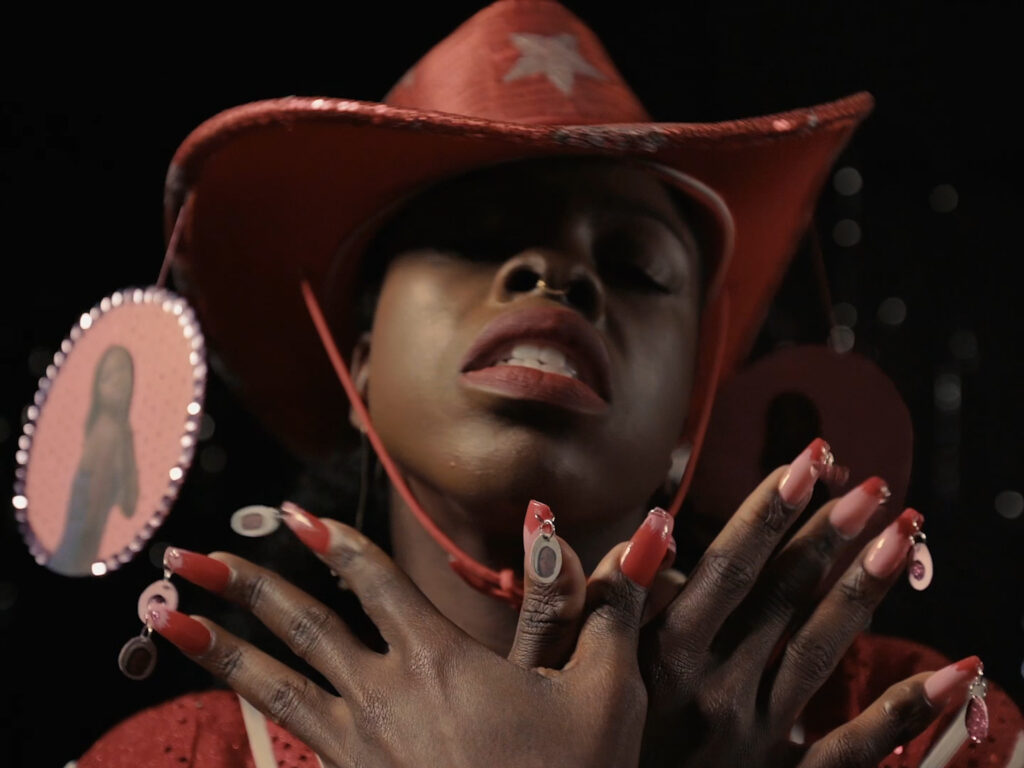
Pérez Art Museum Miami (PAMM): Can you introduce yourself and talk a bit about the story behind your piece T (2019), including its title?
Keisha Rae Witherspoon: I’m a Miami-born, half Jamaican, half American creative. I grew up in a Caribbean household, and art wasn’t really the focus. The art part of my life was something I suppressed for a very long time. In terms of T, it was around the time of the Trayvon (Martin) killing. Trayvon is part of the T symbolism and the hyper visibility of Brown and Black death at the hands of law enforcement. And there was something about the body cams revealing these things very consistently, and there not being any, or at least not satisfactory justice for what we were seeing. I can’t really say I have a genesis or an origin story, so much as my brain thinks of images, blips, and symbols.
I dreamt up this imaginary ball where people would celebrate the deceased of that year—like an annual ritual for loved ones who were killed. I didn’t want it to be completely fictional, so it was an actual invitation to the community to come out, dance, and celebrate. I merged real community members with the performers that we brought on as a cast. A lot of people also don’t know that T is completely scripted. It is a hybrid documentary piece that I wanted to have a structure for but leave all the room in the world for improvisation by characters or performers. T is also Tupac, T is also the crucifix. It’s, again, an extension of these blips that I have in my mind.
Yucef Merhi
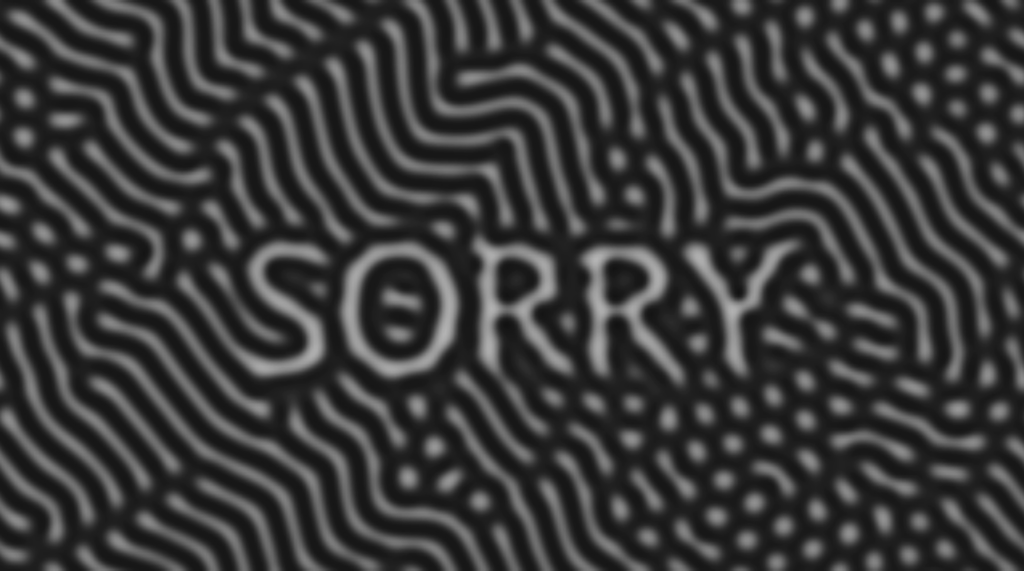
PAMM: Yucef, we love to hear how artists talk about themselves. Can you please introduce yourself and tell us more about your piece SORRY (2015)?
Yucef Merhi: I started developing my visions, my works, and this relationship with machines and language at a very early stage in my life. By the age of seven, I got my first Atari 2600 as a birthday gift. And the experience had this special taste because it was a physical, tangible thing that you held in your hands. And you had to deal also with glitches and errors in these machines. But additionally, it introduced me to a new form of reality that was on the screen, that was interactive, that had the mission of entertaining people. But I honestly didn’t want to be entertained. I wanted to have communication with this machine, and that was my initial drive; I wanted to talk to the Atari. I wanted to have a sort of conversation.
I ended up building a keyboard that I plugged into the Atari, and I found a cartridge that allowed me to access the memory of the Atari, so I could program it and write instructions. I found books on programming at the public library. At the age of eight, I already had a few works that were, in a way, close to systems where the screen was showing the translation of programming language into natural language, and natural language into visual language. So, you could see the whole process of how code becomes a movie. My childhood was surrounded by the presence of this technology and that was the starting point of my interest not only for computational technology, computer devices but also to decode the mystery of language because I was using language, but this language was also programmed language.
Later, I found that computers were also mimicking human behavior. I think now it’s clear that we are not only trying to emulate ourselves, but we want to surpass ourselves from a logical, analytical point of view. And this is important to keep in mind because we are developing something that mimics intellectual intelligence, but there are many different forms of intelligence. And as humans, we have a variety of intelligences that are not limited to just verbal intellectual intelligence.
domingo castillo flores
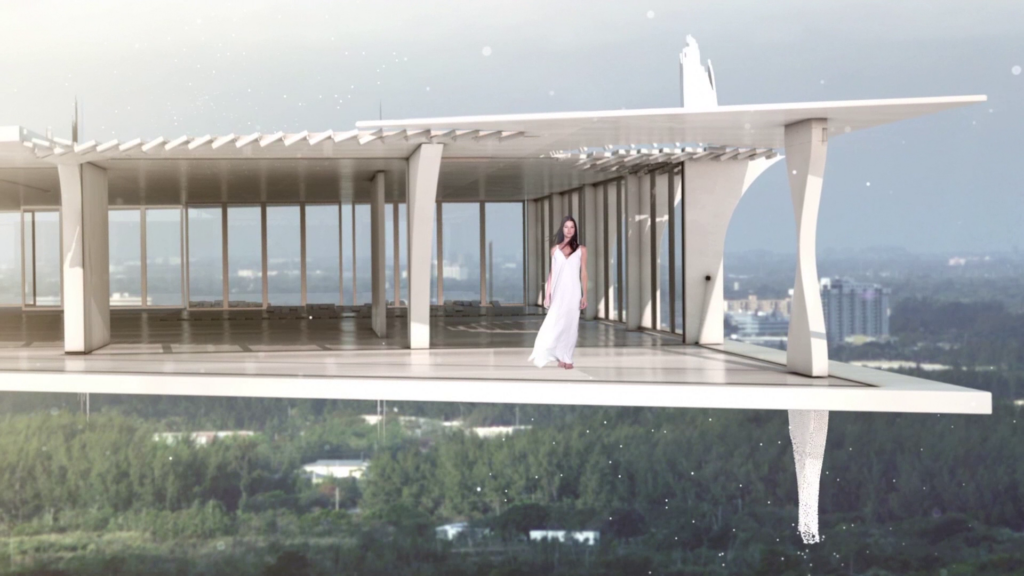
PAMM: Could you introduce yourself and talk a bit about the story behind your work on PAMMTV’s Intertidal exhibition, the piece Surface Image: Epilogue: (Version), 2015–2026?
domingo castillo flores: My name is Domingo Castillo Flores. I’ve been working out of Miami as an artist since about 2006. So, Surface Image: Epilogue: (Version) is part of a larger project called Surface Image, which interrogates Miami through the media that shapes its making. So, for example, these images that real estate developers made of Miami when it was still a swamp, the videos and films they would produce to sell the city. And Version looks at videos made in the mid-2010s about Miami, and they were kind of projecting 10 years into the future at the time. Actually, most of the buildings in that film were not finished at the time; they were all in production or trying to find the money. Most of the buildings have been completed since then. This is why, any time the piece is shown, the year gets extended, because the film is never complete.
So, the actual film is an incomplete work because what I realized in the process of making the film is that since the city is always projecting into the future, one’s experience in the city, in the present, is made up of almost unfinished histories or the things that got completed and the things that didn’t get completed. So, it never actually arrives at being a city—it stays in this perpetual becoming, which is really good for investment. Everyone who lives in the city has to deal with the changes that are pushing into the present and putting a lot of pressure into a lived reality. This is why the work exists in this fairly mutable fashion. So, each of those things is interrogating different parts of Miami’s history and different parts of this kind of becoming, you know?
LIZ’BOW
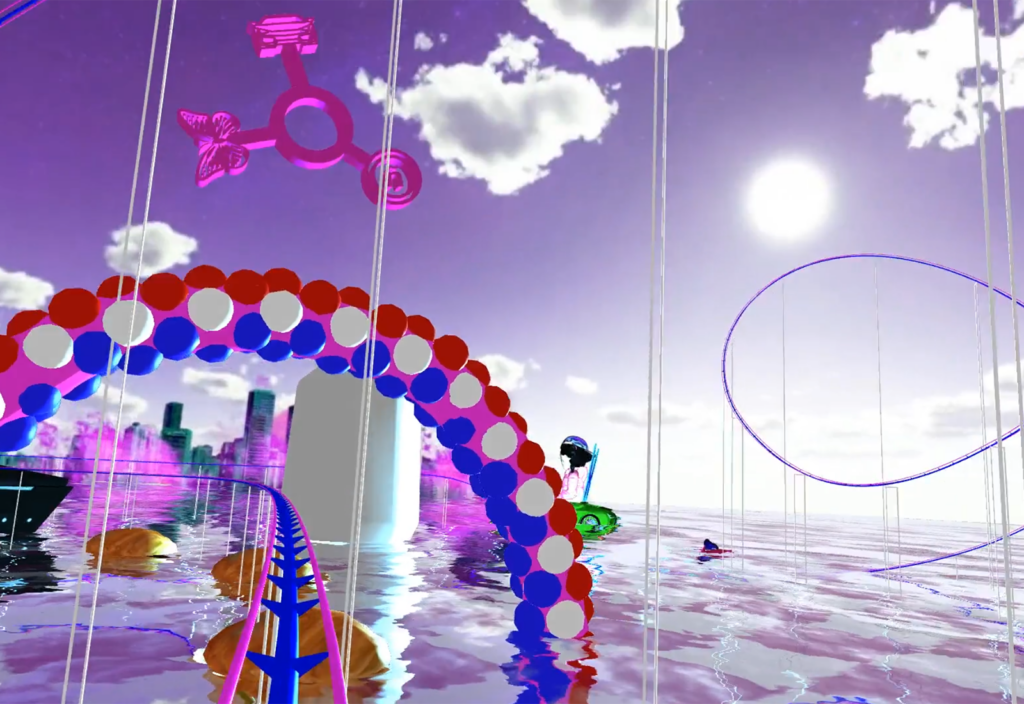
PAMM: I would love for you two to introduce yourselves telling us how did you two met and also talk about the story behind the piece Niñalandia Skycoaster (2024) showing now on PAMMTV.
Liz’Bow: We are Liz and Bow.
Liz: We met 10 years ago.
Bow: We met in Chicago. I was at this party working as a human lamp. It’s a job where I can only make eye contact with people, basically. So, Liz met me as the lamp.
Liz: I went to Chicago for the first time. I had done an artist residency around there. Then I go to the party and see this lamp just across the room. And I was like, “Who’s that lamp?” I go up to Bow and start talking to Bow for hours. But Bow, like Bow said, can only make eye contact, not respond. And I was bringing everyone over. “Have you seen this lamp? Let’s see if the lamp will break,” break from not talking. Then I had to leave, and Bow was still working as a lamp, so we couldn’t ever actually talk. I couldn’t stop thinking about the lamp, but I had another friend who knew them, and I messaged Bow the next morning. I invited Bow to a performance. I was performing with the Poncili Creación twins in one of their shows. I was like, “Come to our show,” and Bow said, “I already have plans.” Bow’s plan was to come to our show, and they didn’t know that it was the same show. When we actually got to speak, we came up with a spreadsheet of things we wanted to work on, which is a very natural but also unnatural thing, because who meets someone and then starts coming up with a giant list of things to work on with them. It was kind of like some magical moment.
Bow: As Liz said, we made a spreadsheet, and there are ten or twenty things on there, and now, 10 years later, we have done almost all the things on that spreadsheet. So, one of the first projects we did together was with museums. We did these new media identity workshops where we worked with kids and asked them questions like “What are things in the world that aren’t real?” and “What would the world be like if they were real?” Then we got them to draw things. We got them to use objects as clothing. We would photograph them in front of a green screen. We would do all this stuff, they would have fun, and then we’d go home and make these crazy images that would take forever to make, and it makes no sense to do that as part of a kid’s workshop. This was a lot of work, but it looked cool. We’d come back to them and bring them something new, and they would react to it and understand, or see themselves in a new way, maybe because we had worked with their imaging.
Bow: Niñalandia is like a whole world. It’s a universe.
Liz: Exactly! This world we’ve been working on for some years is this ongoing project too. It’s not new. We’re just adding more.
Bow: It started as a video backdrop for one of our shows, and over time, it transformed into these three-dimensional objects. It absorbed all these other aspects of our lives.
Liz: For this universe, we want it to not just exist digitally, So, we’re diving deeper and bringing things out from there. And we have so much in there that there can be so many objects, so many different things, so much stuff. We can go shopping in our videos and be like, “Oh yeah, this would be cool as a sculpture.”
Bow: Yeah. And a big part of the motivation is just bringing all these elements into the real world in some way, you know, like making the world a little more pink, making it a little more femme, bringing milk into the clouds, bringing all these aspects from our universe.
Organization and Support


