


- 1/13 1. Introduction
- 2/13 2. Why Berggruen Went Home
- 3/13 3. Still Life
- 4/13 4. Diego Rivera, Naturaleza muerta
- 5/13 5. Interior
- 6/13 6. Henri Matisse, Interieur d’Atelier à Nice (In the Studio in Nice)
- 7/13 7. Painting Through Occupation
- 8/13 8. Portraiture
- 9/13 9. Pablo Picasso, Homme au chapeau
- 10/13 10. A Name Coincidence
- 11/13 11. Landscape
- 12/13 12. Paul Klee, Nekropolis
- 13/13 13. Thank You for Visiting
Introduction
Picasso–Klee–Matisse: Masterpieces from the Museum Berggruen brings works from the Museum Berggruen in Berlin to PAMM. The collection was gathered by one person, Heinz Berggruen, who spent a lifetime collecting the work of a small circle of artists.
Berggruen was born in Berlin and studied German literature, working as a journalist before the Nazis rose to power. Around 1936 he left Germany for the United States, where he studied at UC Berkeley and later worked at the San Francisco Museum of Art. There he assisted the muralist Diego Rivera and first learned about the work of Paul Klee. After serving in the U.S. Army toward the end of World War II, he settled in Paris and opened a gallery.
Berggruen never trained as an artist or a curator. He developed his eye by looking closely at the art around him. When he built his own collection, he went deep rather than wide following a few artists across their lives and careers. This exhibition focuses on three of those artists: Pablo Picasso, Paul Klee, and Henri Matisse.
This guide follows four themes that run through the collection: Interior, Landscape, Portraiture, and Still Life. Each stop features one work, with background on the theme, the artist, and the artwork itself. Between stops, short audio moments from a member of PAMM’s curatorial team share stories from Berggruen’s life and collecting.
Organization and Support
This exhibition is supported by an indemnity from the Federal Council on the Arts and the Humanities.
Picasso–Klee–Matisse: Masterpieces from the Museum Berggruen is presented with lead support from Kenneth C. Griffin and Griffin Catalyst, Patricia and William Kleh, Aaron and Dorothy Podhurst and an anonymous donor. Additional support from Danielle Lambert, the Ashken Family Foundation, Karen H. Bechtel and William M. Osborne, Carol Crapple, Diane and Werner Grob, Nedra and Dr. Mark* Oren, Jay Newman and Elissa Kramer, Leslie and Greg Ferrero, Patricia M. Papper, Esta Stecher, Mary Wolfson and Robert Rosenberg, Tina Raja, Chris and Suzanne Armstrong, Irene Barr and Rafael and Marijean Miyar is gratefully acknowledged. The exhibition is made possible with the support of the Miami-Dade County Tourist Development Council, the Miami-Dade County Department of Cultural Affairs, the Cultural Affairs Council, the Miami-Dade County Mayor and Board of County Commissioners.




Still Life
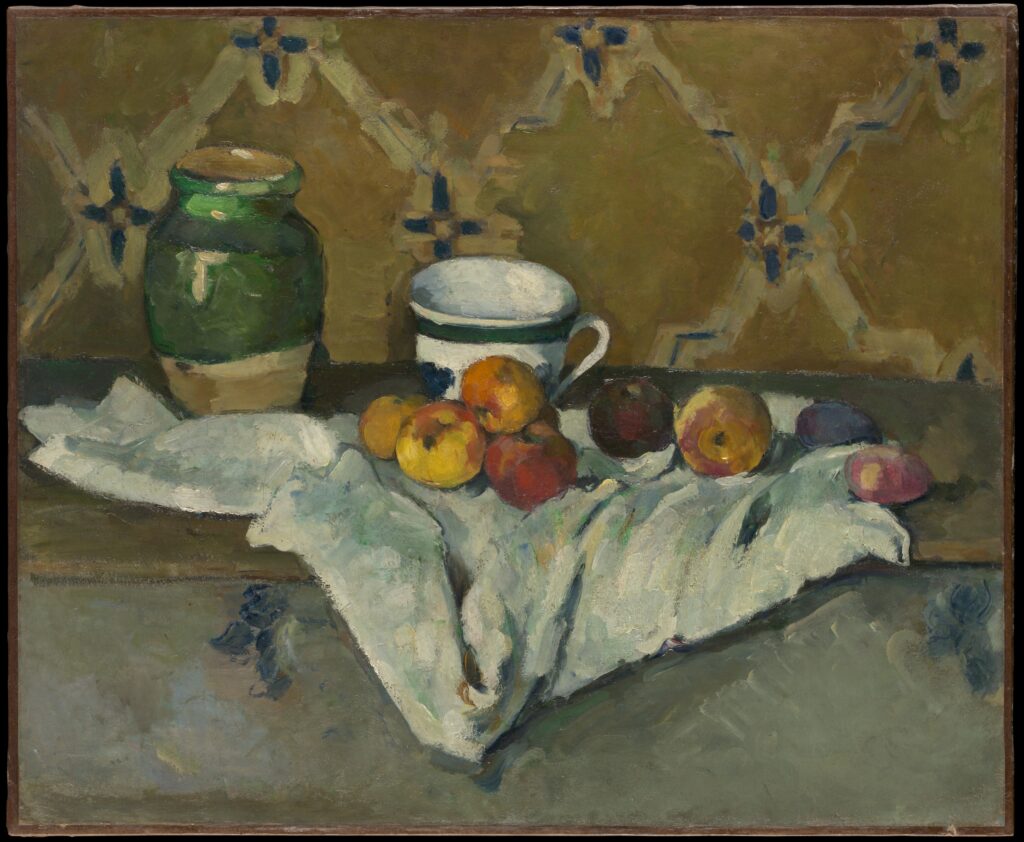
Long before he became known for the large-scale murals that would define his career, Rivera worked in Europe, where he studied the movements shaping painting there in the early twentieth century and joined the conversation among the artists making it. Naturaleza muerta comes from 1908, a moment just before Cubism emerged as a defined movement. It offers a useful “before” picture of a still life built on close observation and traditional modeling that, Cubism would soon upend.
Still life, more than any other genre, became the testing ground where Picasso and Braque worked out Cubism’s two major phases. The first phase, Analytical Cubism, took objects apart into fragmented, multi-angled planes rendered in a muted palette. Around 1912, Picasso and Braque pushed further into a second phase, Synthetic Cubism, reversing the earlier approach. Rather than breaking objects down, artists began building images back up from flat, simplified shapes, bright color, and even pasted materials like newspaper and wallpaper, a technique known as collage. Guitars, bottles, newspapers, and fruit bowls, the ordinary stuff of a tabletop, were what made this experimentation possible. A still life could be endlessly rearranged and reinvented without needing a cooperative model or a particular location.
Rivera resettled in Paris in 1909 and was making Cubist paintings of his own by 1913, several years after this still life. His Montparnasse studio and neighborhood became central to his work, and he moved among many artists. There, he grew closer to Picasso, but Rivera did not copy Paris Cubism. He would add his own personal flair by bending the subject matter towards his own interests inspired by his heritage, later saying that “my Cubist paintings are my most Mexican.” By 1918, he had left Cubism behind, and after returning to Mexico in 1921, he turned to the large-scale murals he is best known for. Seen alongside the Cubist works in this exhibition, Naturaleza muerta shows where he started.
Diego Rivera, Naturaleza muerta
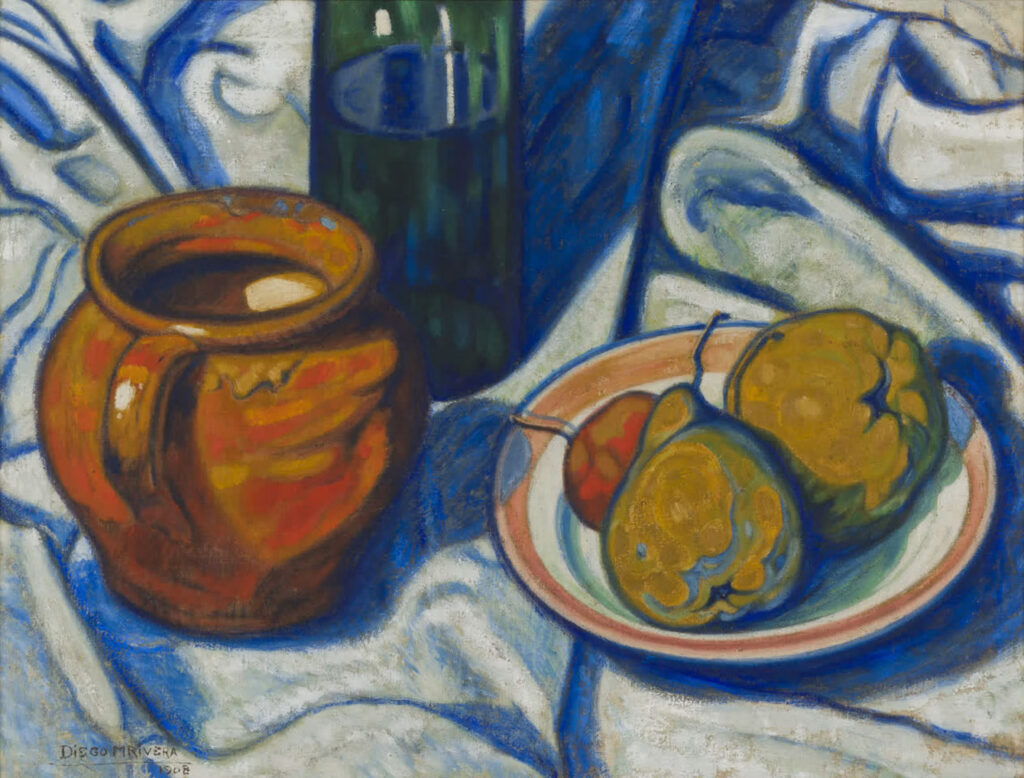
Naturaleza muerta (Still Life) is a painting by Diego Rivera made with oil paint on canvas. Created in 1908, it measures about 17 inches tall and 15 inches wide. It is in landscape orientation, meaning that its longer side runs parallel to the ground.
The painting presents a close arrangement of everyday objects. A ceramic pitcher and a plate holding several pieces of fruit rests on folds of white fabric outlined by strong areas of blue. Rivera uses loose, visible brushstrokes throughout the composition, giving the objects and fabric soft, uneven edges.
The background is mostly covered by folds of white cloth that rise and fall behind the objects. Thick blue lines trace the curves and shadows of the fabric. Near the upper center, a tall, dark green bottle rises behind the pitcher and fruit. Only part of the bottle is visible, with its lower section hidden behind the objects in front. Small areas of blue, white, and lighter green mark its surface, suggesting reflections of light on the glass. Darker blue fills the space to the right of the bottle, creating a deep shadow behind the objects in front.
Moving from left to right, a large ceramic pitcher sits in the lower-left half of the painting. The pitcher has a round, heavy body painted in warm shades of orange, red, brown, and gold. A curved handle extends from its left side. At the top, a wide oval rim opens into a dark brown interior. A small pale shape rests inside the opening near the right edge. Highlights of white, yellow, and orange move across the pitcher, while dark brown and blue shadows outline its rounded form.
To the right of the pitcher is a shallow, round plate. Its wide rim is painted with bands of pale cream, soft red, green, and blue. Several pieces of fruit rest closely together inside. Near the front is a rounded yellow-orange fruit outlined in a deep blue color. Behind it, a smaller red fruit sits partly hidden. A larger yellow-green fruit fills the upper-right side of the plate, with a dark green area along its lower edge. Curved blue lines separate the fruits and define their rounded shapes.
Across the bottom, the white cloth gathers into broad folds beneath the pitcher and plate. Blue shadows curve through the fabric, connecting the objects to the surface below. The folds travel around the pitcher, beneath the plate, and toward the lower corners of the painting. In the lower-left corner, Rivera’s name and the date 1908 are written directly onto the painted surface.
Throughout the composition, warm oranges, reds, and yellows meet cooler blues, greens, and whites. The pitcher and fruit sit close together against the folded cloth, while thick outlines and visible brushstrokes give the still life a layered, textured surface.
Interior
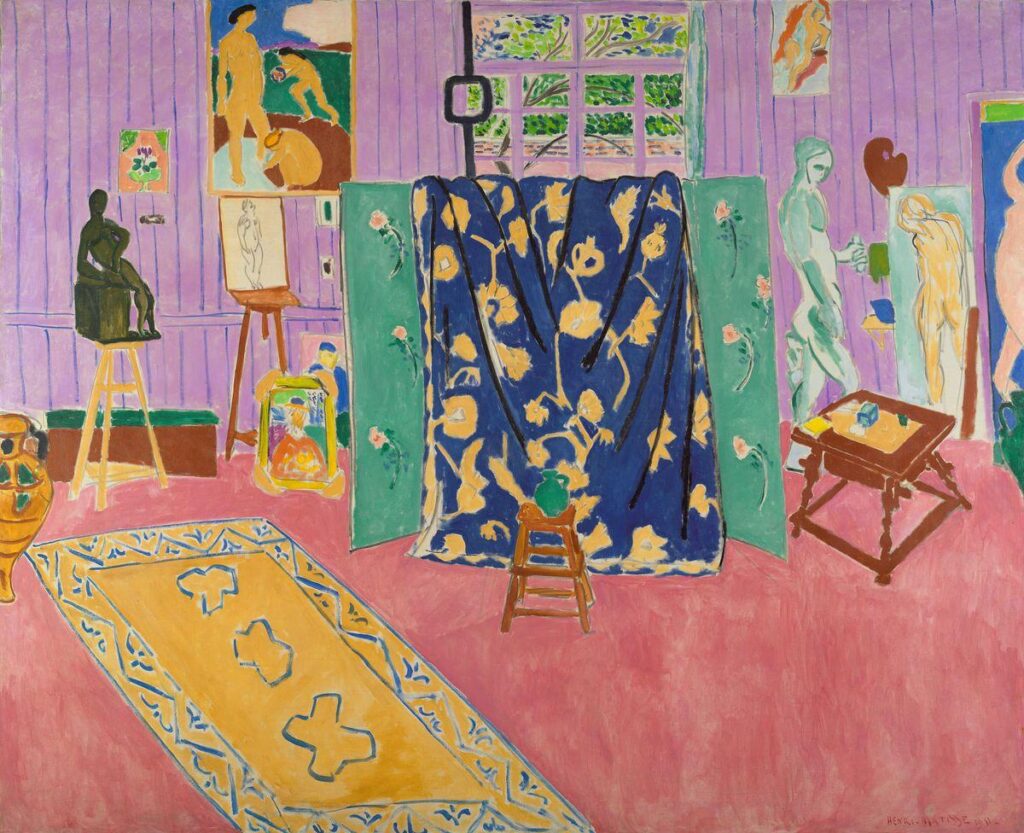
Matisse spent much of the 1920s and 1930s working from rented rooms along the French Riviera, and his studio in Nice became one of his most frequent subjects. Rather than treating the interior as a neutral backdrop, Matisse built entire compositions around it. Patterned fabrics, shuttered light, and the furniture of daily working life all carry as much visual weight as any figure in the room.
As a founding figure of Fauvism in the early 1900s, Matisse had already established color and pattern, not realistic shading or perspective, as the primary tools for building a picture. By the time he painted this interior two decades later, that instinct had matured into a decorative style where rooms are rendered as flat, interlocking fields of pattern and color rather than deep, measured space.
This is a useful contrast to keep in mind elsewhere in the exhibition. Where Picasso and Klee often break an interior or a figure apart into fragments, Matisse tends to keep the surface whole, choosing color and pattern over fracture as his primary way of reorganizing what the eye sees.
Intérieur d’Atelier à Nice gives visitors a chance to consider what a room reveals about the person who occupied it, and how an entirely different formal language than Cubism’s could arrive at an equally modern way of seeing.
Henri Matisse, Interieur d’Atelier à Nice (In the Studio in Nice)
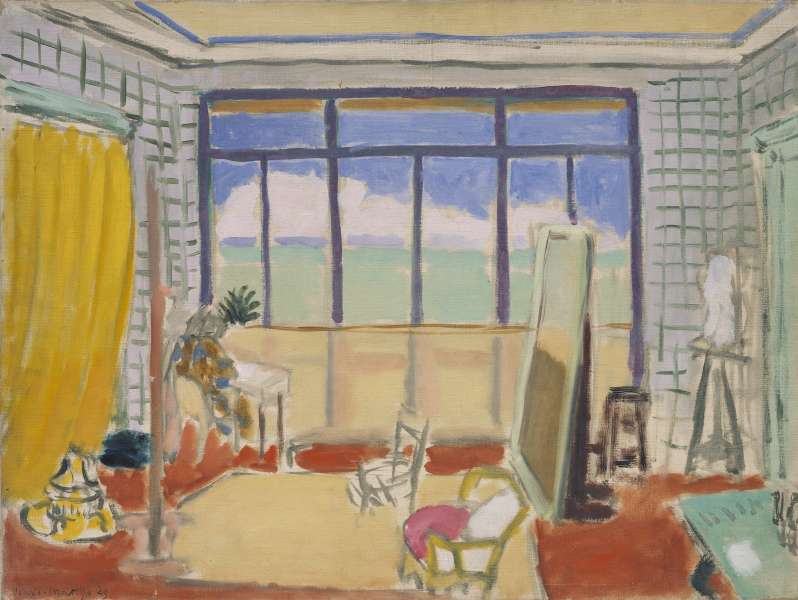
Intérieur d’atelier à Nice (In the Studio in Nice), by French artist Henri Matisse, is an oil painting on canvas. It measures about eighteen inches tall by twenty-four inches wide, and it has a landscape orientation. The painting shows the inside of the artist’s studio in Nice, on the Mediterranean coast of France. The paint is applied thinly and quickly in soft, sunlit colors: buttery yellow, rusty red, sea green, lavender, and sky blue.
A wall of tall windows fills the center of the painting, divided by deep blue bars. Through the glass, a band of turquoise sea stretches across the horizon beneath a bright blue sky with low white clouds. The walls on either side are white, above, a pale yellow ceiling edged in blue framing the viewer’s eye.
On the viewer’s left, a long mustard-yellow curtain hangs to the floor. Below it sits a round yellow and white patterned vessel, and a thin brown pole rises in the foreground. Further back, near the window, a figure in patterned blue and ochre clothing sits with their back to the viewer at a small white table, beneath a spiky green plant. The figure is only loosely sketched and is likely the artist himself, making this a quiet self-portrait seen from behind.
The floor is a wide stretch of pale yellow edged with strokes of rust red. Near the center stands a white ladder-back chair, and in front of it is a gold armchair holding a bright pink and white cushion.
On the viewer’s right, a large canvas leans upright. A painting within the painting appears to mirror the view. Behind it stands a dark wooden stool and a small white sculpture on a tall stand. Along the right edge, a pale green door suggests the room is a passageway to other spaces. In the lower right corner, a green tabletop points toward the viewer, with a second small white sculpture resting on it. The artist’s signature and the date are painted in the lower left corner.
Portraiture
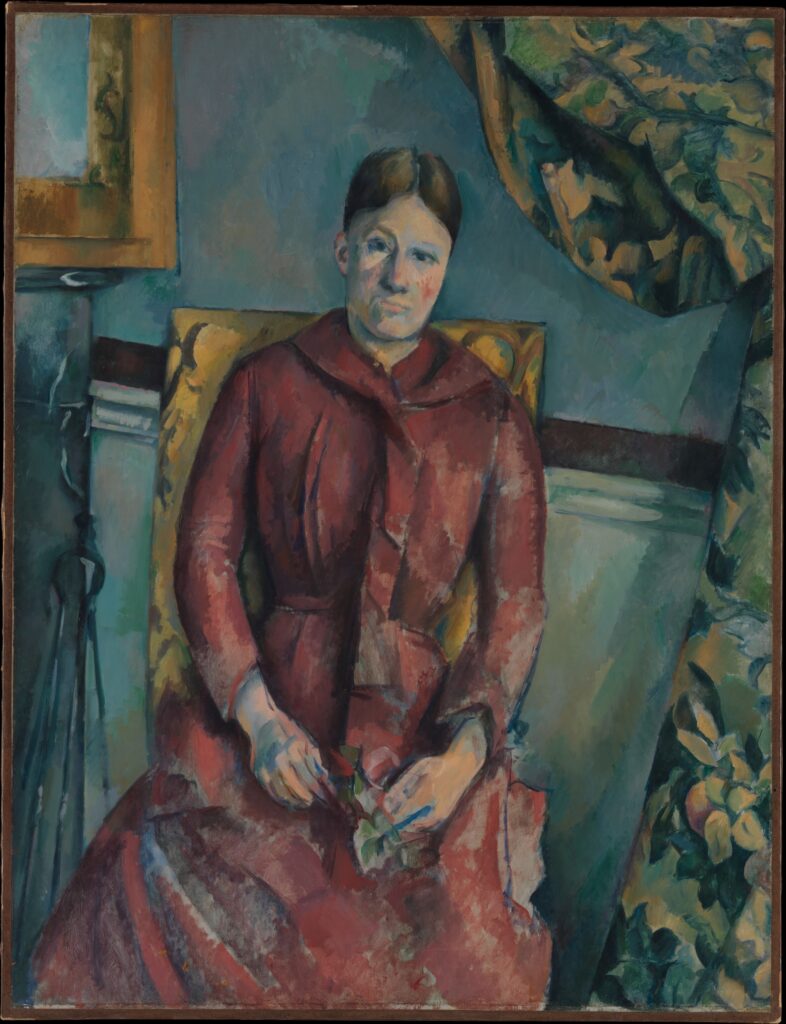
Painted at the height of Picasso’s early engagement with Cubism, Homme au chapeau shows how far a portrait can move from direct likeness while still holding onto a recognizable identity. The sitter’s face is broken into overlapping planes and shifting angles, yet certain details, like the hat that gives the painting its name, remain legible enough to anchor the viewer.
This painting belongs to what is now called Analytical Cubism, the first phase of Cubism, developed jointly by Picasso and Georges Braque between about 1909 and 1912. In this phase, the subject is taken apart, or analyzed, into intersecting planes and shown from multiple angles at once, as though the viewer were walking around it. Color is deliberately restrained, usually muted browns, grays, and ochres, so that attention stays on structure and form rather than surface decoration.
This section asks what a portrait needs to still function as one. Does a likeness depend on an accurate face, or can a single object, gesture, or fragment do the same work? Homme au chapeau invites a slower kind of looking, one where recognition comes gradually, through pieces, rather than an immediate, whole impression.
Pablo Picasso, Homme au chapeau
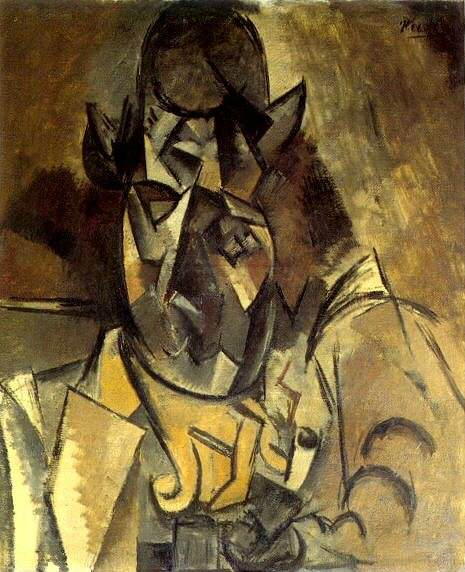
Homme au chapeau / Portrait de Georges Braque, or Man with a Hat / Portrait of Georges Braque, by Spanish artist Pablo Picasso, is an oil painting on canvas. It measures twenty-four inches tall by just under twenty inches wide and is hung in portrait orientation, meaning its shortest sided runs parallel to the ground.
The painting is an early example of Cubism, a style in which the subject is broken into angular, flat planes as if seen from several sides at once. The palette is limited to earthy colors of chocolate brown, sepia, ochre, gray, and creamy white, with sharp black lines cutting across thick, visible brushstrokes.
The painting shows a man from the chest up, facing the viewer. His head is long and narrow. On top sits a small, dark, rounded bowler hat whose brim tips up into points on either side. On the viewer’s right, the brim rises into a sharp triangle. Below the hat, the face is broken into angled pieces of light and shadow. The nose is a long, dark wedge running down the center of the face. Short, delineated dark strokes suggest a mustache, and a curved black line traces the edge of his jaw. On the viewer’s left, a lapel catches the light.
The background is loosely brushed in tones of brown. It darkens to a deep sepia around the man’s head, like a halo, and lightens toward the upper right corner, where the artist’s signature appears. Even though the face is broken apart, viewers can read the outline of the head, hat. Making the painting still recognizable as a portrait.
The hat is the reason the painting carries a second title. Picasso’s friend and fellow painter Georges Braque was known for wearing this style of bowler hat. Braque developed Cubism together with Picasso, and around the time this work was painted the two artists were in close exchange. Because of his hat, the man came to be identified as Braque. The Museum of Modern Art in New York added Braque’s name to the title in its landmark 1936 exhibition Cubism and Abstract Art. Picasso later said he had painted the portrait without a model, and that, with Braque’s consent, he passed it off as Braque’s portrait as a joke.
A Name Coincidence
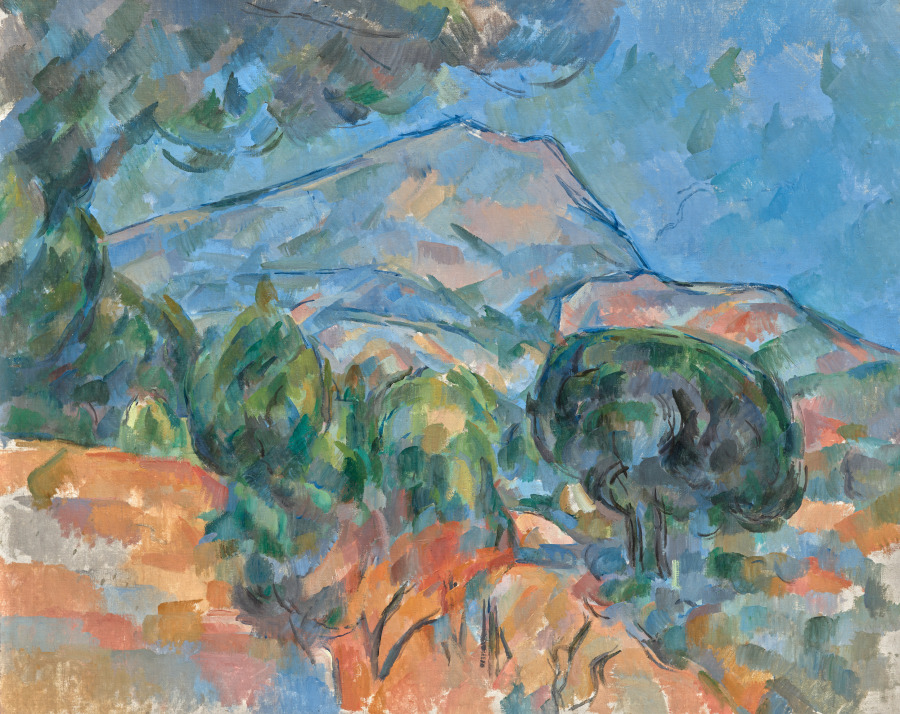
Heinz Berggruen and Paul Klee never met, but a curator noticed a small connection between their names.
“And I think what’s a nice anecdote as well that comes from a curator, Sabine Rewald, is that Berggruen is German for Green Mountain and Klee is German for Clover. So even though they didn’t know each other and Berggruen was always an admirer of Klee, there are these small ties to the two of them that we can see.”
Berggruen felt supported by Klee’s work. Let’s look at one of his landscapes.
Landscape
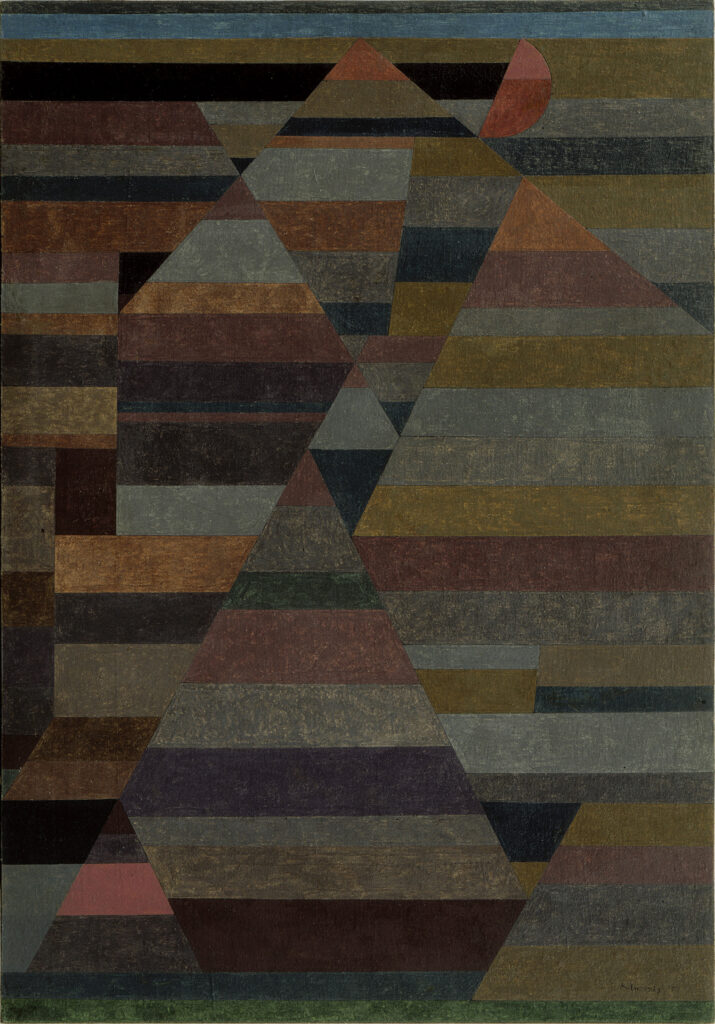
Paul Klee was born in 1879 near Bern, Switzerland, to a German father and a Swiss mother, and held Swiss citizenship for most of his life while working primarily in Germany. Music ran through his family. His father taught it, his mother trained as a singer, and Klee himself was an accomplished violinist who considered a career in music before committing to painting. That musical sensibility, an interest in rhythm, repetition, and structure, stayed with him throughout his career and shows up in the layered, patterned quality of much of his work.
Klee trained as an artist in Munich and, by the 1910s, had become associated with Der Blaue Reiter, a group of artists that included Wassily Kandinsky and Franz Marc. The group was less interested in depicting the visible world accurately than in using color and form to express emotional and spiritual states, an idea that would stay central to Klee’s work for the rest of his life. A 1914 trip to Tunisia is often cited as the turning point when Klee declared himself fully a painter of color rather than line. In the 1920s, he taught at the Bauhaus, the influential German school of art and design, where he developed a systematic approach to color theory that he passed on to his students, visible here in the careful, graduated bands of tone.
Klee’s career was cut short by the rise of the Nazi party in Germany. Labeled a “degenerate artist” along with many of his modernist contemporaries, he lost his teaching position and saw his work removed from German museums. He returned to Switzerland in 1933 and continued painting until his death in 1940, producing some of his most prolific work in his final years despite failing health.
Nekropolis followed a second trip, to North Africa during the winter of 1928 and 1929, where Klee encountered the region’s deserts, architecture, and ancient burial sites. The painting’s stacked bands of color and triangular forms echo that experience without illustrating it directly. A good example of how Klee translated real places into color and structure rather than recording them directly.
This section considers landscape as something an artist constructs rather than records. Klee was less interested in painting what a place looked like than in capturing how it felt to pass through it, carrying its light, its structure, and its history back into the studio.

