


Introduction
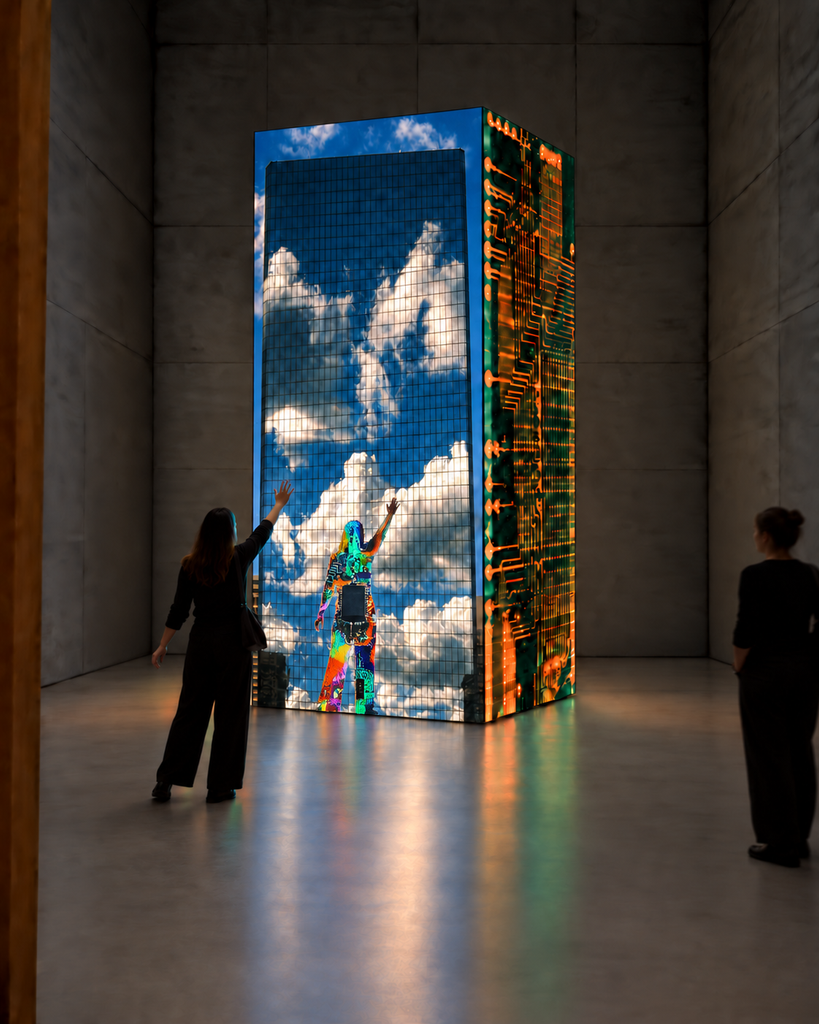
Techno Firma is an interactive artwork by John Fitzgerald and Godfrey Reggio. It fills the Double Height Gallery with images and sound that change as visitors move through the room. The installation is illuminated by Epson and co-produced with Onassis ONX. It is the first exhibition at PAMM built around an artist-driven work of artificial intelligence (AI).
Reggio is the director of the Qatsi trilogy: Koyaanisqatsi, Powaqqatsi and Naqoyqatsi. Koyaanisqatsi, first shown in 1982, has no narration, dialogue or characters. Its title is a Hopi word that means “life out of balance.” The film follows humanity’s shift from natural to built environments. It is part of the Criterion Collection and the United States National Film Registry.
Fitzgerald and Reggio began working together in 2023. The work started with a prompt from Reggio to Fitzgerald: “we must use the fire of the medium of technology in order to question it.” Techno Firma is their answer, made with the tools of this moment.
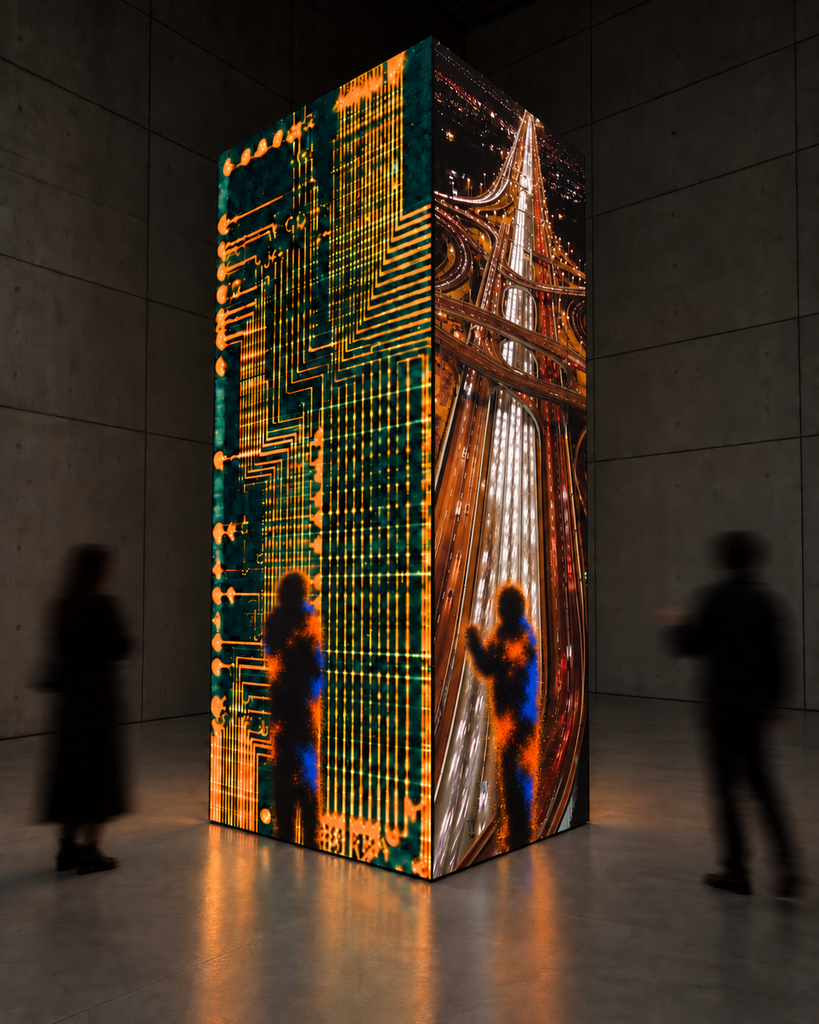
The artwork is inspired by the slow-motion and time-lapse cinematography of Reggio’s film Koyaanisqatsi. Across the three screens, vast natural landscapes, industrial sites and cities appear and collapse. A rocket launch, a factory line and a forest in retreat all respond to the people in the room.
Earlier versions of this work were shown as The Vivid Unknown in Amsterdam, New York, Cannes and Athens. Techno Firma is a new work, with a new name, new AI models, new software, and an original score.
Visitors can walk around the obelisk and step into the tracking area in front of each screen to shape what happens or watch from the seating areas. This exhibition guide explores how the work was made, how it responds to you, and how it connects to South Florida.
Organization and Support



How It Was Made
Techno Firma is made with generative AI. A generative AI, or generative artificial intelligence, model is a computer program that learns patterns from many examples, then makes new images or video from written instructions called prompts. Teaching the model with examples is called training. Training a model is a form of machine learning.
The artists built their model from three kinds of material.
The first is Reggio’s words: more than 55,000 of them, in his own voice, transcribed word for word from conversations and letters with Fitzgerald, published interviews, lectures and writings. The words are divided into 323 passages, each tagged by subject. From these passages the artists wrote a set of rules for what the system makes, and each rule points back to the passage it came from.
The second is Reggio’s personal archive. It includes drawings, storyboards, production cards, annotated photographs, scrapbook pages and postcards he collected and made around his films.
The third is images the model made itself. The model first makes images that have never existed, such as landscapes, cities and crowds. The selected results then train the next version of the model, and each version moves further from any photograph.
Reggio has said, “Old nature is real, new nature is virtual; one has seasons, the other has software.” The images in Techno Firma are new nature, all generated by computer, not filmed on location. Like a copy of a copy, each round loses something of the last and adds variation. Reggio’s direction for this was “distortion for clarity.”
The process
Reggio’s words are divided into passages, which become rules, and then prompts. The model uses the prompts to generate new images and video clips. Fitzgerald selects from the results, Reggio reviews them, and each selection is captioned in Reggio’s vocabulary. The selections train the next version of the model, and the cycle repeats. Every image is logged with its prompt, the model that made it and its seed, a number that sets the image’s starting point, so any image can be traced back to the words that produced it.
The working archive for this project contains 44,230 images and 3,446 video clips made from 2023 to 2026.
Tools and choices
The artists started from open-source image and video models, which are tools anyone can download, train on their own material, run on their own computers and look inside. Since 2023 they have worked with successive models, including StyleGAN2, Stable Diffusion 1.5, SDXL and Flux 3. Techno Firma uses LTX, Krea and Flux 3. The makers of these base models trained them on large collections of images. Techno Firma‘s own training adds only Reggio’s material and the work’s own generations.
The artists also set the terms for how the work is made.
Fitzgerald and Reggio made the work together, at Reggio’s invitation, from his own words and archive, with the Godfrey Reggio Foundation. Reggio’s words set the rules the system follows. Fitzgerald chooses what each version of the model learns, and Reggio reviews it. What Fitzgerald leaves out, the model forgets. Both artists govern the model and its training process, jointly with the Godfrey Reggio Foundation.
Every image is rendered on the artists’ own workstations. A custom software runs through TouchDesigner for exhibition display in a system built by Daniel Mangosing. The score is original and generative, composed by Matthew Tierney and Benjamin Shirken, with input from the model and visitor positions in the room.
AI and South Florida
AI runs on physical buildings called data centers, and some of them are here. The region also faces some of the clearest effects of a changing climate, and its technology sector is growing.
A data center is a building full of computers that uses electricity and water for cooling. As of April 2026, Miami-Dade County has 27 of Florida’s 110 data centers. The International Energy Agency reports that a typical AI-focused data center uses as much electricity as 100,000 households, and that the largest now under construction will use about 20 times as much. Nationally, data centers used about 4.4 percent of U.S. electricity in 2023, and a June 2026 analysis from Lawrence Berkeley National Laboratory estimates they could use 9.5 to 15 percent by the end of the decade. The newer data centers planned in Miami-Dade are much smaller than the very large “hyperscale” facilities built elsewhere in the country, and as of mid-2026 Florida has none. In 2026, Florida passed a law requiring the very largest data centers to pay their own electricity costs and confirming that local governments can reject them. Palm Beach County has also paused new applications for data centers of 50 megawatts or more for up to a year. Miami-Dade zoning classifies data centers as telecommunications hubs, which are allowed on industrial land, and residents and community groups have asked for more information about new projects. These decisions come as more AI companies base themselves in South Florida. In February 2026, a company that builds AI software to analyze large amounts of data for government agencies and businesses, announced that it had moved its headquarters to Miami. Its contracts with government agencies, including the Department of Defense and U.S. Immigration and Customs Enforcement, have drawn public debate.
Data centers and rising seas are connected through energy. Most of the electricity that powers data centers still comes from fossil fuels, which add to the greenhouse gases that warm the planet and raise sea level. The International Energy Agency expects data centers to account for less than 1 percent of global carbon dioxide emissions by 2030, so they are a small part of a larger picture. Southeast Florida is among the most vulnerable regions in the country to climate change. The Southeast Florida Climate Compact, a partnership of Miami-Dade, Broward, Palm Beach and Monroe counties, projects 10 to 17 inches of sea level rise by 2040 and 21 to 54 inches by 2070. Sea level is already rising by about 1 to 2 inches per decade.

