guide

On View

This is America: Selections from PAMM’s Collection

Introduction

2026 marks the 250th anniversary of the Declaration of Independence, a document which begins its second paragraph with the famous sentence: 

“We hold these truths to be self-evident, that all men are created equal, that they are endowed by their Creator with certain unalienable Rights, that among these are Life, Liberty and the pursuit of Happiness.”  

Since then, this phrase has been quoted and used to frame the core principals of the United States of America. Likewise, it has been used to criticize the shortcomings of the government in upholding these values. The result has been a history of civil conflict and division as well as one of progress and achievements. 

The artists featured in this guide are all contemporary artists local to Miami and each investigates contemporary issues that we face as Americans and residents of South Florida. For that reason, please note: Some artworks in the exhibition address sensitive subject matter, including violence and graphic imagery, which may be challenging for some viewers. 

Organization and Support
This Is America: Selections from PAMM’s Collection is organized by Maritza M. Lacayo, Associate Curator, with the support of Naomi Bitton, Curatorial Administrative Assistant, and Fabiana A. Sotillo, Curatorial Assistant. The exhibition is presented with lead individual support from Diane and Werner Grob. Additional support from Jayne Binzer-Jacowitz and Steven Jacowitz is gratefully acknowledged.

guide

On View

This is America: Selections from PAMM’s Collection

What does history repeat?

On May 25, 2020, George Floyd was murdered by Derek Chauvin in Minneapolis, Minnesota. When videos of the murder became public and spread on social media, protests began in cities across the country, including Miami.  On June 5, 2020, protestors in Miami disrupted traffic at an I-95 entrance ramp. Images of police in SWAT (military grade) gear confronting protestors in SWAT gear spread on the news and social media, and are what artist Eddie Arroyo depicts in his piece, “June 5, 2020, North Miami Avenue and NE 38th Street”. With increasing instances of extreme shows of force, these images of violence against protestors by police became commonplace.  

In the wake of the murder of George Floyd and the resulting protests, the questions Americans were asking were: Are all men truly created equal in the eyes of the government and if we have a right to liberty, is this what liberty looks like? 

guide

On View

This is America: Selections from PAMM’s Collection

Eddie Arroyo, June 5, 2020, North Miami Avenue and NE 38th Street
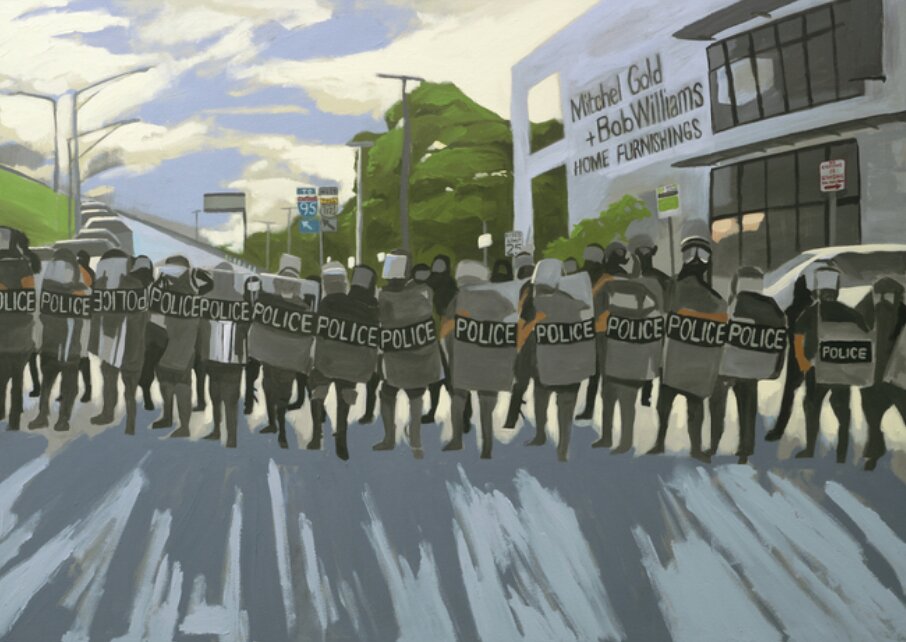
Eddie Arroyo. June 5, 2020, North Miami Avenue and NE 38th Street, 2020. Acrylic on canvas. 60 x 84 inches. Collection Pérez Art Museum Miami, museum purchase with funds provided by Diane and Werner Grob and Alexa and Adam Wolman. © Eddie Arroyo

June 5, 2020, North Miami Avenue and NE 38th Street by Eddie Arroyo is an acrylic on canvas painting from 2020.  The painting is sixty inches tall by eighty-four inches wide. It is hung in landscape orientation, meaning that it is hung with its longest side parallel to the floor.  

It is a wide, cinematically horizontal painting, featuring a row of police in black riot gear, standing in the middle of an intersection. The sun appears to be setting behind the officers, casting a shadow onto the street in front of them. 

The painting is divided vertically into three horizontal rows. The top left side of the landscape painting features a slightly purplish-blue sky filled with large yellowish white clouds. Beneath and slightly to the right of the sky with brownish forest green and yellowish green highlights. The view of these trees is obstructed by vertical poles and expressway entrant signs that recede into the background in one-point perspective. Moving closer into the middle ground on the left side of this top row are vertical poles with streetlamps arcing upward and outward to the right. To the right side of this bar is a two-story gray building with visible black letters that read “Mitchel + Bob Williams Home furnishing. 

Underneath this top row is the middle third of the paint. Completely filling middle section of this painting, from the left edge to the right edge of the painting are police officers wearing all black short sleeved uniforms, boots and helmets. They carry vertical plastic shields that read police in white letters on a black horizontal bar in the middle of it. Shining between their legs, yellowish gray light shines, marking a dividing line between the middle third and the bottom third row of the painting. 

In the bottom row, dark blueish purple shadows are cast towards the front of the image, fanning out in one-point perspective. The light that hits the pavement between the shadows, along the bottom edge of the painting, is a lighter tint of purple blue. 

guide

On View

This is America: Selections from PAMM’s Collection

What divides us?

The history of division within the United States goes as far back as the inception of the country. Marked on all the progress and economical gain is slavery and the treatment of people of color, including First Nations People. The Civil War was a direct result of disagreements about slavery, the effects of which are still felt to this day. While the protests of George Floyd’s murder aimed to highlight the continued mistreatment of African Americans, their counter protests argued that these mistreatments were a fabrication. A notable instance was when Kyle Rittenhouse attended a protest in 2020 and fatally shot two men, an act he was acquitted of and has now become a celebrity within the Far-right, selling signed copies of his book. Far-right groups like the Proud Boys co-opted these counter protests and it became increasingly difficult to separate partisan issues from outright racism.  

This stark separation became evident when President Donald Trump encouraged his supporters to protest, riot, and eventually infiltrate the Capitol in Washington, DC. This moment is depicted in the piece 6th of January by John Willaim Bailly. Where protestors of police brutality were met with tear gas, batons, and shields, the people who stormed the Capitol did so with little resistance from authorities. Americans questioned why the response seemed so different and what it truly means when we separate ourselves into us and them

guide

On View

This is America: Selections from PAMM’s Collection

John William Bailly, 6th of January, 2021
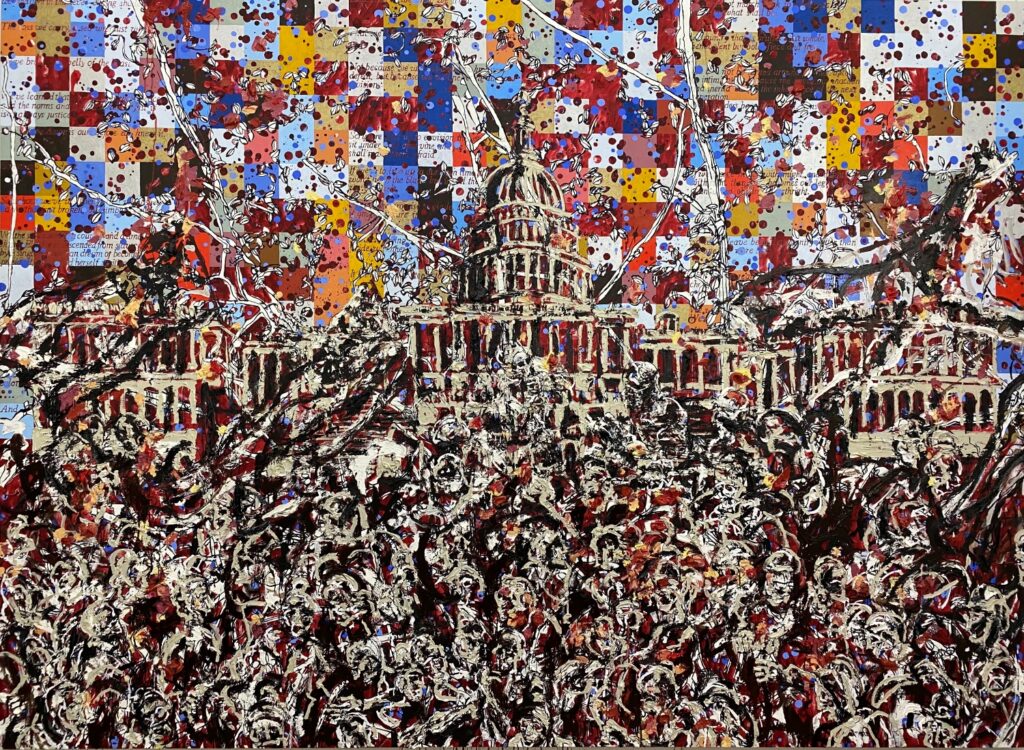
John William Bailly. 6th of January, 2021, 2021. Oil on canvas. 86 1/2 x 120 inches. Collection Pérez Art Museum Miami, museum purchase with funds provided by Bonnie and Peter Dockter. © John William Bailly

6th of January, 2021 is an oil painting on canvas by British-French-American artist, John William Bailly, made in 2021. It measures roughly seven tall by ten feet wide and is hung in a landscape orientation, meaning its shorter side runs parallel to the ground.  

The painting first reveals a dense and chaotic assortment of colors, shapes, lines, and patterns. The scene can be divided into horizontal thirds: a sky at the top, a background in the middle, and a foreground below. The sky is rendered as a gridlock or patchwork pattern of different small squares—reds, blues, yellows, browns, blacks, and whites— with fragments of text and poetry visible across many of them. 

In the center background, the dome of the United States Capitol building in Washington, D.C., rises prominently, rendered in red and white vertical stripes. In the foreground, a churning mass of tangled figures, limbs, and bodies surges upwards in a pyramidal formation towards the Capitol. The figures are rendered in energetic white and dark gestural marks that overlap and interweave. Several cherry blossom tree branches rise from the crowd into the patchwork sky above. 

Throughout the composition, gestural lines overlap and twist frantically. The painted surface shows evidence of scratching, dripping, and heavy layering, with visible texture and energetic brushwork across the entire canvas. The crowd in the foreground presses forward as a tangled, surging mass toward the Capitol building, with individual figures dissolving into the dense network of overlapping marks and limbs. The patchwork sky fragments the upper portion of the composition into competing blocks of color and text, creating a fractured visual field above the tumultuous scene below. The title references the storming of the United States Capitol on January 6, 2021. 

guide

On View

This is America: Selections from PAMM’s Collection

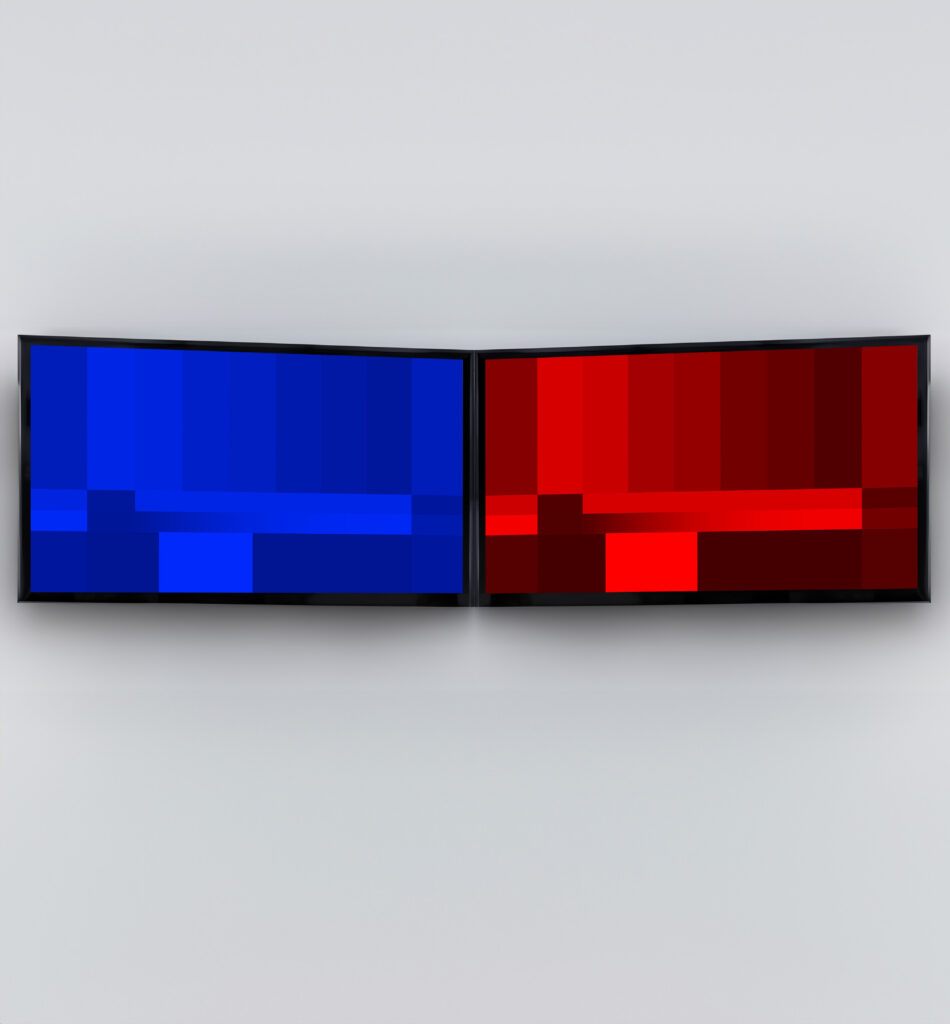
Yucef Merhi, Color Bars

Yucef Merhi. Color Bars, 2024. Two-channel video, 60 min. loop. Dimensions variable. Edition of 3. Courtesy Pan American Art Projects. © Yucef Merhi

Color Bars is a two-channel video installation by Venezuelan-American artist Yucef Merhi, created in 2024. The work consists of two horizontal rectangular screens mounted side by side in black frames, each displaying a grid of vertical color bars. 

The left screen shows varying shades of blue arranged in vertical columns. The blue tones range from bright electric blue to deep navy, creating a pixelated pattern of rectangles. Approximately three-quarters down the frame, a horizontal band of lighter blue cuts across the vertical bars, creating a distinct division in the composition. 

The right screen mirrors this structure using shades of red. Bright red bars alternate with deep maroon and dark red tones, creating a similar pixelated vertical pattern. A horizontal band of bright red cuts across the frame at the same position, stretching through the darker red vertical bars. 

The composition references the color bar test patterns that were broadcast on television screens during periods of no transmission or technical adjustment. The work runs on a 60-minute loop and includes audio of the characteristic tone that accompanied such test patterns. 

guide

On View

This is America: Selections from PAMM’s Collection

Who is American?

The United States is often called a melting pot. A place where people from all over the world unite and live together with a shared purpose. However, immigrants to this country have always been treated and seen as outsiders by its citizens who’ve lived here longer. From the Irish and German immigrants of the early 1800s, the Eastern Europeans of Italy, Poland, Russia and Jewish people in the early 1900s to more current immigrants from Central America, South America, the Caribbean and more. The people who have come to this country seeking a better life have often found themselves ostracized and framed as the enemy of other Americans. This othering went as far as the Repatriation of Mexican immigrants during the great depression where they were blamed for taking jobs from White Americans and as a result deported to Mexico. It is reported that upwards of 60% of the people deported were lawful citizens of the United States.  

These issues persist and are made evident by the policies of the government. The most present is the current expansion of ICE (Immigration and Customs Enforcement) and its targeting of not only immigrants but citizens as well. On January 7, 2026, Renee Nicole Macklin Good was killed by an ICE agent while she was in her car. Good was an American Citizen. The shooting was defended by President Donald Trump. At the same time, somewhere over 1200 people have gone missing from ICE custody, most notably from the detention center in the Everglades referred to as Alligator Alcatraz. The treatment of both citizens and immigrants in the United States both in the past and present continuously sparks the debate about who is considered an American and why.  

guide

On View

This is America: Selections from PAMM’s Collection

José Bedia, Desde que te fuistes…tu no te imaginas
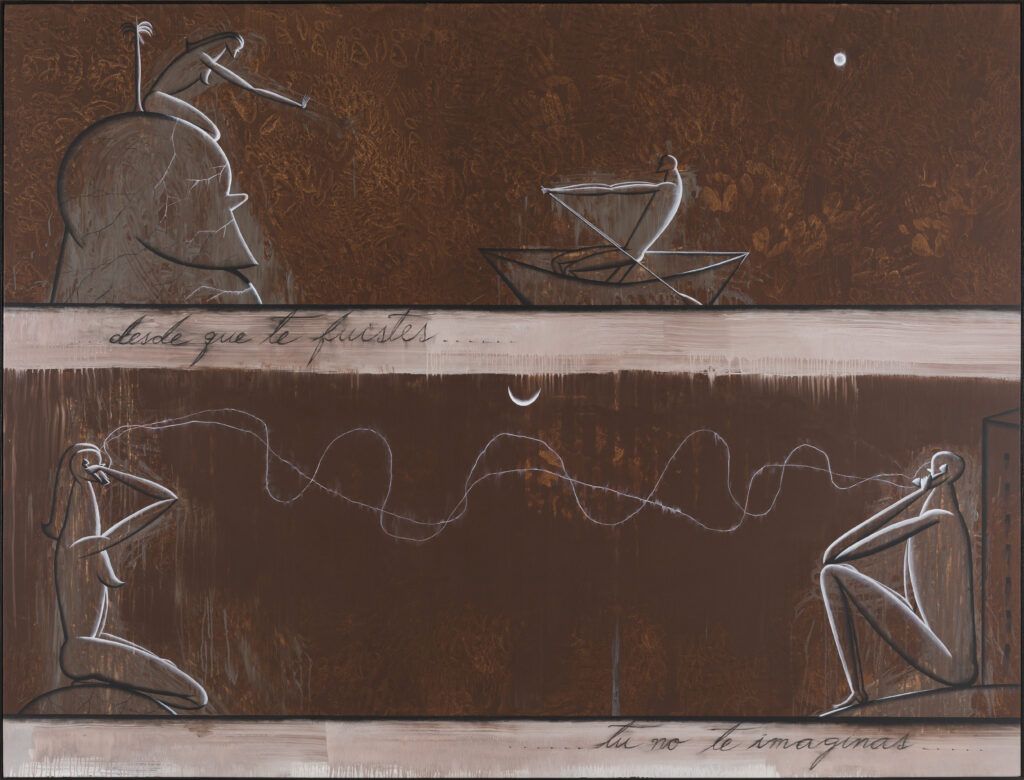
José Bedia. Desde que te fuistes…tu no te imaginas, 1996. Acrylic on canvas. 70 x 93 inches. Collection Pérez Art Museum Miami, gift of Peter Menéndez. © José Bedia.

Desde que te fuistes…tu no te imaginas (Since you left…you can’t imagine) is a painting by Cuban born, Miami based painter Jose Bedia which was made in 1996. It is made with acrylic paint on canvas. It measures approximately six feet tall by eight feet wide and is hung in landscape orientation, meaning its longest side runs parallel to the ground.  


The painting is horizontally divided into two picture planes that depict a stylized narrative sequence. In the upper section of the composition, a female figure sits upon a rock that resembles a large head, waving farewell to her male counterpart as he rows away in a small boat heading toward the right side of the composition. He faces her as he strains at the oars. The background is a reddish-brown wash textured with handprints and entirely void of other details except for a small white dot representing the moon in the upper right corner of the scene. The figures are drawn simply with black and white lines in a style reminiscent of cave paintings, standing out against the monochromatic background. A thin horizontal section divides the top sequence from the bottom like a banner. It is light beige in color, and the words “desde que te fuistes…” (since you left…) are handwritten in cursive within it, placed directly beneath the woman in the upper half. 

The bottom narrative sequence depicts again the same male, and female figures this time seated on far opposite sides of the composition with a considerable distance separating them. They are drawn in profile facing one another, and each is sitting upon a small hill. The male figure on the far right appears to lean back on a rectangular structure with dots in it that resembles a building with windows. The background is again a dark reddish-brown color and void of any details except for a small crescent moon which is placed perfectly in the space between and slightly above the two figures. The distance separating the figures is bridged only by two white undulating lines that emerge from the face of one figure and cross the space to reach the face of the other. Beneath this sequence, another light-colored banner-like section borders the bottom edge of the canvas. Under the depiction of the male figure, the words “tu no te imaginas” (you can’t imagine) are written in cursive.  

guide

On View

This is America: Selections from PAMM’s Collection

Sandra Ramos, From the series Migraciones II
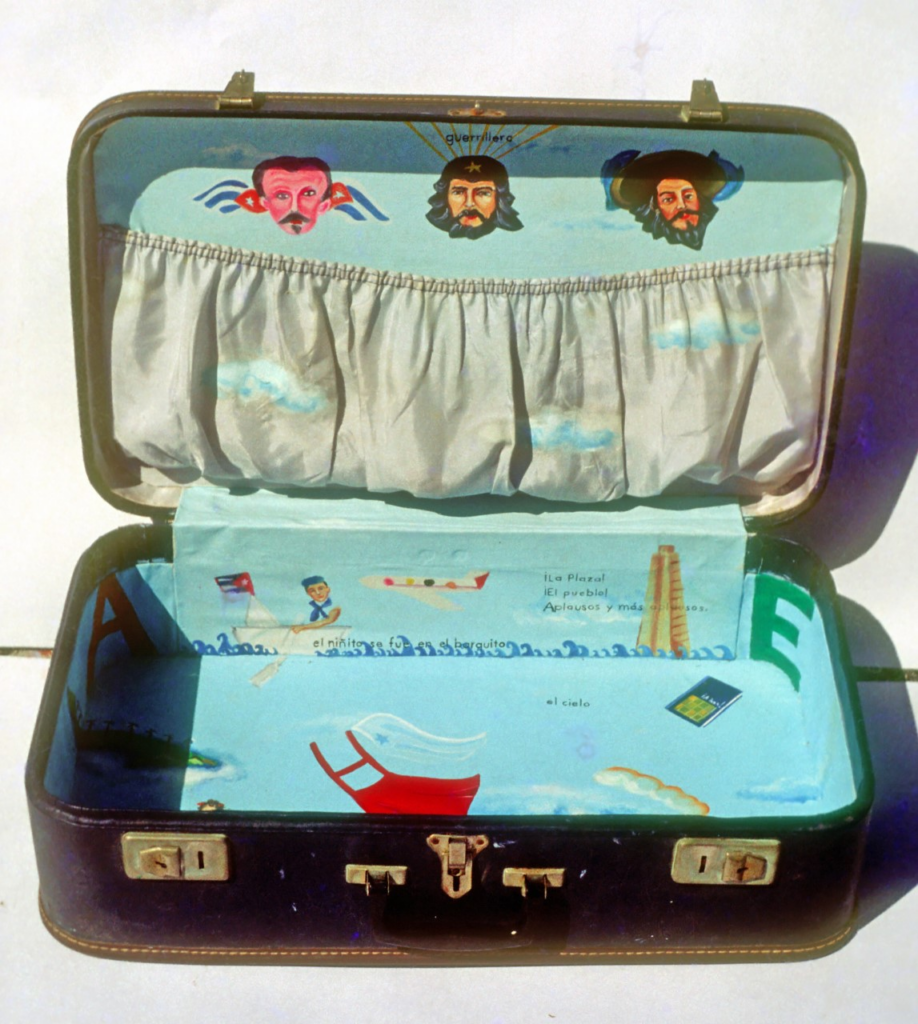
“Migrations II” From the series Migraciones, by Sandra Ramos is a mixed media piece from 1994. It measures twenty inches by twenty-four and a half inches by eighteen inches. 

The piece is made of a suitcase with various images inside.  

The suitcase sits open viewed from above emphasizing the absence of objects that would occupy its interior. Beginning from the top left corner the heads of José Martí, Ernesto Ché Guevara and Camilo Cienfuegos, the main heroes worshipped by the Cuban Revolution, occupy the highest place among the clouds. Two Cuban flags wave from the sides of Jose Marti’s head like pig tales, bands of light shoot from behind Ernesto Che with the words Guerrillero handwritten in the center while two fishes swim around Camilo Cienfuegos like yin and yang. The elastic band at the top of the pocket that carries socks or toiletries separates the heads from the rest of the paintings creating a makeshift horizon line. Ruffles from the drapery of the pocket fold over painted clouds leading us down to the bottom of the case. An A sits pressed to the left corner that points to a floating island in the clouds labeled “mapa”. On the other leg of the A begins a sequence of waves that lap against a boy in a rowboat flying a Cuban flag. “El niñito se fue en el barquito” overlays the boat and waves. A plane flies in the opposite direction of the boy in the boat while a hotel resort towers over the horizon line of waves closest to the right corner of the case. An “E” wraps around the inner edge of the right-side hovering above “el cielo” and a whispy depiction of a girl in a red dress made up of clouds. Under this angel-like figure sits a baby on a cloud labeled “El Nube”. At the ground level is a house with lush plants and two familiar faces peering out the windows as if waiting for someone’s return. “Mama, Papa, Familia” overlaps the scene as warm smoke trickles into “el cielo”. 

guide

On View

This is America: Selections from PAMM’s Collection

What helps Americans?

Social Security is not only a document that is used to verify the status of American Citizens, but also primarily a government program that aims to allow citizens to retire while reducing the anxieties of poverty. Enacted on August 14, 1935, the program has been operating for over 90 years. While this program has been in service for most of our lives, in its infancy it faced opposition from not only government officials but from citizens of the country. The program was called a form of Socialism, and many feared it would reduce the labor force. The program was initially passed with many exclusions: farmers, teachers, nurses, government employees, librarians, hospital employees, and social workers. These exclusions affected a large percentage of women and people of color. It was determined that of the people of color who did qualify, only 1.5% received benefits. It is currently estimated that the program will run out of money in 2034. 

Retirement is only one aspect of life in which the government has a substantial impact. In recent years debates around health insurance, transportation, education, and cost of living continue to divide the public. While many believe social services to improve quality of life are necessary, their opposition fears increased taxation and a dependency on the government and its programs. What the Social Security program shows us is both the benefits and downfalls of government programs and how many of the talking points used have been in circulation for nearly a century.  

guide

On View

This is America: Selections from PAMM’s Collection

Thomas Bils, Phone Wallet Keys

Thomas Bils. Phone Wallet Keys, 2025. Oil on linen. 15 x 24 x 2 inches. Collection Pérez Art Museum Miami, museum purchase with funds provided by the New Art Dealers Alliance. © Thomas Bils

 Phone Wallet Keys is an oil painting on linen made in 2025 by Floridian artist Thomas Bils. It measures fifteen by twenty-four inches, or roughly one foot tall by two feet wide. It is hung in landscape orientation, meaning its longer side runs parallel to the ground. 

This painting depicts a close-up view of a hand holding a United States Social Security card horizontally. The card’s familiar blue border and characteristic title banner dominate the frame almost entirely. A thumb enters from the bottom right corner of the composition, and presses firmly across the center of the card, partially obscuring the name and number. Little of the background or the rest of the hand is visible beyond the border of the document. The close cropping creates an intimate viewing experience, as if the document is being held directly in front of the viewer’s face.  

The painting is rendered in a hyperrealist style with photographic precision. The subtle grain of the paper, the intricately printed patterns of the card, and the faint wear along the card’s edges where it was torn from its printed template are all rendered with extreme detail. The thumb is meticulously depicted with natural skin creases, irregularities, and shifting flesh tones. The soft pressure against the card slightly deforms the fingertip, creating a tactile sense of realism.  

The visible text on the card reads “Thomas Joh” before being obscured by the thumb, suggesting this is the artist’s own Social Security card. The partial obscuring of the identifying information creates a tension between the document’s public, bureaucratic function and the privacy of personal identification. 

guide

On View

This is America: Selections from PAMM’s Collection

What is America?

America is often used as shorthand for the United States of America. Although it is only one country connected to 34 others within two continents, it has established itself as the global power. What it has aimed to be in its 250-year-old history has varied, and its success in being those things can be debated. It is a place that enslaved people and attempted to exterminate another group of people. Yet it is also the place that birthed Jazz, the airplane, and sent mankind to the moon. It is a place riddled with internal conflict and yet a place where people from all walks of life can live in harmony. To answer what America is, is complicated because it is all of its faults and all the things that have drawn people to it. What many of the artists in this exhibition have shown us is that America is not a flag, it is not a government document. Nor is it us and them, one language, or one perspective. America is a continent. A piece of land within a larger planet. It is the reminder that we are all here and we are all human. It is flawed and complicated because we are flawed and complicated. To recognize and call attention to it is necessary to help it evolve in the hopes that it is left in a better place for the next generations.  

“I love America more than any other country in the world and, exactly for this reason, I insist on the right to criticize her perpetually.” 

― James Baldwin 

guide

On View

This is America: Selections from PAMM’s Collection

Tomás Esson, Mi otra mitad 

Mi otra mitad (My Other Half) is an acrylic painting on Masonite by Cuban-American artist Tomás Esson, created in 2011. The work measures approximately three and a half feet tall by six and a half feet wide and is set in an ornate gilded frame with rubber bull horns affixed to the top corners. It hangs in horizontal orientation, meaning that its widest side is parallel to the ground. 

From a distance, the composition evokes the structure of an American flag. In the upper left corner, a blue rectangular section contains rows of repeating forms with each consisting of a pair of black horns with red flesh between them, arranged in an orderly pattern against the blue field. The remainder of the composition, occupying roughly three-quarters of the surface, consists of densely packed horizontal stripes filled with writhing human forms. 

These stripes contain bodies rendered in varying skin tones including browns, pinks, beiges, blacks, and yellows. Upon closer inspection, the forms shift and blend between recognizable anatomical elements: faces, mouths, phallic forms, vulvas, and other orifices. The bodies are so tightly compressed and intertwined that they create an undulating, churning mass where individual figures dissolve into one another. Blue ribbon-like forms emanate from some of the phallic forms, flowing across and around the composition. 

The juxtaposition between the orderly pattern in the blue corner and the compressed, morphing human forms in the stripes creates a stark visual and conceptual contrast within the flag-like structure. 

guide

On View

This is America: Selections from PAMM’s Collection

Gonzalo Hernandez, This is not America’s Flag (After Alfredo Jaar)

This is not America’s Flag (After Alfredo Jaar), it is a jacquard woven textile by Peruvian-born, Miami-based artist Gonzalo Hernández, created in 2024. It measures twelve inches tall by fifteen inches wide and hangs on the wall in a portrait orientation, meaning its shortest side runs parallel to the ground.  

In this textile and language-based work, the phrase This is not America’s Flag is woven in white letters in a rainbow-colored shade, set in a modern typeface on a black background. The phrase is organized into three layers, with woven stars and lines appearing in the upper-right and upper-left corners, alluding to the image of the United States national flag. The piece is bordered in yellow. From a certain distance, This is not America’s Flag can resemble a doormat, but in a museum gallery setting, it is connected to a broader societal context rather than to its utilitarian quality. 

Gonzalo Hernández’s piece title and visual approach take inspiration from a seminal fortyfive-second animation piece by Chilean artist Alfredo Jaar titled A Logo for America, which was displayed on an electronic billboard in New York City’s Times Square in the spring of 1987. In Jaar’s original work, the phrases “This is Not America,” “This is Not America’s Flag,” and “America” were juxtaposed with the image of the United States flag and the map of North and South America in three frames. As Jaar’s piece did nearly 40 years ago, Gonzalo Hernández’s work provokes the viewer by questioning ideas of patriotism and national identity in today’s Americas. 

guide

On View

This is America: Selections from PAMM’s Collection

Feedback

We hope you enjoyed this Digital Exhibition Guide!

We appreciate you taking the time to submit feedback to us as we strive to make PAMM as engaging as possible. You may submit your feedback anonymously through this form.