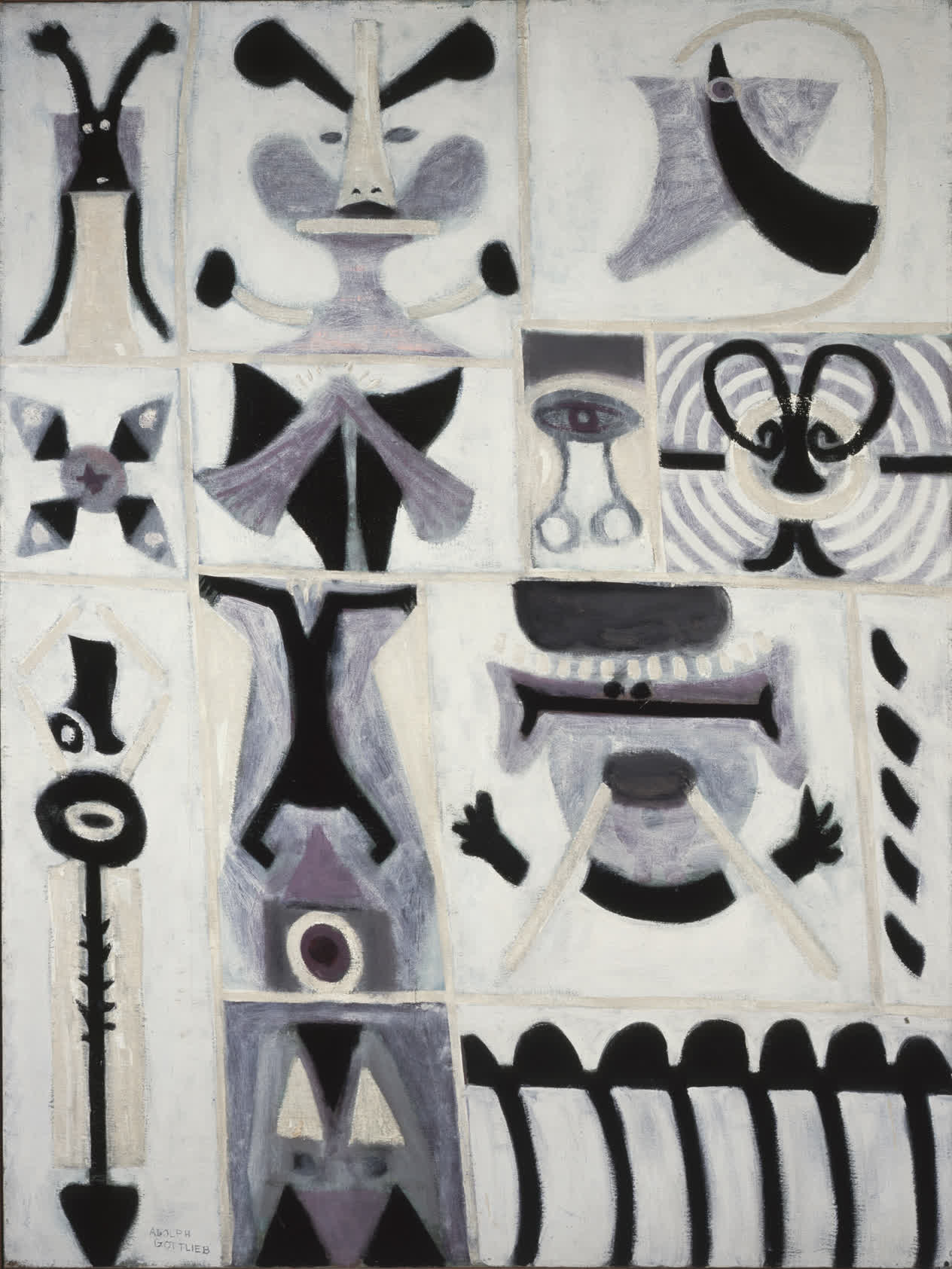
Adolph Gottlieb Altar 1947
© 2022 Adolph and Esther Gottlieb Foundation / Licensed by VAGA at Artists Rights Society (ARS), NY

Adolph Gottlieb was one of the founders of the Abstract Expressionist movement. Influenced by the arrival of European artists involved in Surrealism to New York during the 1940s, he developed a pictographic style informed by cultures outside of the West. He sought to create works that remained free of rational or intellectual control and communicated at an intuitive and emotional level. He believed that by studying ancient forms he could devise his own symbolism that tapped into a universal subconscious that crossed cultural divides.
Gottlieb’s visual vocabulary includes spirals, eyes, arrows, and masks inspired by artworks produced by African, South Pacific, and Native American cultures. He believed that art from these contexts had an inherent “accessible spiritual content” that challenged Western Art, cultural forms which in his interpretation had for centuries been concerned only with the outward appearance of things. Rather than copying motifs directly, he painted according to the spontaneous dictates of his unconscious, wanting his forms to act as symbols and retain a sense of mystery and uncertainty.
Identification
Title
Altar
Production Date
1947
Object Number
1997.4
Credit Line
Collection Pérez Art Museum Miami, gift of Tina and Lee Hills
Copyright
© 2022 Adolph and Esther Gottlieb Foundation / Licensed by VAGA at Artists Rights Society (ARS), NY
https://www.pamm.org/en/artwork/1997.4
Copy artwork link
Physical Qualities
Medium
Oil on canvas
Dimensions
48 x 36 inches
Visual Description
Altar by Adolph Gottlieb is a painting from 1947. It is made of oil paint on canvas and measures four feet by three feet. It is hung in portrait orientation, meaning its shortest side runs parallel to the ground.
This painting is an example of an abstraction, which is a style of painting that focuses on the gestural movement of shapes and colors rather than depicting scenes or figures.
The composition is comprised of a grid of squares and rectangles that contain various abstract shapes within them. The color palette is limited to off whites, blacks, greys, and violets.
Starting from the top left and moving across to the right as if reading a line of text, there is a black colored shape that roughly resembles a letter “X” that appears to be sitting on a cream and violet colored pedestal. To its right is a complex series of shapes that give the appearance of an other-worldly figure. The arrangement of the shapes gives the impression of an abstracted face. Finishing the first row on the top right, there are three distinct shapes: a black curved triangle that resembles a horn, a large cream-colored hook that resembles a backwards letter “C”, and a violet-colored triangle resembling the horn of a musical instrument such as a tuba or trombone.
The second row features a geometric shape comprised of four diamond shapes meeting at a violet circle in the middle. To its right there is a complicated abstracted shape that resembles two letter “V” shapes facing opposite directions. One is black and the other is violet with grey. Continuing to the right there is a grey eye with purple details and two grey circles underneath it. Finishing the second row is a fractal pattern of violet and cream circles serving as a backdrop for an abstracted shape that resembles a rodent or figure with large ears.
The last row begins with a shape that resembles a figure in a ballerina’s pose. It appears to have two arms above its head wearing a top hat. Its body is made of a large black circle with two smaller circles within it. Under the circle are two long white rectangles connected by a thin strip of black paint. The black paint continues toward a triangular point that resembles an arrow. To its right are a series of shapes arranged in a vertical rectangle. At the top is an “X” shape that resembles a mechanical claw. It reaches toward a violet triangle that rests on a grey square that houses circles colored white, violet, and grey. Toward the bottom there is a series of triangles arranged within a grey shape that resembles a rock. The triangles are black, white, and violet. To the right of this tall rectangle is a large white square that holds what appears to be an abstracted figure with its arms outstretched. The head of this figure is large and circular with two ivory rods extending from its center like tusks. Above the circle is a black line with curved edges and above this line is a grey object resembling a cooking pot. Underneath this square there is a row of vertical black lines with dome-like shapes at the ends which gives the appearance of a row of penguins. The last section of this row is above the penguin shapes and is a thin vertical rectangle of white paint with small and black horn like shapes pointing toward the left of the composition.