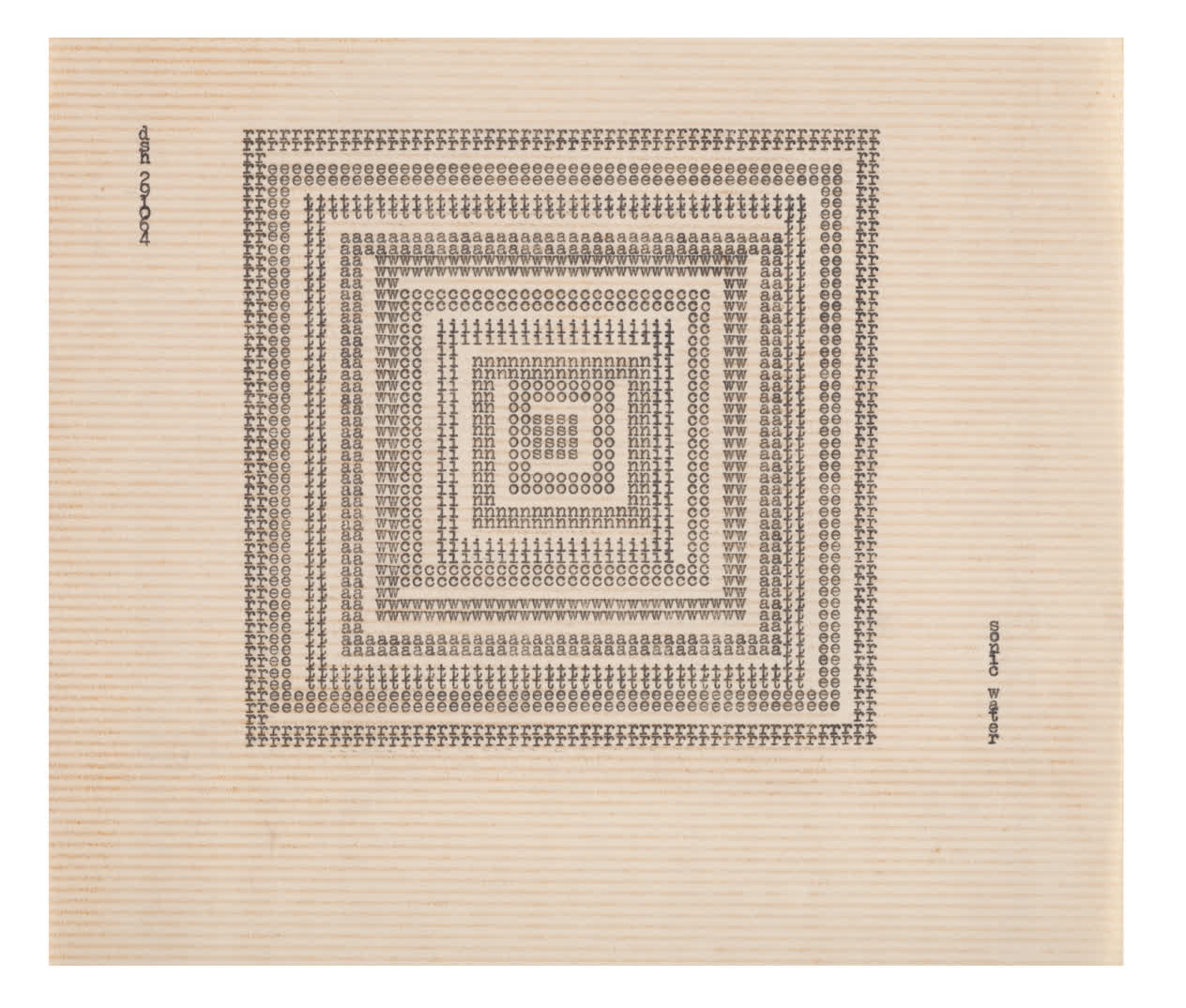
Dom Sylvester Houédard Sonic Water 1964
© Dom Sylvester Houédard

Dom Sylvester Houédard (sometimes referred to simply as “dsh,” after the typed signature that appears in his compositions) was a Benedictine monk and a widely respected theologian and biblical scholar. He was also one of the first English-language concrete poets, whose sizable personal network encompassed some of the most lauded figures of the literary and artistic avant-garde of the 1960s and 1970s, including William S. Burroughs, John Cage, and Allen Ginsberg, as well as fellow concrete poets Augusto de Campos, Ian Hamilton Finlay, and Eugen Gomringer. Much of Houédard’s concrete poetry shares fluid boundaries with typewriter art, the genre in which he made his greatest contribution. In hundreds of compositions, he devised interlocking geometric forms and explored uncanny optical effects. For Houédard, the typewriter functioned as a spiritual instrument, a means of expressing metaphysical concepts related not only to Catholicism but also to the various Eastern and unconventional religious paradigms in which he was immersed. Works such as Sonic Water (dsh 291064) epitomize this combination of technical virtuosity and transcendental mysticism.
Identification
Title
Sonic Water
Production Date
1964
Object Number
2016.253
Credit Line
Collection Pérez Art Museum Miami, acquired from The Sackner Archive of Concrete and Visual Poetry, with support from the John S. and James L. Knight Foundation
Copyright
© Dom Sylvester Houédard
https://www.pamm.org/en/artwork/2016.253
Copy artwork link
Physical Qualities
Medium
Typewriter ink on paper
Dimensions
7 x 8 1/2 inches
Visual Description
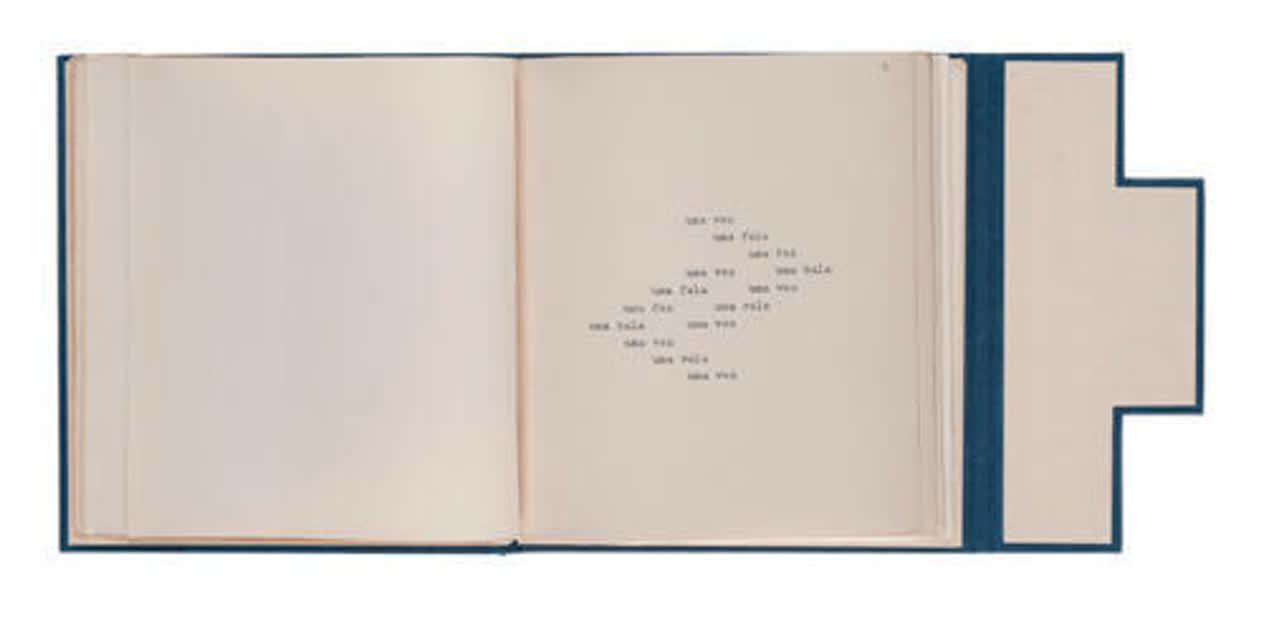
“Sonic Water (dsh 291064) by Dom Sylvester Houédard is a painting from 1964. It is seven inches by eight and a half inches. It is made of typewriter ink on paper and is hung in landscape orientation, meaning that its longest side runs parallel to the floor. This piece is an example of a concrete poem, meaning that it is writing that prioritizes the shape of the combination of words on a page, more than the content, or message conveyed to the reader. In this case, the text is comprised of single repeated letters, rather than words. Sonic Water is composed of the letters of the title arranged in order in the shape of ten squares, two letters in width, arranged one inside of each other. All the typed letters are in lower case letters.
At the center of the image starts the beginning of the title “Sonic Water”. A box made of 16 letter “S” are neatly typed next to each other, 4 letters wide and 4 letters tall. This tight square of ‘S’ sits inside of a larger box of “O”s . This box is directly connected to the first block on the inside left, and is spaced out by one row of blank spaces on the right, bottom and left. This box sits inside of a third box. This third block is connected to the second along the top row. This third box also has edges that are two typed letters across. This third box consists of the letter ‘n’. It is connected to the fourth box on the right hand side. The fourth box is composed of the letter ‘I’. The fourth box is two letters in width. There is a space be fourth and the fifth on the top, left, and the bottom. It is connected to the fifth box on the bottom. The empty space is one space apart. The fifth box is composed of the letter ‘C”. It is two letters thick. It is connected to the sixth box on the left-hand side. The one letter space outside of the fifth box is on the top, right, and bottom. The sixth box is comprised of the letter “W”. It is two letters thick, and is connected to the seventh box on the top side. The U shaped one letter thick space is along the left, bottom, and right. The seventh box is comprised of the letter “A”. It is two letters thick and connected to the eighth letter on the right hand side. The one lettered space on the outside of the seventh boxed is along the top, left, and bottom side. The eighth letter is composed of the letter ‘T’ that is two letters thick. It is connected to the ninth box on the bottom side. The one letter space outside of the eighth box is along the left, top, and right side. The ninth box is composed of the letter ‘e’, and is two letters thick. It is connected to the tenth box on the left hand side. The one letter space outside of the ninth box is on the top, right, and bottom sides. The tenth and last box is two letters thick and is composed of the letter ‘r’ and surrounds all of the interior boxes. On the bottom right of the tenth box, lined up with the bottom of the box and parallel to the right of the box are the words “sonic water”. Alternatively, on the left of the tenth box, outside of the left corner, lined up with the top of the tenth box and parallel to the left side. This reads ‘dsh 291064’. Compared to the boxes, these two lines appear to float in space on the paper. The paper appears to have horizontal lines spread throughout it that are approximately one letter spaced apart. “