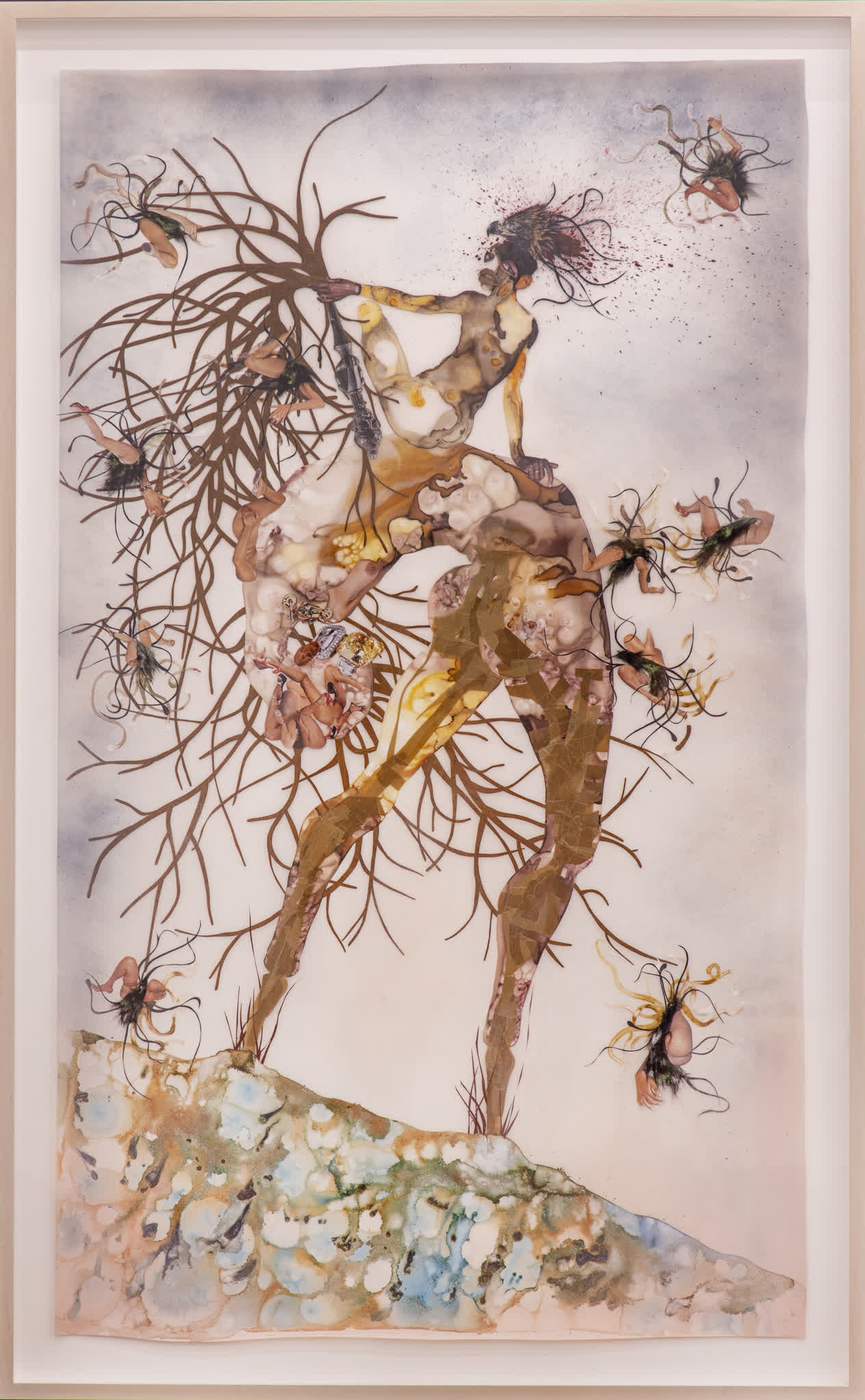
Wangechi Mutu You tried so hard to make us away 2005
© Wangechi Mutu. Courtesy the artist and Gladstone Gallery

The contorted female figure in You tried so hard to make us away generates strong waves of attraction and repulsion. Wangechi Mutu assembled the image from contact paper and photographs of face and body parts cut out from mass-market publications like Glamour, Vogue, and National Geographic, as well as from coffee table travel books and motorcycle magazines. The artist combines these collage elements with hand-rendered passages in ink, acrylic, glitter, and watercolor. The effect evokes luxuriously patterned fabrics, as well as wounds and lesions. The figure displays the slender, elongated proportions, full lips, and mascaraed eyes of a runway model—a Western paradigm of beauty.
Identification
Title
You tried so hard to make us away
Production Date
2005
Object Number
2005.10
Credit Line
Collection Pérez Art Museum Miami, museum purchase with funds provided by PAMM’s Collectors Council and the New Work series
Copyright
© Wangechi Mutu. Courtesy the artist and Gladstone Gallery
https://www.pamm.org/en/artwork/2005.10
Copy artwork link
Physical Qualities
Medium
Ink, acrylic, glitter, fur, contact paper, and collage on Mylar
Dimensions
88 x 51 1/4 inches
Visual Description
You tried so hard to make us away, 2005 by Kenyan-American artist Wangechi Mutu, is a mixed media collage made up of ink, acrylic paint, glitter, fur, and contact paper on mylar. It measures slightly over seven feet four inches tall and four feet three inches wide. It hangs in a portrait orientation, meaning the longer seven-foot side reaches up toward the ceiling.
This large portrait-style collage features two abstracted female figures painted in washed out colors that are semi-transparent, appearing like watercolor or ink stains on a large white background. Mutu’s figures have human-like outlines, but their limbs and other parts of their anatomy morph into a network of thin lines that look like branches, tendrils, or sometimes tentacles.
A large female figure dominates this collage, taking up the full height of the artwork. She is facing away from the viewer, with mostly her backside visible. She is standing with her legs slightly more than shoulder-width apart on a slanted groundline, with her left and right ankles sprouting from the earth like tree trunks. The inclined ground she is standing on starts at about two feet up from the bottom left corner, and descends down to the bottom right corner of the collaged portrait, forming a right triangle in the bottom left of the collage. This triangular base is painted in faded green, yellow and orange, with a mottled, patchy look.
Travelling up the figure’s legs, the outline of her calves and thighs give way to her buttocks. Her back arches and curves back over her left buttock. Her head is curved so far backward that her chin points toward the ground and her face is looking at the backside of her left knee. She is also painted in washed out, semi translucent reds, yellows, and browns. Instead of arms, sprouting from her skyward torso is a network of thin brown lines that look like tree branches or the exposed roots of a mangrove forest. These brown lines crisscross the entire left side of the collage and reach over and behind the bent woman.
Because the bent woman is bent so far backward, her chest forms a flat line about two-thirds up from the bottom of the collage. Sitting on this flat surface is a smaller figure. This smaller woman sits with her left leg bent at the knee. Her left arm extends horizontally to meet this same bent knee. Thus, her left arm, left thigh, and left side of her torso, form an upside-down triangle. To the left of the triangular pose, her left hand grasps one of the larger branches that grows from the larger woman’s body. Her right arm is extended straight back behind her, as if she were using it to lean on the larger woman’s body for support. Her face is seen in profile looking toward the left, and her purple-tinged hair billows behind her to the right, like the lilac tentacles of a jellyfish. Her body is painted in the same stain and rust-like colors as the rest of the collage.
There are also ten jellyfish-like bundles of curved lines and tendrils throughout this collage. They look vaguely aquatic and seem to float in and around the branches that dominate the left of the composition, or the lightly tinted white background makes up the right side of the collage.