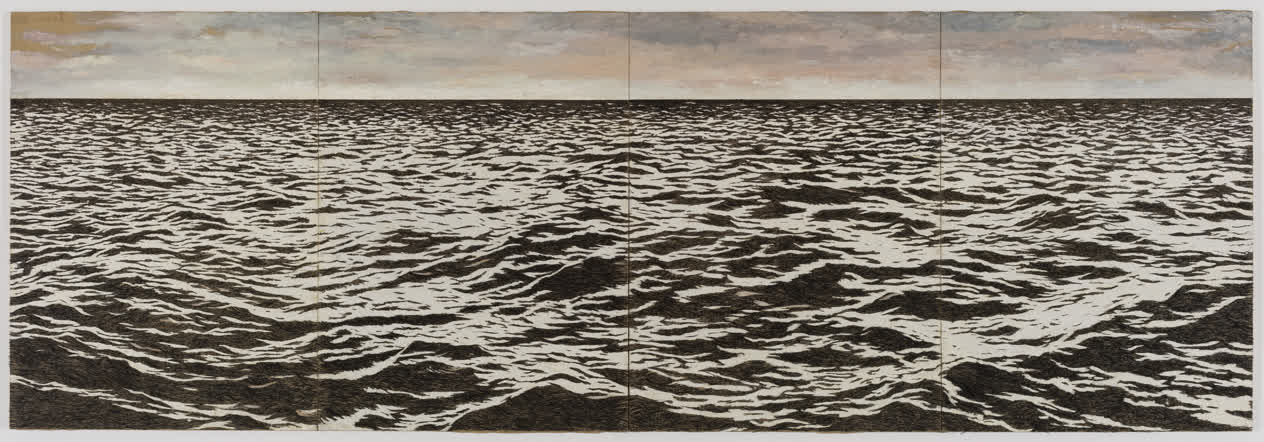
Yoan Capote Island (see-escape) 2010
© Capote Studio

Yoan Capote uses sculpture, painting, installation, and video to create analogies between the visual poetry of inanimate objects and the intangible world of the mind. The experience of being Cuban and living in Havana strongly influences his work, which often deals with themes that reference Cuban identity, including migration or government control.
Island (see-escape) is part of a series in which Capote depicts various ocean scenes with paint, nails, and fishhooks. From a distance, this work seems to consist of four panels thickly layered with oil paint to create an image of the sea. However, upon close inspection, the texture of the painting reveals itself to be thousands of fishhooks nailed to the canvas—manifesting a sense of power and aggression. Capote references Romanticism’s notions of the sublime in evoking the awe and terror faced by many when confronting the sea in precarious vessels. By reflecting the geographic experience, obsessions, and limitations of living on an island, this work synthesizes the illusion of traveling beyond the horizon line.
Identification
Title
Island (see-escape)
Production Date
2010
Object Number
2017.012
Credit Line
Collection Pérez Art Museum Miami, museum purchase with funds provided by Jorge M. Pérez
Copyright
© Capote Studio
https://www.pamm.org/en/artwork/2017.012
Copy artwork link
Physical Qualities
Medium
Oil, nails, and fishhooks on jute mounted on plywood
Dimensions
106 x 315 inches
Visual Description
Yoan Capote’s Island (see-escape) is a large format mixed media artwork similar in size and shape to a wide landscape painting. Capote used oil, nails, and fishhooks on jute mounted on plywood to construct this piece.
The artwork is divided into four equally sized panels that are joined together to create the expansive composition. In total, it measures three hundred and fifteen inches along its longer side, and a hundred and five and seven-eighths’ inches along it’s shorter dimension. This is equivalent to a little over twenty-six feet long, by around nine feet high.
Seen from some distance, the overall effect of this artwork gives the impression of a large and endless seascape. This never-ending expanse of ocean takes up the majority of the surface area. The horizon line separating the water and sky is indicated by a line that cuts straight across the upper quarter of the composition, limiting the sky to a narrow strip at the top of the artwork. The sky is painted in shades of light blue, pale pinks, and matte violet across the entire upper width of Island (see-escape).
The sea is not perfectly still, nor is it roiling and turbulent. The small swells and troughs of water give the impression of moving and windswept water. The water itself is rendered by using negative space to reflect light on its surface. Fluid areas of black substance are next to blank spaces, creating a realistic impression of a moving seascape. Up close, the composition reveals that the black color that dominates the water’s visible surface is composed of thousands upon thousands of small fishhooks, packed closely to mimic paint on canvas.
The hooks are arranged on the plywood in a style that reinforces the size and distance conveyed by the seascape. Much like a painter will foreshorten objects, or paint objects closer to the viewer larger in order to convey depth, Capote uses larger hooks at the bottom of Island (see-escape). The large fishhooks project outward, with the sharp, curved end turned toward the viewer. As the eye travels up the artwork, looking further into the distance, the fishhooks shrink, much in the way a painter would paint objects further in the distance smaller. By the time the eye reaches the horizon line toward the top of the painting, the fishhooks are miniscule, holding but one with a thumb and index finger would be difficult for most. The density of the fishhooks also increases as they crowd the horizon line, ultimately forming a sharp dividing line, both literal and figurative, with the sky.