George Grosz, Raoul Hausmann, and John Heartfield Der Dada, no. 3 (Der Dada, No. 3) 1920

© 2022 Estate of George Grosz / Licensed by VAGA at Artists Rights Society (ARS), NY© The Heartfield Community of Heirs / Artists Rights Society (ARS), New York, 2022

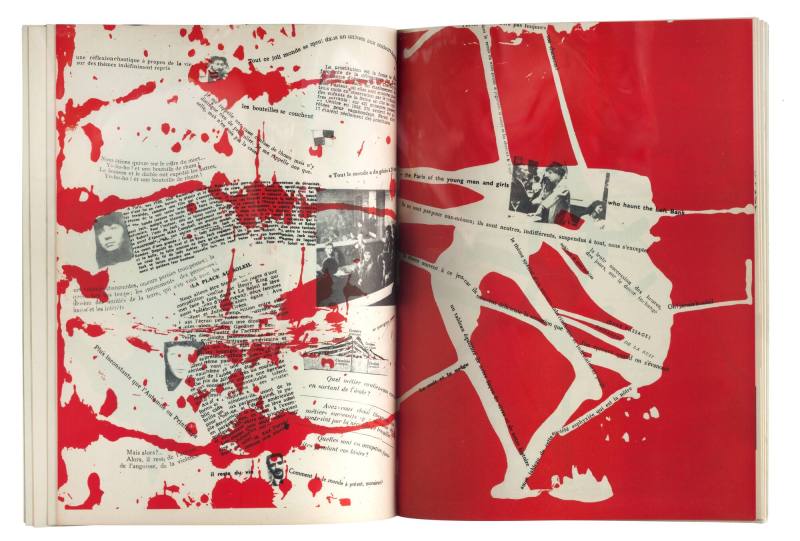
Originally founded by Raoul Hausmann, the periodical Der Dada was a principal vehicle with which the members of the Berlin Dada group disseminated their iconoclastic ideas. It was also where they enacted some of their earliest experiments with typography, collage, and photomontage. The Dadaists employed these methods to subvert the conventions of advertising and print publications: by disassociating the visual techniques of mainstream mass media from any sense of coherency, they sought to undermine the tacit authority of the printed page, together with the bourgeois values that the modern media ostensibly propagates.
This issue of the short-lived but influential journal is the third of five that the group produced. It was edited jointly by George Grosz, John Heartfield, and Hausmann, who, in typical absurdist fashion, signed their names “Groszfield,” “Hearthaus,” and “Georgemann.” The issue features a notably international array of Dadaists representing manifestations of the tendency in Zurich, Cologne, and Paris, indicating the Berlin group’s ambitions to take the helm of the movement.
Identification
Title
Der Dada, no. 3 (Der Dada, No. 3)
Production Date
1920
Object Number
2016.248
Credit Line
Collection Pérez Art Museum Miami, acquired from The Sackner Archive of Concrete and Visual Poetry, with support from the John S. and James L. Knight Foundation. Gift of Ruth and Marvin A. Sackner
Copyright
© 2022 Estate of George Grosz / Licensed by VAGA at Artists Rights Society (ARS), NY© The Heartfield Community of Heirs / Artists Rights Society (ARS), New York, 2022
https://www.pamm.org/en/artwork/2016.248
Copy artwork link
Physical Qualities
Medium
Softcover periodical
Dimensions
9 x 6 1/2 x 1/16 inches
Visual Description
Der Dada, number three, is a soft cover periodical made in 1920. It is nine inches tall by six inches wide and is one inch thick. It is in portrait orientation, meaning its shortest side runs parallel to the floor.
Edited jointly by George Grosz, John Heartfield, and Hausmann, this issue of the journal is the third of five that the group produced. The cover, yellowed with age, contains a black and white graphic collage with images and text swirling around its center.
At the top of the cover, the name “”Der dada”” and the number three is spelled out with thick, black, blocky text. The letter D in Der is capitalized and larger than the following letters e and r, which are stacked on top of each other on the right to meet its height. The title is flanked by anatomical images of whole eyeballs that look out in different directions.
This play with text size is mirrored throughout the rest of the cover, as the word Dada is repeated several times in different styles of blocky text, along with other German words. Some words are contained in small rectangular frames that resemble newspaper clippings. The text cascades down and across the cover. It starts from the top left, shoots down to the right before zigzagging back up again like a lightning bolt. Some words are in all capital letters, others have rounded edges. Some are white with black outlines as if pulled straight from a theater marquee.
At the bottom left, we see a clipping of a man pasted at an angle just above the word DADA written in all caps. His expression is fierce with mouth agape as if mid-shout. His right eye is collaged over with another eye, which gives it a bulging appearance and adds ambiguity to his expression. By comparison, we see the back of a miniature naked white man looking away and down into the space created by the images. On the other side of this dense whirlwind of cascading text, emerges the graphic image of a motorcycle tire. The tire leans towards the right, and appears to be the mechanism churning this storm of image and text.