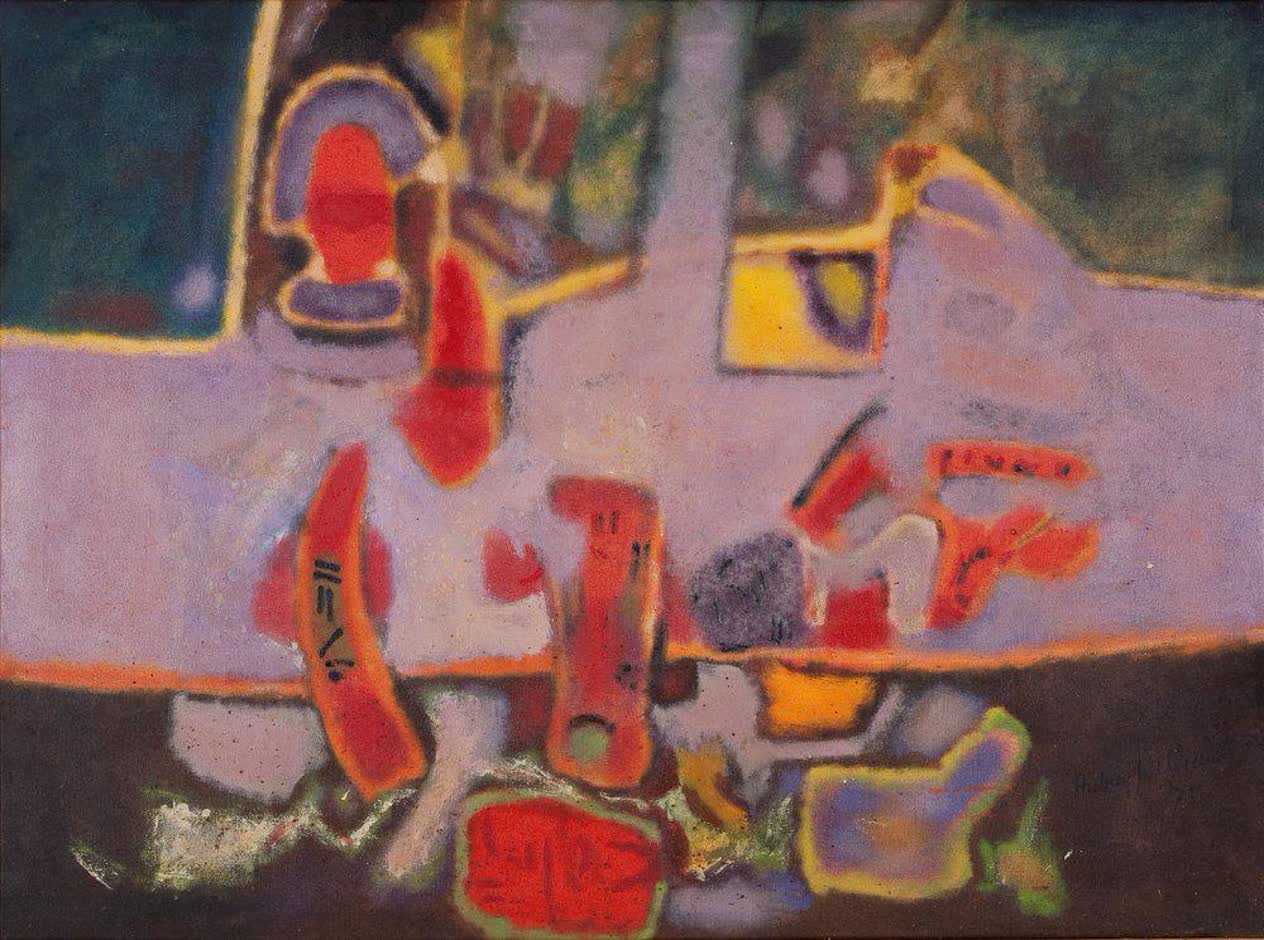
Frank Stella Chodorow II (Chodorów I) 1971
In the late 1950s, Frank Stella’s austere “black paintings,” in which thin white lines painted on a black ground echoed the form of the canvas, gained him widespread recognition. By the 1960s he was acknowledged as a leading exponent of Minimalism, which emphasized the artwork as a physical object independent of any allusions to the outside world. As Stella famously said, “What you see, is what you see.”
In the 1970s, Stella began producing series of works that became increasingly complex in terms of space and form, eventually developing into what he called “maximalist” paintings. The Polish Village series was the first step in this progression. The works in this series feature planes of color that abut and overlap to create a composition whose outside form conforms to the shape of its internal components. The interaction of colors and surface textures, and the occasional suggestion of overlapping planes, create an impression of shallow space, as in relief. Stella described the work’s planes as suspended upon “imaginary axes, floating in front of my face.”
The series was inspired by the geometric forms of the early 20th- century Russian Constructivism and by the carpentry of Eastern European wooden synagogues. The titles of the individual works in the series are derived from the names of Polish towns whose wooden synagogues had been destroyed during the Nazi occupation. In spite of this emotional weight, Stella still insisted that his paintings were simply compositions, not commentaries.
Identification
Title
Chodorow II (Chodorów I)
Production Date
1971
Object Number
1997.23
Credit Line
Collection Pérez Art Museum Miami, gift of Mimi and Bud Floback
Copyright
© Frank Stella / Artists Rights Society (ARS), New York
https://www.pamm.org/en/artwork/1997.23
Copy artwork link
Physical Qualities
Medium
Acrylic, canvas, felt, and enamel on shaped canvas
Dimensions
108 x 106 inches