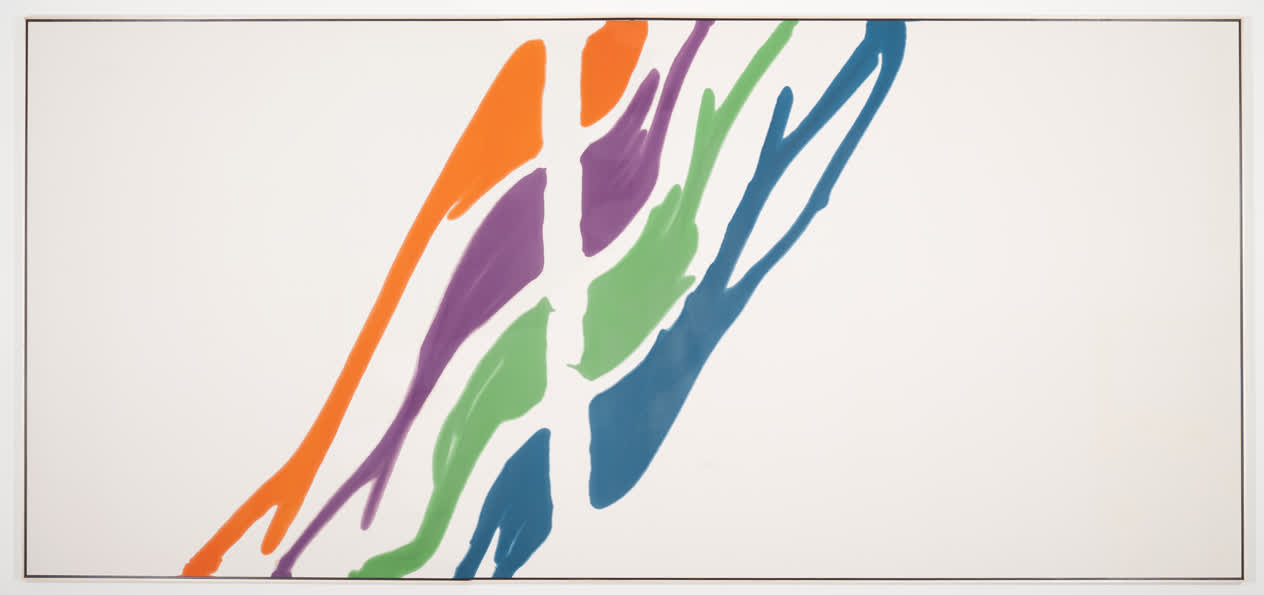
Morris Louis Delta Eta 1960
© Pérez Art Museum Miami

In 1953, Washington DC–based artist Morris Louis and fellow artist Kenneth Noland visited the New York studio of Helen Frankenthaler, where they saw her painting Mountains and Sea (1952). This painting was the artist’s first work involving her method of soaking raw canvas with diluted paint. Both artists were extremely inspired by Frankenthaler’s experiments and soon began to create their own innovations influenced by her technique.
As evident in Delta Eta, Louis developed a working method involving the placement of thinned, brightly colored paint onto monumental expanses of raw canvas. He would incline the canvas to varying degrees in order to control the flow and movement of the diluted paint as it soaked into the fabric. His process specifically avoided the use of a paintbrush or any other tool that would serve as an evidence of the artist’s hand in making the painting. The stains appear to extend beyond the edges of the work, formally implying that the image Louis created continues into a space beyond the frame.
Identification
Title
Delta Eta
Production Date
1960
Object Number
2011.37
Credit Line
Collection Pérez Art Museum Miami, gift of the Estate of Morris Louis
Copyright
© Pérez Art Museum Miami
https://www.pamm.org/en/artwork/2011.37
Copy artwork link
Physical Qualities
Medium
Acrylic resin on canvas
Dimensions
105 1/4 x 231 inches
Visual Description
Delta Eta by artist Morris Louis is a painting on canvas made in 1960. It measures nearly nine feet by nineteen feet and is hung in landscape orientation, meaning its longest side runs parallel to the floor. This painting is an example of Abstract Expressionism, which is a style of painting that focuses on the gestural and often spontaneous movement of shapes and colors and how they can convey emotion. It is from the artist’s Unfurled series, which is characteristic of Delta Eta, as it is comprised of what could be considered three distinct sections. The outer sections are mostly comprised of a large expanse of unprimed canvas, which is a soft beige in color as well as a soft weave in texture. The middle section consists of four life-size drips of paint that span diagonally across the composition and past its edges, mimicking the slow and viscous drip of maple syrup. These monumental and splashing strips of paint are in various colors that seem to glow from within the canvas. A cadmium orange thickly drips from the top center of the canvas towards the left-hand side. Below that is a grape purple drip, followed by an apple green and finally a velvety deep teal. Although these drips flow closely to each other, they do not touch, thus creating a tension of movement and a striking vividness against the raw canvas. The flow of these drips is neatly interrupted in the very center of the canvas with an implied line of untouched background. In order to create this illusion of a vertical line, the movement of the paint seems to ambiguously stop abruptly and then continue again. The artist is known for pouring a viscous paint called “Magma” directly onto a canvas and then either tilting the frame or varying the tautness of the canvas to gently direct the paint. Because of the unprimed nature of the canvas, the paint is completely penetrated into it, similar to dying fabric. The intentional placement of these drips as well as their soft texture heavily implies that this is the case with Delta Eta. The entire composition seems to vibrate with both starkness and vibrancy, stillness and movement, resulting in a meditative experience.