Eamon Oré-Girón Infinite Regress LXXV 2019
© Eamon Ore-Giron

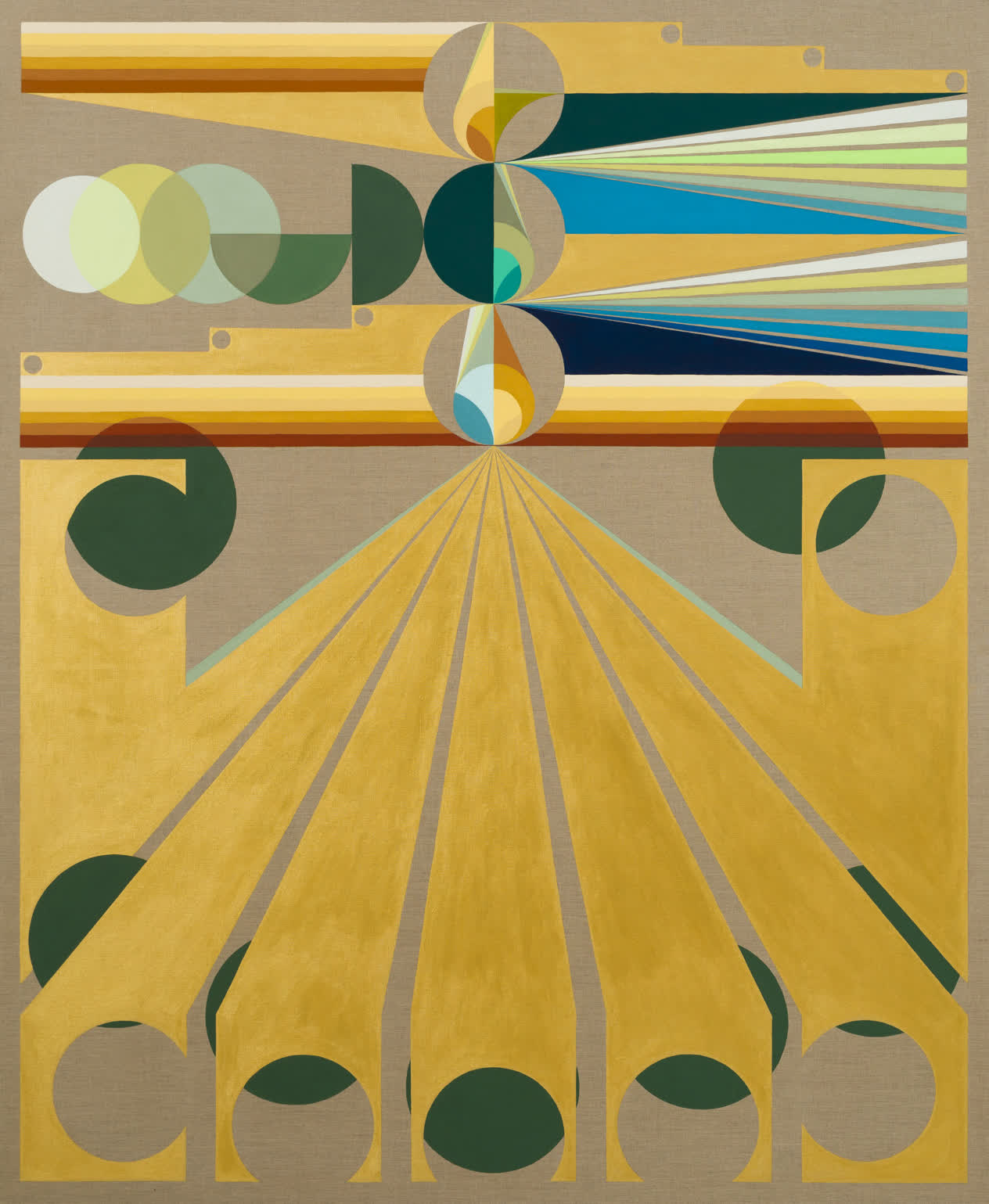
Eamon Oré-Girón’s paintings evoke a wide array of references, from cosmic “New Age” imagery and traditional Indigenous textiles to the work of various early 20th-century modernist artists like El Lissitzky and Aleksandr Rodchenko. Oré-Girón employs a bright, bold palette, which often includes metallic paints. The slick, smooth quality of the painted areas contrasts with the fibrous, textured surface of the raw canvas. For Oré-Girón, the brownish tones of the raw linen recall the arid landscape around Tucson, where he grew up, as well as the earthy hue of the Andean city of Huancayo, Peru, where his father is from and which the artist has visited throughout his life. Oré-Girón’s use of gold is another resonant aspect. Here, gold functions as an allusion to the Spanish colonization of Latin America, the golden touches found in icons of the Virgin Mary produced by the Cuzco school of retablo painting, and the gold thread that is often woven into the traditional shawls (mantas) worn by Indigenous Peruvian women.
Identification
Title
Infinite Regress LXXV
Production Date
2019
Object Number
2020.085
Credit Line
Collection Pérez Art Museum Miami, museum purchase with funds provided by PAMM’s Collectors Council with additional contributions provided by Karen Bechtel, Evelio and Lorena Gomez, Jorge M. Pérez, and Craig Robins
Copyright
© Eamon Ore-Giron
https://www.pamm.org/en/artwork/2020.085
Copy artwork link
Physical Qualities
Medium
Flashe on linen
Dimensions
102 x 84 inches
Visual Description
Infinite Regress LXXV by Eamon Ore-Giron is a painting from 1973. It is made of flashe on linen. It measures eight and a half feet tall by seven feet wide. It is hung in portrait orientation, meaning its shortest side runs parallel to the ground.
This art work is an example of an abstraction, which is a style of painting that focuses on the gestural movement of shapes and colors rather than depicting scenes or figures.
The painting features a dense array of intersecting lines, rectangles, triangles, and circles over a brown linen background.
Starting from the bottom of the canvas and moving up, there is a large and irregular shape that resembles a pyramid and is painted golden yellow. At its base it has five circular cut outs that expose the linen underneath. The pyramid-like shape is made of long triangles that converge at the peak. Underneath each triangle there are five green circles that are partially obscured by the golden structure. On either side of the peak of the pyramid there are dark green circles that rest behind bent rectangular shapes that complete the structure of the pyramid.
Touching the peak of the pyramid is a column of vertically stacked circles with abstract shapes painted inside them ranging in colors including blues, yellows, oranges, greens, greys, and browns.
Behind the column of circles there are two rectangular sections of paint that mirror one another and are placed on top of each other with a third section in between. The two mirrored sections are formed by a gradient that is a dark red at its base and transitions between shades of oranges and yellows before becoming white at the top. To the right there is a section of long triangles painted in various shades of blue, yellow and white. The third section in between these mirrored sections contains a row of circles and half-circles to the viewers left that are painted white, yellow, teal, and green. To the right, a triangle that is light blue on the top half, and golden yellow on the bottom.